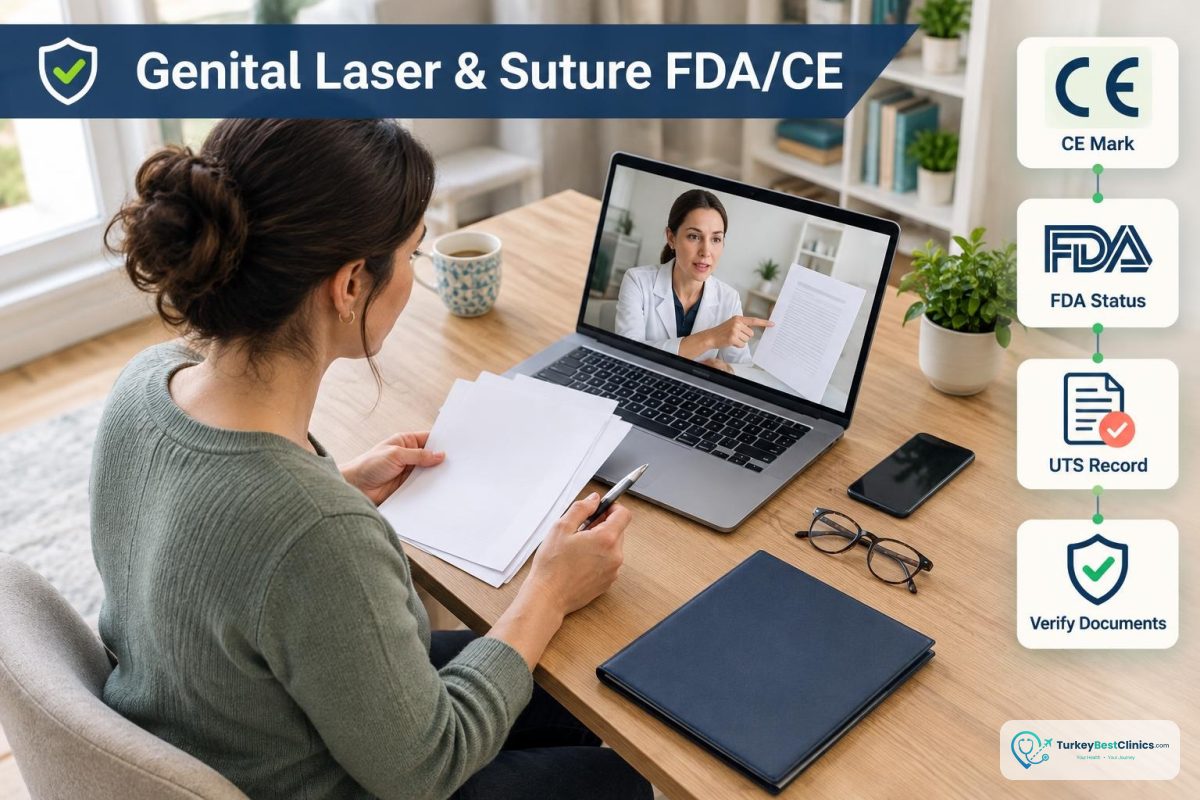
What do genital laser and radiofrequency documents indicate?
When planning a genital aesthetic or gynecological procedure, the presence of a CE mark on the device alone does not mean that the procedure is suitable or risk-free for you, or that a particular clinical outcome is guaranteed. The CE mark indicates that the product meets the relevant conformity requirements under European Union medical device legislation; it is not a certificate of treatment success.
For laser and radiofrequency systems, documentation must be assessed according to the device’s exact model, intended use, type of energy and the medical indication declared by the manufacturer. Fractional CO2 lasers, Er:YAG lasers and radiofrequency platforms used on genital tissue do not all fall into the same technical category; therefore, the same document list may not apply to every device.
In cases involving concerns such as vaginal dryness, tissue laxity, stress urinary incontinence or anatomical changes after childbirth, the suitability of energy-based procedures should be assessed through a gynecological examination and medical history. Advertising terms such as “vaginal rejuvenation” or “non-surgical solution” do not mean that the device treats a specific disease.
The difference between CE, FDA and ÜTS registration in Turkey
CE marking and conformity documents
CE is a conformity mark for medical devices placed on the European market. For higher-risk products or products supplied in sterile condition, an authorized conformity assessment body may need to be involved in addition to the manufacturer’s technical documentation. In such cases, you should check the body’s name, identification number and the scope of the certificate.
Instead of asking a clinic only for a photograph of the CE logo, request the following documents: the manufacturer’s EU Declaration of Conformity, any applicable CE certificate, the device’s exact model and serial information, intended use, manufacturer details and instructions for use. A document issued for another model, or a general catalogue supplied only by the manufacturer, does not provide sufficient verification.
Why is FDA status different?
The FDA is the United States agency responsible for marketing authorization and device safety evaluations. From an FDA perspective, the term “approved” is not correct for every product; depending on the nature of the device, it may have 510(k) clearance, De Novo authorization, PMA approval or another regulatory status.
The presence of a device in the FDA database does not automatically mean that its use in Turkey has been approved. Likewise, a device with CE documentation is not required to have FDA clearance or approval. If a clinic states the device’s FDA status, it should be able to provide the exact model name, manufacturer and registration or decision number.
ÜTS and the Ministry of Health framework in Turkey
In Turkey, the Product Tracking System, known as ÜTS, is an important source for the market placement and traceability of medical devices. ÜTS registration alone does not prove that a procedure is medically suitable for you; however, it can help assess the product’s supply and registration chain in Turkey.
The organization where the procedure will be performed should hold a Health Tourism Authorization Certificate issued by the Ministry of Health of the Republic of Türkiye. This is an important administrative and institutional indicator of healthcare provision. However, the certificate alone does not confirm that every device or suture material used is clinically suitable for you; the device documentation should be reviewed separately.
Information to obtain during the procedure package and document request process
When planning international healthcare services, transfers, accommodation, interpreting and initial post-procedure care support may be offered; however, these logistical services do not replace the device’s CE or FDA status. It is useful to request written details of which services are included in the quotation, arrangements for accompanying persons and the online follow-up plan after you return to your country.
During the initial assessment, the clinic should evaluate a gynecological examination, detailed medical history, previous surgeries, childbirth history, the possibility of pregnancy, signs of infection and the products or medications you use. If an energy-based procedure is planned, the device’s wavelength or energy technology, intended use, treatment area, number of sessions and expected recovery time should be explained clearly.
Clarify in advance whether your companion can stay with you at the hospital and how far the hotel is from the hospital. As restrictions on extended walking, hot environments, swimming pools, saunas or sexual activity may be recommended after the procedure, plan quiet, short indoor activities or rest options near the hotel for your companion.
How should you compare documentation and treatment costs?
CE or FDA documentation is generally not presented to you as a separate “certificate fee”; it is included in the cost of clinical use of the device and the institution’s technical operating expenses. Separate charges may apply for independent document review, translation, technical verification or a second opinion. These items should be considered separately from the total price of the genital aesthetic procedure.
| Item compared | Turkey | United Kingdom | Germany | United States |
|---|---|---|---|---|
| Standard fee charged to the patient for device documentation | No standard tariff; usually included in the procedure quotation | No standard tariff | No standard tariff | No standard tariff |
| Independent technical document review | Quotation based on the expert and scope | Quotation based on the expert and scope | Quotation based on the expert and scope | Quotation based on the expert and scope |
| Genital laser or radiofrequency procedure | Varies according to the device, number of sessions and physician’s assessment | Varies according to the private clinic’s tariff | Varies according to the private clinic’s tariff | Varies according to the private clinic’s tariff |
Providing a single “average price in Turkey” for this subject would be misleading because energy-based laser treatment, surgical vaginoplasty, labiaplasty, pelvic floor procedures and combined gynecological surgery do not belong to the same price category. When comparing prices, do not look only at the euro amount; check whether consultation, anesthesia, hospital use, pathology, follow-up, revision and online monitoring are included.
Technical details to check when verifying documentation
- Physician’s specialty and experience: The physician performing the procedure should explain their specialization in obstetrics and gynecology, relevant experience in pelvic floor or gynecological surgery and history of working with similar energy-based devices. Ask the center not only for the total number of procedures performed, but also for the distribution of experience by device type and treatment area.
- Device technology: Fractional CO2 lasers, Er:YAG lasers and radiofrequency devices use different energy mechanisms. The device’s technical name, model number, manufacturer, intended use, sterilization requirements and contraindications stated by the manufacturer should be included in the file.
- Nature of the suture material: The absorbable or non-absorbable nature of the suture, whether it is monofilament or braided, material type, size, sterilization method, lot number and expiry date should be recorded. For surgical sutures, CE conformity is documented according to the product’s risk class and the manufacturer’s assessment.
- Manufacturer and traceability: The product name, catalogue or reference number, lot information and expiry date on the packaging should correspond to the product shown in the documentation. Do not consider documents sufficient if they relate to opened products, have illegible labels or are supported by a photograph of another product.
- Maintenance and calibration: For laser and radiofrequency systems, periodic maintenance, energy output checks and service records complying with the manufacturer’s instructions are important. The clinic should be able to provide the date of the device’s last maintenance and confirm that the required technical checks have been completed.
- Location: Prices at clinics in Istanbul, Antalya and Izmir may vary because of hospital infrastructure, operating room use, anesthesia teams and accommodation services. Location alone is not an indicator of quality; check whether the procedure will be performed in a fully equipped hospital or an outpatient procedure center.
Practical steps after requesting the documents
The following questions can help you assess not only the documents themselves, but also whether the correct product and appropriate use framework are being proposed during your clinic consultation:
- What are the exact brand, model and intended use of the planned genital laser or radiofrequency device? Can the CE Declaration of Conformity, any certificate from an authorized body and ÜTS registration be shown for the same model?
- Is this device’s FDA status approval, 510(k) clearance or De Novo authorization? Can the FDA registration number and manufacturer information be verified through an independent database?
- Will the manufacturer, absorbability, material type, lot number, expiry date and sterile package record of the suture material to be used be added to the procedure file?
It is reasonable to request copies of the documents; however, some sections may be redacted because of personal data, trade secrets or limited technical information belonging to the manufacturer. Even so, the exact model, scope of the document, validity date, manufacturer and product traceability information should be clearly visible.
Do not make your final decision based solely on an FDA or CE logo. The physician’s assessment, the medical rationale for the procedure, traceability of the product to be used, fully equipped hospital conditions, sterilization protocol and follow-up plan after you return to your country should all be considered together.