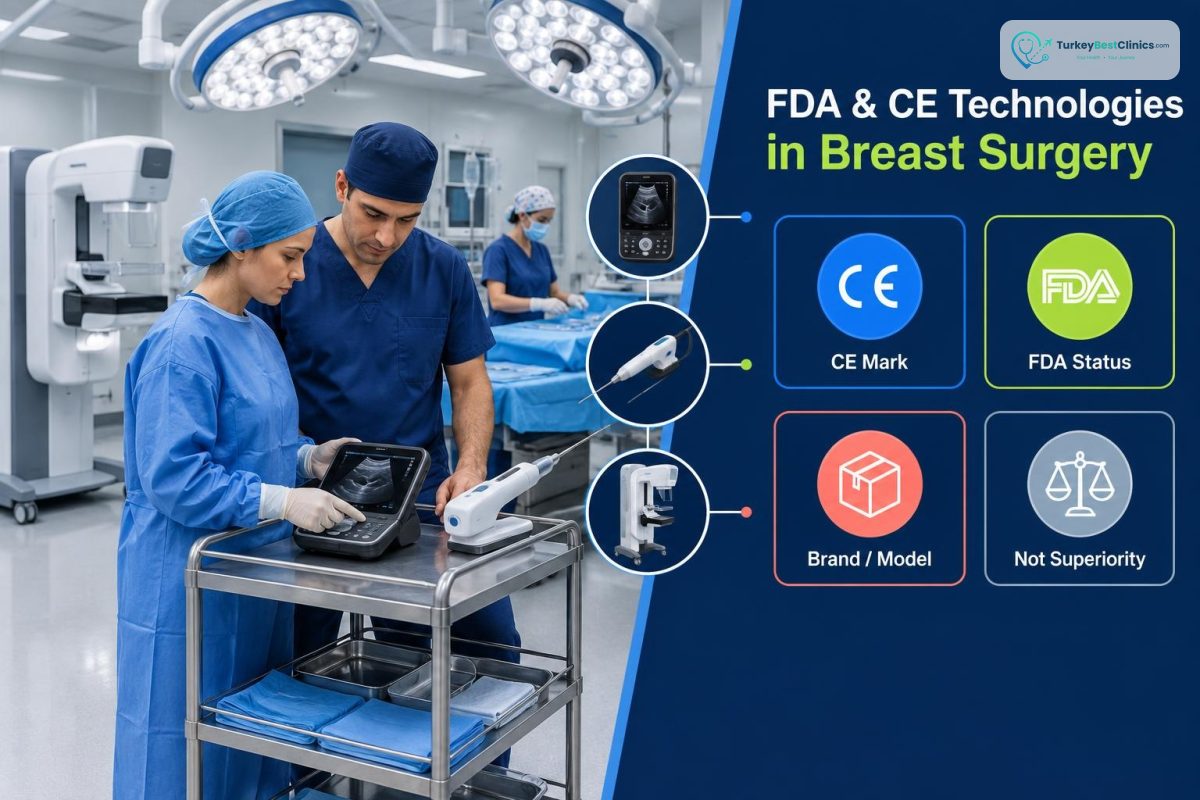
What Are Ultrasound and Smart Localization Systems Used for in Breast Surgery?
Before and during breast surgery, ultrasound, mammography and lesion localization systems help identify suspicious areas, plan biopsies or surgery, and compare the excised tissue with the target area. The technology used is determined by whether the lesion can be seen on ultrasound, the presence of microcalcifications, previous biopsy results and the type of surgery planned.
When evaluating the term “FDA/CE-approved system,” do not look only at the logo displayed on the device. The brand, model, software version, probe or accessory, intended use and registration status in Turkey should all be reviewed together.
- Ultrasound: Uses sound waves to create images and does not use ionizing radiation.
- Mammography: Used especially to assess microcalcifications and certain structural changes; it involves low-dose X-rays.
- Smart localization systems: May help localize a lesion before surgery using wire, radar, magnetic, radiofrequency or other localization approaches.
The technical suitability of these systems cannot be considered separately from your medical evaluation and surgical plan. A device’s licensing or conformity status does not guarantee a definitive diagnosis or a specific surgical outcome for you.
FDA, CE and Breast Imaging Standards in Turkey
How Should FDA Status Be Interpreted?
Different regulatory pathways may appear in the FDA database for breast ultrasound and mammography devices in the United States. A device may have received 510(k) clearance; this means the FDA has determined that the device is substantially equivalent to a similar device already marketed. For higher-risk or novel technologies, PMA approval or De Novo classification may apply.
The existence of an FDA registration does not mean that the device can be used for the same intended purpose in every country. This is particularly important for image-analysis software: the anatomical area, age group, clinical scenario or intended use as an aid for which the algorithm was evaluated should be checked separately.
What Does the CE Mark Indicate?
The CE mark indicates that the device complies with the essential safety and performance requirements under European Union legislation or has undergone the relevant conformity assessment. For medical devices, depending on the device class, the manufacturer’s technical documentation, quality system, clinical evaluation and, where required, review by an independent notified body play a role.
The CE mark does not mean that a device is “clinically superior in Europe.” In addition, certificates issued under the former MDD and conformity processes under the new MDR are not the same; the certificate’s validity period, product class and intended use should be reviewed together.
Records to Check in Turkey
The healthcare provider should verify the compliance and product registration of medical devices to be used in Turkey. When choosing a clinic, it is reasonable to request the device’s brand and model, the manufacturer or authorized representative, maintenance and calibration records, and intended use in writing.
If surgery is being planned as part of medical tourism, it is important that the procedure be planned at an institution holding a Health Tourism Authorization Certificate issued by the Ministry of Health and with fully equipped hospital infrastructure. Sterilization protocols, operating-room quality processes, radiation safety and emergency support should be assessed separately from the device’s FDA or CE status.
What Is Included in a Breast Surgery Imaging Package?
The planned package may include VIP airport-to-hospital transfer, accommodation, interpreter support and coordination related to the initial recovery period; the scope and duration should be clearly stated in the written quotation. Ultrasound-guided localization, mammography-guided localization, submission of the lesion for pathology and joint review of the necessary preoperative images by the surgeon and radiologist should be planned separately.
Before surgery, breast imaging, blood tests, an anesthesia assessment and review of existing biopsy and pathology records are generally required. The length of hospital stay varies according to the scope of the procedure; minor surgery may involve same-day discharge or one night, while more extensive procedures may require several nights. The decision to fly home depends on the wound condition, need for drains, pain control and the surgeon’s assessment.
Your companion may be able to stay at a hotel near the hospital and participate in the process in accordance with visitor policies. During your rest period, low-intensity options such as brief wellness services for your companion or quiet walks in parks near the hospital may be preferable. Since arm movement and heavy lifting may be restricted after breast surgery, luggage and transportation assistance for your companion should be arranged in advance.
After you return to your country, the appearance of the wound, pathology results, stitches or drain status, and follow-up imaging may be assessed through online follow-up consultations. Online follow-up does not replace an in-person examination or emergency medical care; if you develop a fever, rapidly increasing swelling, marked redness, shortness of breath or uncontrolled pain, you should seek local medical care.
Breast Surgery Costs in Turkey and Other Countries
FDA or CE conformity verification does not have a standard “device approval package” price on its own. The ranges below are approximate market indicators for private medical tourism packages that may include imaging and surgical planning; the exact price varies according to the type of surgery, pathology, hospital stay and localization material used.
| Country | Approximate breast surgery and imaging package | Price currency |
|---|---|---|
| Turkey | 3,500–9,000 | € |
| United Kingdom | 6,000–14,000 | £ |
| Germany | 7,000–15,000 | € |
| United States | 12,000–30,000 | $ |
These figures are not a guarantee of diagnosis or treatment and are provided only for budget comparison. Ask for the quotation to list the device brand and model, number of imaging procedures, localization material, pathology, anesthesia, hospital stay, possible revision, interpreter and transfer costs separately.
Technical and Clinical Criteria Affecting FDA and CE Status
The main factors determining the price and scope of the process are as follows:
- Physician’s expertise: Experience in breast radiology and breast surgery is important for procedures such as ultrasound-guided needle placement, stereotactic mammography and radiographic examination of excised tissue. You may ask in writing about the Turkish physician’s annual case volume, relevant specialty and academic area of study.
- Technology and method: 2D or 3D tomosynthesis mammography, a high-frequency ultrasound probe, elastography, wire localization, radar or magnetic seed systems do not have the same regulatory status. The FDA 510(k), PMA, De Novo or CE-MDR conformity information for each component should be checked separately.
- Software and artificial intelligence functions: The FDA status, manufacturer’s statement, version and intended use of image-processing or decision-support software are important. The term “AI-assisted” alone does not mean FDA approval.
- Clinic location: Hospital, accommodation, radiology and pathology costs may vary between Istanbul, Ankara, Izmir and other cities. Access to a fully equipped operating room, a radiation safety program, emergency care capacity and an accredited pathology laboratory should be assessed together.
| Localization methods compared for you | Main potential benefit for you | Your recovery and hospital stay |
|---|---|---|
| Ultrasound-guided localization and surgery | Real-time guidance for a target visible on ultrasound without using radiation | Same day or one night depending on the scope of the procedure; varies according to the incision and pathology result |
| Mammography-guided wire or marker localization | Stereotactic localization of targets that are difficult to see on ultrasound, such as microcalcifications | Usually a short imaging procedure and a hospital stay determined by the planned surgery |
This comparison does not determine which method is suitable for you. The imaging characteristics of the lesion, biopsy result, previous surgeries and the surgeon’s plan should be assessed together.
Document Verification and Next Steps
Before requesting a quotation, asking the following three questions in writing can help you understand the device’s actual regulatory status and the scope of the process:
- What is the exact brand and model of the planned ultrasound, mammography or tomosynthesis device, and for which intended use is its FDA 510(k), PMA, De Novo or CE-MDR conformity document valid?
- What are the manufacturer, single-use product registration, sterility information and medical device registration status in Turkey of the wire, radar, magnetic seed or other smart localization product to be used?
- In what order will imaging, surgery, pathology and online follow-up be carried out; how many nights will you need to stay in hospital, and how will information be shared with your doctor in your country after you receive the pathology results?
Do not accept general statements such as “FDA approved” or “CE approved” as sufficient evidence unless these documents are provided. The most reliable assessment can be made by reviewing the device’s complete identity, intended use, current certificate, records in Turkey and the authorization details of the hospital where the surgery will be performed.