What Is a Urinary Incontinence Sling Mesh Used For?
In stress urinary incontinence, pressure on the bladder increases during coughing, sneezing, laughing, or physical activity, which can make bladder control more difficult. A mesh used as a midurethral sling is a thin surgical material designed to support the urethra and improve control during these changes in pressure.
This material is usually made from polypropylene and designed to be porous and compatible with body tissues. However, the appropriate method for you is determined after assessing the type of incontinence, previous surgeries, pelvic floor condition, urinary tract symptoms, and overall health. Mesh is not suitable for every type of urinary incontinence, and the final decision is made following an examination by a urogynecologist or obstetrician and gynecologist.
Mesh certification and surgical suitability are not the same thing
The fact that a product has quality and conformity documentation does not, by itself, mean that you are suitable for surgery. The product’s technical file, manufacturer’s quality system, and traceability are assessed separately from the correct indication, surgical technique, and postoperative follow-up.
Mesh Quality, Authorization, and Traceability in Turkey
It is important to plan the surgery at a fully equipped hospital authorized by the Ministry of Health of the Republic of Türkiye to provide health tourism services and operating in accordance with the relevant regulations. This authorization does not directly mean that a specific mesh brand has a quality certificate; it indicates that the healthcare provider is authorized regarding international patient admission, documentation, information, and service processes.
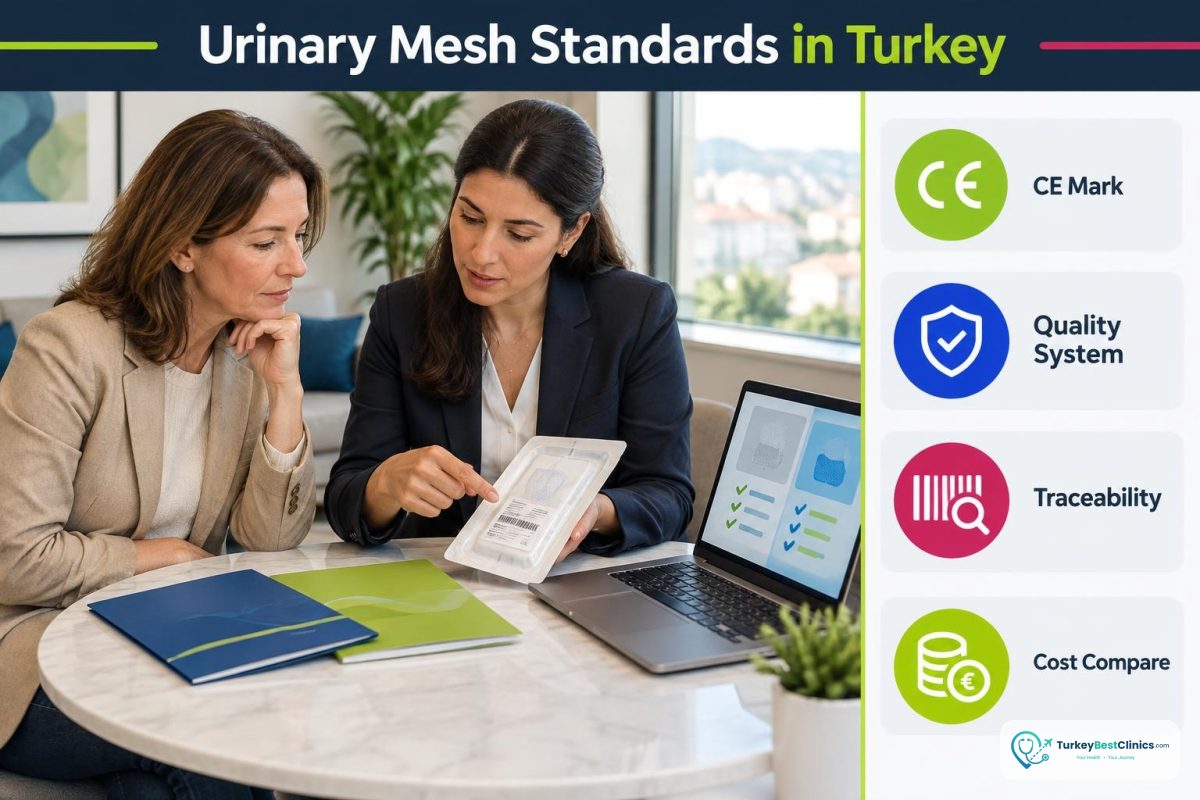
For medical devices used in Turkey, the product’s regulatory compliance, registration status, and supply chain should be checked. Before surgery, the clinic should be able to add the commercial name, manufacturer, model, lot or serial number, and instructions for use of the planned mesh to your medical file.
Key documents you may request
- CE marking and EU conformity documents: Products placed on the market in the European Economic Area should have documentation and conformity assessments demonstrating compliance with the relevant regulations. For medical devices, you may ask which classification and assessment route was used under the current EU Medical Device Regulation, MDR 2017/745.
- Notified body information: If a notified body was involved in the product assessment process, its name and identification number may be provided. Rather than relying only on a logo, check that the document states the product model and validity date.
- ISO 13485 quality management system: This document does not guarantee every individual clinical outcome of the product; it shows that the manufacturer has a quality management system for medical device production.
- Product labeling and instructions for use: These should state the sterilization status, dimensions, material composition, intended use, contraindications, and storage conditions.
- UDI or similar device identification information: Where applicable, the unique device identifier, lot number, and expiration date should be recorded.
- Registration and supply information in Turkey: The clinic should be able to explain that the product was obtained through a legal supply channel and that the implant record is retained in your surgical file.
US FDA approval or FDA 510(k) clearance indicates the product’s regulatory status in the United States; it is not a universal certification that replaces the CE marking. Similarly, ISO 10993 biocompatibility testing may show that certain biological risks associated with the material have been assessed, but these tests do not guarantee that you will not experience complications.
Concrete indicators of urogynecology experience
Rather than asking only about your Turkish physician’s total number of surgeries, it is more meaningful to ask about their experience with stress urinary incontinence, retropubic slings, transobturator slings, mesh complications, and mesh removal when necessary. The hospital should be able to explain in writing factors such as access to cystoscopy, anesthesia assessment, infection control protocols, and emergency urology support.
Your Mesh Surgery Package and Personalized Process
The package may include airport-to-hospital transfers, accommodation at a hotel near the hospital, interpreter support, initial care, and basic guidance after discharge. Preoperative assessments such as urinalysis, urine culture, pelvic examination, an incontinence diary, ultrasound assessment of bladder emptying, and, if considered necessary, urodynamic testing are planned before surgery. The stay in Turkey is approximately 3–7 days in many straightforward cases, although this may vary depending on surgical findings.
Clarify in advance whether your companion can stay with you in the hospital and what conditions apply to companion accommodation. Choosing a hotel close to the hospital can reduce transportation-related stress, especially during the first few days. While you rest, your companion may take a walk in a quiet park near the hospital or use the hotel’s wellness facilities to the extent permitted by your physician; long walks and heavy lifting are not recommended during the early postoperative period.
Step-by-step surgical and follow-up protocol
- Remote pre-assessment: Your medical history, when the incontinence occurs, previous pelvic surgeries, and existing medical reports are reviewed.
- In-person examination in Turkey: Urinary tract infection, pelvic organ prolapse, bladder emptying, and signs of stress urinary incontinence are assessed.
- Preoperative tests: A complete blood count, basic biochemistry, urinalysis, and, when necessary, culture, ECG, or additional anesthesia-related tests are requested.
- Product verification: The brand and model of the mesh to be used, lot number, package integrity, and sterilization status are recorded in your file before surgery.
- Surgery and early observation: The procedure generally requires a short period of hospital observation. Urination, bleeding, pain, and signs of infection are monitored.
- Online follow-up: After you return home, the wound area, urination, pain, fever, bleeding, and new urinary symptoms are monitored through online consultations. If symptoms develop, you should contact a healthcare provider in your country and share the reports with the team in Turkey.
Comparison of retropubic and transobturator slings
| Methods Compared for You | Most Important Potential Advantage for You | Your Recovery and Hospital Stay |
|---|---|---|
| Retropubic midurethral sling | May provide more direct support beneath the urethra and may be preferred in certain anatomical situations or cases of recurrent stress urinary incontinence. | In many cases, a short stay or same-day discharge is considered. Monitoring may be required for risks such as bladder perforation and difficulty emptying the bladder. |
| Transobturator midurethral sling | Uses a route away from the retropubic space and offers a different surgical approach in suitable anatomy. | Early movement is usually possible; follow-up is provided for groin and thigh pain, temporary urinary problems, and infection. |
The choice between these two approaches is not based solely on price or recovery time. Urethral mobility, previous sling surgery, the presence of accompanying prolapse, and the surgeon’s clinical assessment are decisive factors. Non-mesh options, such as an autologous fascial sling, may be considered in certain situations; because tissue must be taken from the abdomen or thigh, the process is different.
Mesh Surgery Costs in Turkey and Country Comparison
The figures below are approximate planning ranges only and reflect general price levels for international private healthcare services in 2026. You should verify in a written quotation whether the product, hospital, anesthesia, tests, additional prolapse repair, and complication management are included.
| Country | Approximate total cost | Important pricing note |
|---|---|---|
| Turkey | €2,500–€5,500 | The scope of the examination, mesh, surgery, anesthesia, and short hospital stay varies by provider. |
| United Kingdom | £6,000–£12,000 | Private hospital and surgeon fees; tests and follow-up may be charged separately. |
| Germany | €6,000–€10,000 | Hospital, anesthesia, and device costs may be listed as separate items. |
| United States | $10,000–$20,000 | Insurance coverage, surgeon fees, and hospital charges can significantly change the total cost. |
Factors That Affect Mesh Pricing and the Surgical Process
- Physician expertise and experience: Planning by a physician focused on urogynecology and experienced not only in midurethral sling placement but also in cystoscopic checks and managing mesh complications may affect the fee.
- Technique and material used: A retropubic or transobturator sling, the pore structure of the polypropylene mesh, the product’s single-use sterile packaging, and the manufacturer’s model information may affect the total cost. For non-mesh options such as an autologous fascial sling, the additional tissue-harvesting procedure and different operating time must be taken into account.
- Clinic and hospital location: In major centers such as Istanbul, Ankara, and Izmir, international patient coordination and fully equipped hospital infrastructure may affect the price. You should also check separately whether airport transfers, interpreter services, hotel accommodation, additional nights, and companion services are included in the package.
When requesting a quotation, asking for separate line items for the mesh brand and model, product documentation, hospital stay, anesthesia, cystoscopy, follow-up examinations, possible additional-night charges, and the number of online follow-up sessions after your return home allows for a safer comparison than considering only the total price.
Questions to Ask Before Surgery and Next Steps
- What are the exact brand, model, manufacturer, and lot number of this mesh? Will the CE conformity document, instructions for use, and implant record be provided in my surgical file?
- Based on my examination findings, what are the differences between a retropubic and transobturator sling for me? How will risks such as difficulty urinating or mesh erosion be monitored?
- On which dates will online follow-up take place after I return home? If I develop a fever, difficulty urinating, increased bleeding, or new pain, how will coordination between the team in Turkey and my local physician be arranged?
Before deciding on surgery, request that the documents be provided not merely as advertising images but with the product name and validity information. Read and sign the informed consent form only after you have understood the alternative treatments, mesh-specific risks, and the steps to follow in an emergency in a language you understand, and after your questions have been answered.