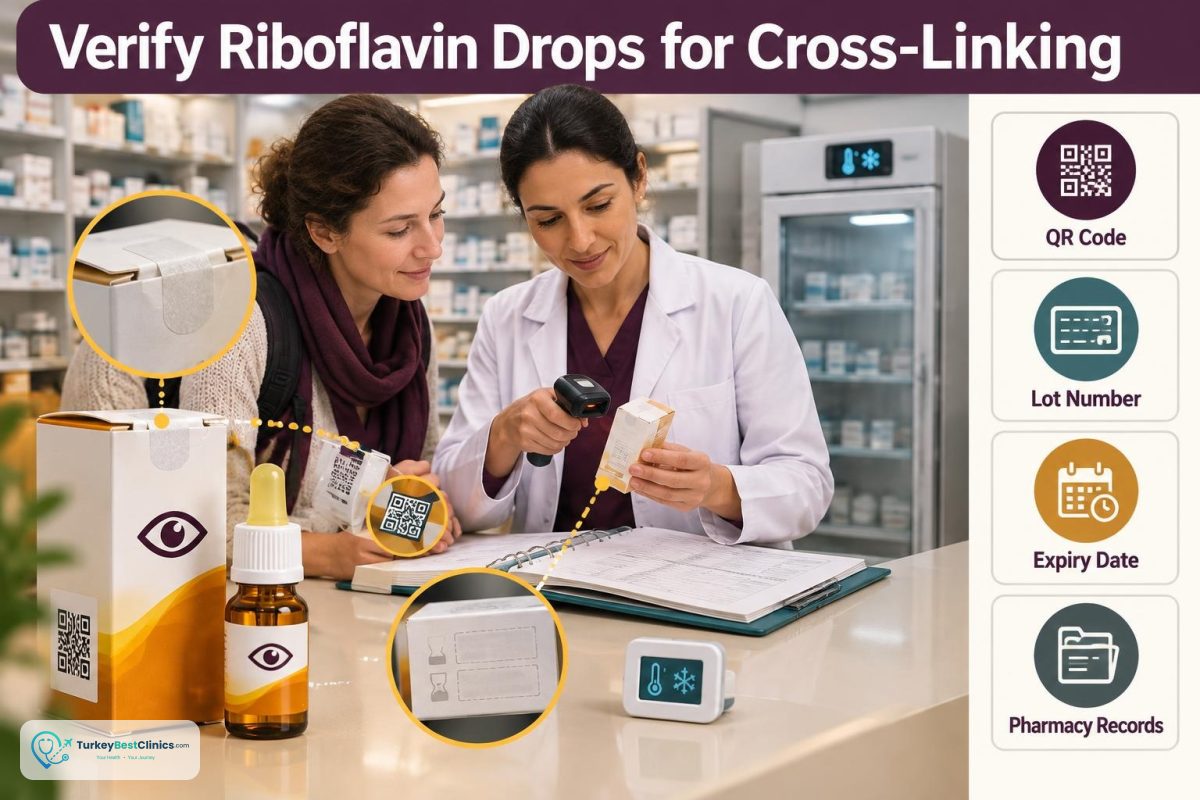
The Role of Riboflavin Drops in Cross-Linking and Why Verification Matters
In keratoconus cross-linking, an ophthalmic solution containing riboflavin is one of the treatment components that enables a controlled interaction between the cornea and ultraviolet-A light. The product name, concentration, sterility, expiry date, and compatibility with the treatment protocol are important for your eye health.
When travelling to Turkey from abroad, do not rely solely on the brand name printed on the box. Clarify the status under which the product is supplied: a licensed medicinal product, a product classified as a medical device, or a magistral/compounded solution prepared in a hospital pharmacy for a specific procedure. These three options may not have the same documentation requirements, so the verification method may vary according to the product’s legal classification.
No single indicator can prove that riboflavin drops are authentic and of good quality. Packaging information, traceability records in Turkey, clinical or hospital pharmacy documentation, cold-chain records, and the explanation provided by the ophthalmologist performing the procedure should all be reviewed together.
Essential information to look for on the label
- Product name and manufacturer or importer details
- Riboflavin concentration and the formulation’s excipients
- Lot or serial number
- Expiry date
- Sterility status and single-use packaging information
- Storage temperature and instructions regarding protection from light
- The product’s licence, registration, or conformity number
The presence of terms such as “sterile,” “premium,” or “original” is not sufficient by itself. Ask for these statements to be supported by the manufacturer, authorised distributor, and clinical records.
Checking the Licence and Traceability of Riboflavin Products in Turkey
When choosing a clinic or hospital in Turkey, confirm that its Ministry of Health Health Tourism Authorisation Certificate is current and that the procedure will be carried out by an ophthalmologist in a fully equipped hospital. This certificate does not automatically mean that every riboflavin product used is licensed; clinical authorisation and product licensing are separate matters.
When the product is classified as a medicine, the product and licence records of the Turkish Medicines and Medical Devices Agency, along with QR code or barcode details and supply documents, should be reviewed. If the product has medical device status, records and conformity documents under the Product Tracking System may be relevant. The clinic should be able to explain in writing which legislation applies to the product.
If the product is prepared in a hospital pharmacy for the procedure, it may not have a commercial licence number. In this case, request the preparation date, source of the active ingredient, concentration calculation, sterilisation or aseptic preparation record, approval by the responsible pharmacist, lot information, and the record of the product administered to the patient.
QR codes, barcodes, and product records
Scanning the QR code on the packaging does not, by itself, prove that the product is safe or clinically appropriate. Check whether the code is consistent with the product name, manufacturer, lot number, and expiry date. If the screen displays a different product or date, stop the process and request an explanation.
If the QR code cannot be read, the packaging appears damaged or relabelled, or the lot numbers on the box and vial do not match, do not proceed without receiving an explanation. If doubts about the product’s registration remain, ask for verification through the official channels of the Turkish Medicines and Medical Devices Agency or the relevant hospital pharmacy.
Assessing Turkish ophthalmologists’ cross-linking experience
Do not assess a physician’s experience solely by terms such as “specialist” or “experienced.” Ask which protocol is used for monitoring signs of keratoconus progression with corneal topography and tomography, epi-off protocols involving epithelial removal, selected epi-on approaches, ultraviolet-A dose management, and postoperative corneal follow-up.
A reliable centre records pre- and postoperative measurements and enters the name and lot number of the riboflavin product used into your medical file. It should also be able to provide information about single-use sterile materials in the operating or procedure room, controlled sterilisation processes, and calibration records for the appropriate ultraviolet-A device.
Product Documentation and Companion Planning in a Keratoconus Cross-Linking Package
An organisational package may include logistics such as VIP airport-to-hospital transfers, hotel accommodation, interpreter support, and assistance with initial postoperative care or prescription arrangements. Ask for the scope and any additional fees in writing. It should also be clearly stated that you will receive a photo of the riboflavin product box, licence or registration information, the lot number, and a copy of the postoperative medical record.
After epi-off cross-linking, light sensitivity, stinging, and fluctuating vision may occur during the first few days, so it is important that your companion can easily reach the hospital and hotel. If your companion can stay with you at the hospital, learn about the institution’s companion policy in advance. While you rest, activities such as a quiet walk in a nearby park or time in the hotel wellness area may be planned, provided they do not conflict with your corneal care restrictions.
Pre- and postoperative process protocol
- Remote preliminary assessment and review of existing corneal topography or tomography
- Eye examination in Turkey, including visual acuity testing, biomicroscopy, corneal thickness measurement, and any additional tests considered necessary
- Assessment of keratoconus progression and the treatment method
- Adding the riboflavin product name, concentration, manufacturer information, and lot record to the medical file
- Initial postoperative check-up and assessment of the corneal surface
- An online follow-up plan after returning to your country and information sharing with your local ophthalmologist when necessary
The length of your stay in Turkey after the procedure may vary depending on the technique used, healing of the corneal surface, follow-up findings, and your flight schedule. The ophthalmologist examining you should determine the exact duration.
Comparison of the two main cross-linking approaches
| Methods Compared for You | Most Important Potential Advantage for You | Your Recovery and Hospital Stay |
|---|---|---|
| Epi-off cross-linking | Because the epithelium is removed, it may offer a more established protocol approach for riboflavin to reach the corneal stroma. | More comfort support may be needed during the first few days because of surface healing. Although most procedures are planned as day cases, follow-up appointments are important. |
| Epi-on or transepithelial cross-linking | Because the corneal epithelium can be preserved, less surface discomfort may be targeted in some selected cases. | Recovery comfort may differ. Suitability depends on riboflavin penetration through the epithelium and the device-protocol combination used. |
Neither of these methods should automatically be considered better for you. Corneal thickness, the rate of keratoconus progression, the condition of the ocular surface, previous procedures, and the physician’s protocol should be assessed together.
Comparing Riboflavin and Cross-Linking Costs in Turkey
The price of riboflavin drops alone represents only part of the total cross-linking cost. The figures below are not official tariffs; they are approximate market ranges provided for comparison and may vary according to the clinic, city, treatment method, device used, and the scope of examinations and follow-up.
| Country | Approximate range for a cross-linking treatment package | Items to confirm whether they are included in the price |
|---|---|---|
| Turkey | €1,000–€2,500 | Riboflavin product, corneal tomography, postoperative checks, bandage contact lens, and online follow-up |
| United Kingdom | £2,000–£4,500 | Private hospital fee, physician assessment, and follow-up appointments |
| Germany | €2,000–€4,000 | Procedure for one or both eyes, device use, and follow-up examinations |
| United States | $3,000–$6,000 | Centre fee, surgeon’s fee, medicines or consumables, and follow-up |
Treatment of one or both eyes, the epi-off or epi-on method, procedure-room conditions, and the number of pre-treatment imaging examinations can significantly affect the price. If you receive an unusually low quote, do not make a decision until the product brand, licence or registration status, sterile preparation method, and follow-up arrangements have been explained in writing.
Factors Affecting the Price of Riboflavin Drops and the Treatment Process
- Physician’s speciality and experience: Experience in corneal diseases, keratoconus progression, interpretation of corneal topography and tomography, and cross-linking protocols may affect the quality of assessment and follow-up.
- Method and type of materials used: The epi-off or epi-on approach, riboflavin concentration and formulation, the choice of a dextran-containing or dextran-free solution, ultraviolet-A device dosing, and single-use sterile consumables can all affect the overall process. These choices should be based on the physician’s examination findings.
- Clinic location: Hospital infrastructure, operating-room use, corneal imaging equipment, hotel costs, and transportation expenses may differ in Istanbul, Ankara, Izmir, and other cities.
Do not confuse product verification with price criteria. A higher price alone does not prove that a product is authentic or more clinically appropriate. The decision should be based on regulatory records, sterility, storage conditions, product-protocol compatibility, and medical follow-up documentation.
Documents you may request in writing before the procedure
- Photos of the front and back of the product box
- Product name, manufacturer, lot number, and expiry date
- An explanation of the licence, registration, or medical device conformity information
- A record showing that the product was obtained from the hospital pharmacy
- Records concerning storage and transport conditions
- Confirmation that the product lot will be included in the postoperative medical record
Next Steps After Verification and Frequently Asked Questions
- How can I tell whether the riboflavin drops are a licensed product or a sterile solution prepared in a hospital pharmacy? Request the product’s regulatory status, manufacturer information, preparation record, and lot number in writing from the clinic or hospital pharmacy. Be aware that a commercially licensed product number may not exist for a non-licensed preparation.
- Should I postpone cross-linking if the QR code on the packaging cannot be read? A non-functioning QR code is not, by itself, proof of counterfeit production. However, it is safer not to proceed until the box and vial information, lot number, expiry date, and supply record have been verified.
- Does product verification differ between epi-off and epi-on procedures? The product’s legal status and lot verification should be checked separately. Depending on the method, the concentration, formulation, application time, and compatibility of the ultraviolet-A protocol with the product instructions should also be assessed.
Before travelling to Turkey, obtain the product label, registration status, treatment protocol, follow-up plan, and details of the total fee in writing from the clinic. Without examining you, no one can confirm that a specific riboflavin product is suitable for you or that the procedure will definitely be successful. The final decision should be made following a corneal examination and assessment by an ophthalmologist.