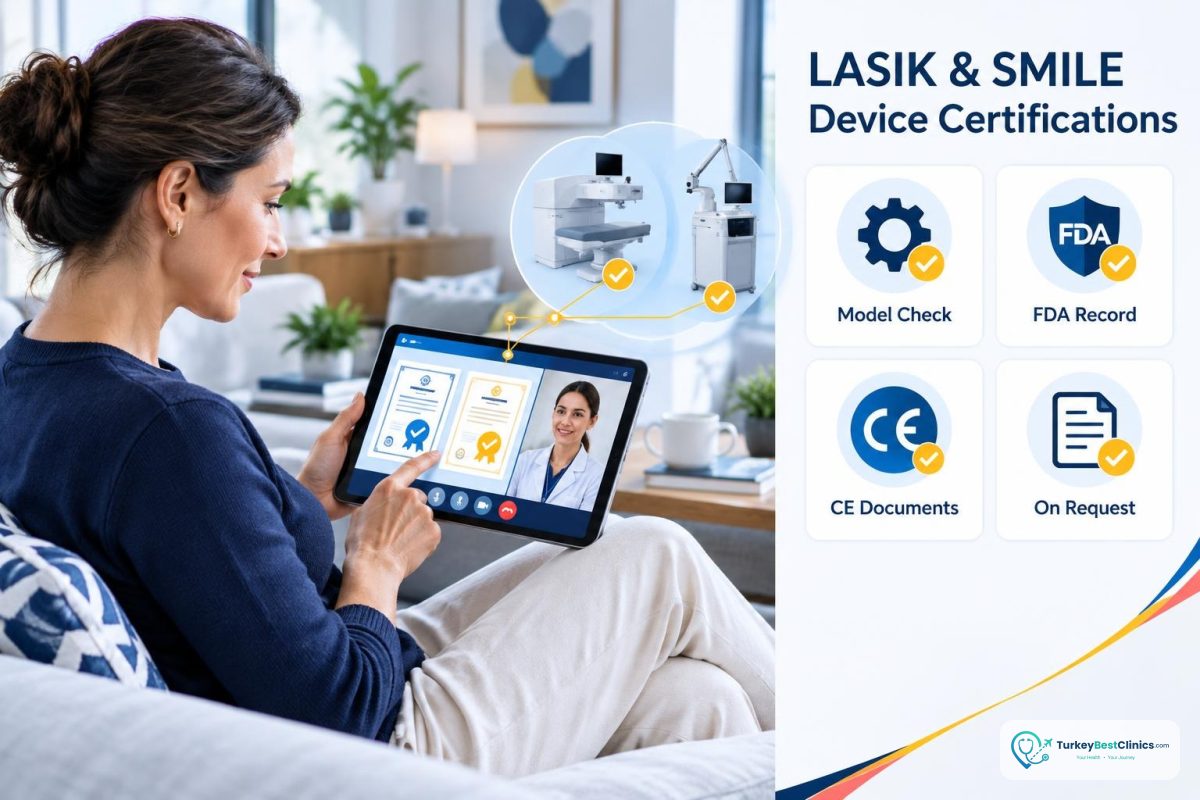
What do LASIK and SMILE device documents mean for you?
When planning laser eye surgery in Turkey, looking only at brand names such as ZEISS or Alcon is not enough. The key points to assess are the exact model of the excimer and femtosecond lasers to be used, whether their intended use is compatible with the planned procedure, the devices’ current technical condition, and whether the clinic where they are located is an authorized healthcare provider.
FDA documentation shows that a device has undergone regulatory evaluation in the United States for a specific intended use and model. The CE mark indicates that the device meets the conformity requirements under European Union medical device legislation; however, the CE mark alone does not guarantee clinical outcomes in every country or confirm suitability for your particular procedure.
Before surgery, asking the clinic for the exact models of the devices to be used and verifiable conformity documents for those models is a sensible step. A general statement such as “FDA- and CE-approved devices,” without the brand name, model code, or document number, does not by itself provide sufficient technical information.
FDA and CE verification for excimer and femtosecond lasers
What information does an FDA record show?
The FDA is the regulatory agency responsible for evaluating medical devices in the United States according to specific risk and use classifications. In laser eye surgery, a device’s FDA status may vary depending on its manufacturer, model, laser technology, and the indication defined for LASIK, PRK, or another procedure.
- 510(k) clearance: May indicate that the device has undergone a substantial equivalence assessment against a similar device already on the market.
- PMA approval: For certain higher-risk devices, this indicates a more extensive review of safety and effectiveness data.
- FDA database record: The device may be searchable in publicly available records by manufacturer and model; a record does not automatically mean that clinical use is approved in every country.
- Indication scope: FDA documentation does not mean that the device can be used for every type of refractive error or every laser technique.
CE marking and conformity documents
The CE mark indicates that a conformity assessment has been completed under European Union medical device rules. In current assessments, the EU Medical Device Regulation (MDR 2017/745) and its transitional provisions are important; therefore, the document’s issue date, validity period, device class, and issuing organization should also be checked.
A CE file may include the manufacturer’s EU Declaration of Conformity, a certificate issued by a notified body when required, and information about the device model and series family. Not every CE document is required to be publicly available; the manufacturer or authorized importer may provide it to the clinic while protecting commercial and technical information.
For systems such as ZEISS MEL 90, ZEISS VisuMax, Alcon WaveLight EX500, or Alcon FS200, document assessment should be conducted at the level of the exact model and intended use, not merely at the brand level. Because certificate status may change over time, these examples alone do not prove that the device held by a particular clinic is currently valid.
Which documents may be included in your LASIK and SMILE package?
When planning medical tourism, VIP transfers, hotel arrangements, interpreter support, and guidance for initial post-procedure care may be included in the logistical package. In addition, preoperative checks such as corneal topography or tomography, pachymetry, tear-film assessment, refraction measurements, and a fundus examination may be scheduled; these evaluations are used to determine suitability for surgery.
You may ask your clinic in writing for the device brand and exact model, the intended use defined by the manufacturer, the CE declaration of conformity or relevant certificate details, and, where applicable, the FDA 510(k) or PMA reference. Instead of the complete original document, the clinic may provide a verifiable document number, a manufacturer verification link, or a copy with identifying information redacted.
The conditions under which your companion may stay with you at the hospital can be clarified in advance; accommodation close to the clinic or hospital can reduce transportation stress on the first night. As bright light and prolonged screen use may need to be limited after LASIK or SMILE, your companion can plan a quiet walk in a nearby park, time in a wellness area, or a rest-focused schedule.
After you return to your home country, postoperative care may be conducted through online follow-up, by sharing reports from examinations performed by your local ophthalmologist, and through assessments by the clinic team at scheduled intervals. The flight date, follow-up schedule, and healthcare provider to contact in an emergency should be explained in writing before surgery.
Practical differences between the LASIK and SMILE approaches
| Methods being compared for you | Main potential advantage for you | Your recovery and hospital stay |
|---|---|---|
| LASIK: Creating a flap with a femtosecond laser and reshaping the cornea with an excimer laser | Visual rehabilitation may progress quickly in many suitable cases; the corneal tissue and ocular surface are assessed in detail. | Same-day discharge is generally planned; the first check-up is usually performed early, although the exact schedule depends on the clinical assessment. |
| SMILE: Creating a lenticule inside the cornea with a femtosecond laser and removing it through a small incision | Creating a smaller incision on the corneal surface may offer an ocular-surface comfort advantage in some suitable cases. | It is usually performed on an outpatient basis; the time needed for vision to become clear varies according to individual corneal characteristics and surgical planning. |
These two methods are not automatic alternatives to one another. Choosing a method based solely on documentation or device brand, without evaluating corneal thickness, topographic characteristics, refractive range, dry eye, previous eye surgeries, and lifestyle together, would not be appropriate.
Laser eye surgery costs and document coverage in Turkey
The figures below are approximate ranges that may be seen in the international medical tourism market for 2026 and do not constitute official quotations. Delivery of device documentation may not automatically be included in the fee; ask for the quotation to list the surgery, preliminary examinations, follow-up appointments, transportation, and reports separately.
| Country | Approximate range for LASIK or SMILE | Point to check regarding documentation and follow-up |
|---|---|---|
| Turkey | €1,500–€3,500 | Device model, preliminary examinations, surgeon follow-up appointments, and online follow-up coverage |
| United Kingdom | GBP 2,500–5,000 | Eye measurements included in the surgical package and the enhancement policy |
| Germany | €2,500–€5,000 | CE conformity information, the device’s technical model, and the follow-up period |
| United States | USD 3,000–6,000 | FDA indication, the platform used by the surgeon, and additional fees |
Key criteria affecting documentation and the surgical plan
- Surgeon’s specialization and experience: Ask not only about the surgeon’s total number of cases, but also about their experience with the platform used for LASIK and SMILE, their approach to managing complications, and their preoperative screening criteria.
- Technology and method used: The excimer laser’s wavefront- or topography-guided planning capabilities, the femtosecond laser platform, the eye-tracking system, and the FDA/CE scope of the model used may affect the price and process details.
- Clinic location: Hospital infrastructure, operating-room standards, international patient coordination, accommodation, and transportation costs may differ between Istanbul, Ankara, Izmir, and other centers.
- Scope of the document: Check whether the FDA or CE documentation directly covers your prescription, the selected procedure, and the combination of devices to be used.
- Technical verification: Ask whether the device’s maintenance and calibration records are up to date, whether disposable components are traceable, and whether the model to be used during surgery is included in your written plan.
The healthcare provider operating in Turkey should also hold a Health Tourism Authorization Certificate approved by the Turkish Ministry of Health. This document concerns the clinic’s authorization to provide international health tourism services; it does not replace FDA or CE conformity for the excimer or femtosecond laser device. A fully equipped hospital setting, sterilization protocols, operating-room safety, and device maintenance records are also separate parts of your surgical plan.
Next steps after requesting documents and frequently asked questions
- Does the CE document provided by the clinic clearly show the exact model of the device being used and its valid intended indication? Consistency can be checked using the document number, manufacturer, model, and validity date.
- Does the FDA record actually cover the same device model for LASIK or SMILE? The manufacturer, device name, and application reference in the FDA database should be compared with the information in the surgical quotation.
- How are fees and follow-up handled if the preliminary examinations indicate that you are not suitable or if surgery is postponed? Obtain the refund terms, alternative assessment options, communication arrangements with a local doctor, and the online follow-up period in writing.
In your document request, you can ask for the following information in a single message: the device brand and exact model, the stage at which the excimer or femtosecond laser will be used, the FDA reference number if applicable, the type and date of the CE conformity document, the device’s maintenance and calibration status, the list of preoperative measurements, and the follow-up protocol after returning to your home country. These details can help you create a verifiable, personalized surgical plan rather than assessing the procedure based only on the brand.