Why Is Premium IOL Documentation Important?
An intraocular lens placed in the eye instead of the natural lens during cataract surgery is a medical implant that remains in the eye for life. When choosing a premium IOL marketed as a “smart lens,” such as a trifocal or EDOF lens or one with other focusing properties, it is important to review not only the brand and price but also the exact product model, dioptric power, manufacturer information, and traceability records.
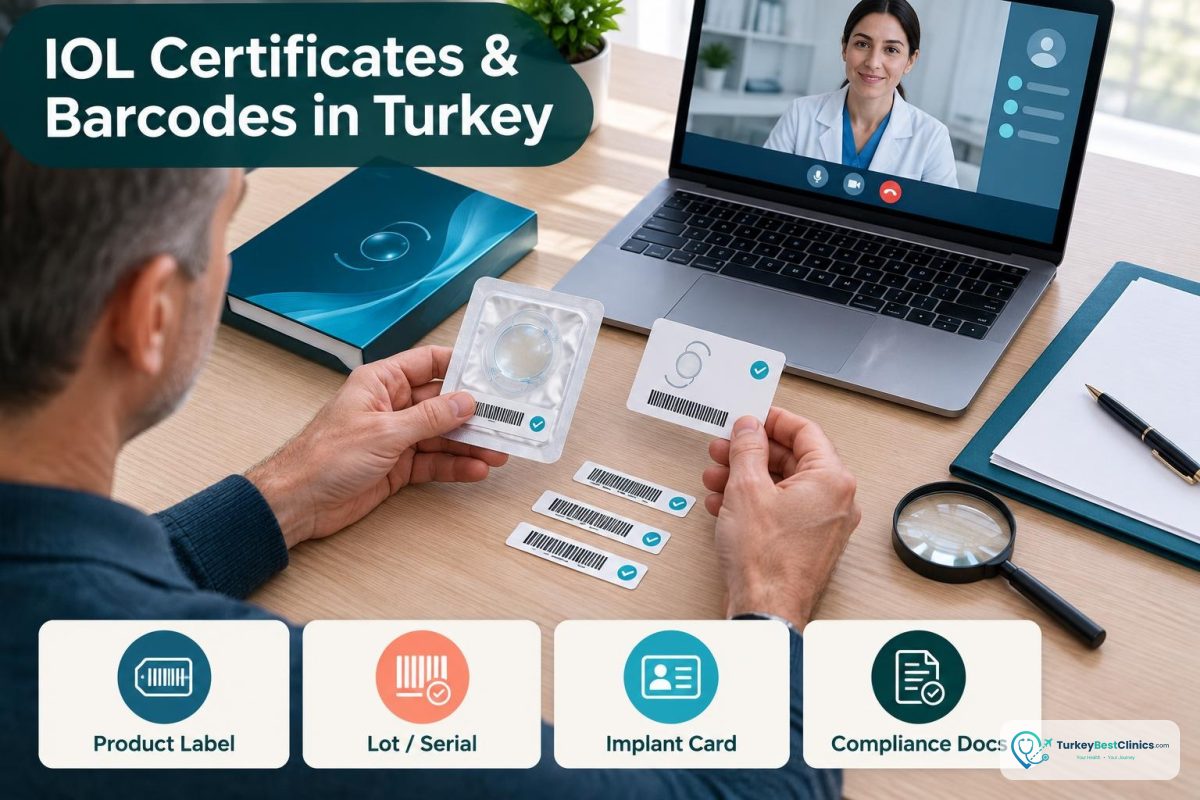
The essential records you should have after surgery include the lens manufacturer, model code, lot or serial number, barcode, dioptric power, expiration date, and implant card. These documents help correctly identify the implant if you consult another ophthalmologist in the future or require an additional eye procedure.
In Turkey, not every clinic uses the phrase “international original certificate” to refer to the same document. Therefore, rather than accepting only a general CE document, ask in advance and in writing whether the label from the sealed package of the product actually implanted in your eye and the implant records will be provided.
Safety and Traceability Standards for Smart Lenses in Turkey
Official health tourism authorization
Planning surgery at a facility holding a Health Tourism Authorization Certificate issued under the regulations of the Ministry of Health of the Republic of Türkiye, and in a fully equipped hospital setting, is an essential starting point for safety. An authorization certificate alone does not prove the authenticity of a specific premium IOL brand; however, it shows that the healthcare facility is subject to certain administrative and institutional requirements when providing international healthcare services.
Before surgery, the clinic should explain its sterilization protocols, operating room infrastructure, emergency response capabilities, biometry device calibration records, and how postoperative eye examinations will be conducted. In cataract surgery, accurate biometry measurements, calculation of the selected lens power, and recording the product used during surgery in the operative report are process steps just as important as the barcode documentation.
What should your document and barcode file contain?
- Product label: Manufacturer, lens model, dioptric power, lot or serial number, expiration date, and barcode information.
- Implant card: A record linking the identification details of the lens implanted in your eye to the date of surgery.
- Operative report: A surgical record stating the brand, model, power, and lot or serial information of the IOL used.
- Conformity and regulatory information: Depending on the region where the product is marketed, the CE marking, declaration of conformity, or relevant manufacturer documentation.
- Invoice or proof of payment: A record identifying the lens model used and, as clearly as possible, the services or items included in the package.
The CE marking indicates that the product meets conformity requirements under certain European Union regulations; by itself, it does not prove that the product was specifically used for you or that every barcode is genuine. US FDA approval also does not automatically apply to every premium IOL. Therefore, when reviewing the documentation, consider the product’s target market, manufacturer records, and the implant label itself together.
Document Flow in Cataract Surgery and Premium Lens Packages
A health tourism package generally includes airport-to-hotel or VIP transfers, hotel accommodation, interpreter support, and medicines or consumables related to the initial care period; you should clearly check the scope and any additional fees in the contract. Before cataract surgery, an eye examination, corneal topography or tomography, biometry, intraocular pressure measurement, and any necessary retinal assessment may be planned.
Transparent practices that may reasonably be expected include presenting the premium IOL model for your approval before the surgery date; sharing photographs or video of the barcode and lot or serial information on the sealed box; and recording the same information on the implant card and operative report after surgery. You should also establish in advance whether the documents will be provided by email, in a printed file, or through a secure online portal.
The package plan should also explain whether your companion can stay with you at the hospital, how close your hotel is to the hospital, and whether you can access options such as a wellness area or quiet park walks while avoiding intensive city activities that may strain your eyes after surgery. During the first few days, you may need assistance because of blurred vision, light sensitivity, or the need to use eye drops, so arrangements that reduce your companion’s transportation and communication responsibilities are important.
Recommended document delivery protocol
- Before surgery, obtain written confirmation of the manufacturer, model, and optical characteristics of the selected premium IOL.
- Check the product label, barcode, lot or serial number, and expiration date on the sealed package.
- Confirm that the actual details of the lens used during surgery have been entered in the operative report and implant card.
- Receive a printed or digital copy of the document set after surgery.
- Clarify how online follow-up appointments and the emergency contact channel will be managed after you return to your country.
Premium IOL Costs in Turkey and International Comparison
The approximate total cost of cataract surgery with a premium IOL in Turkey may vary depending on the lens model, whether one or both eyes are treated, the scope of biometry, the surgeon’s level of expertise, and hospital services. The ranges below are provided for market research purposes only; a definitive quotation should be prepared after examination and selection of the lens model.
| Country | Approximate cost per eye | Key pricing note |
|---|---|---|
| Turkey | €2,000–€4,500 | The premium IOL, examination, surgery, and follow-up inclusions vary by package. |
| United Kingdom | £3,500–£7,000 | The private center, lens type, and surgeon’s fees affect the total. |
| Germany | €3,000–€6,000 | Premium options and additional measurements may be priced separately. |
| United States | $4,000–$8,000 | A wide range may apply depending on the center, insurance coverage, and lens technology. |
When requesting a quotation, review separately not only the surgery fee but also the exact premium IOL model, provision of the barcode and implant card, biometry, postoperative examinations, any additional eye measurements, and transportation and accommodation services. Ask the provider to specify in a written price breakdown exactly which documents are covered by the phrase “international certificate included.”
Factors That Affect Documentation Assurance and the Surgical Process
- Surgeon’s expertise and experience: A cataract surgeon’s experience in planning trifocal and EDOF lenses and assessing corneal irregularities, retinal diseases, and previous eye surgeries affects not only the surgical technique but also whether you are an appropriate candidate for the selected lens.
- Technique and technology used: A choice may be made between standard phacoemulsification and a femtosecond laser-assisted approach. Optical biometry, corneal topography, retinal OCT assessment, and the trifocal or EDOF design of the premium IOL may affect the process and cost.
- Clinic and hospital location: In major centers such as Istanbul, Ankara, or Izmir, product supply chains, international communication, and postoperative follow-up infrastructure may differ. When choosing a location, assess the fully equipped operating room, emergency eye assessment services, and the online follow-up plan after your return before prioritizing proximity to the city center.
Surgical approaches compared for you
| Approaches Compared for You | Most Important Potential Advantage for You | Your Recovery and Hospital Stay |
|---|---|---|
| Phacoemulsification with a premium IOL | Performed through a small incision; the lens selection and barcode information can be entered in the surgical record. | Usually planned as a day-case procedure; the first check-up is generally performed early after surgery. |
| Femtosecond laser-assisted cataract surgery | May allow the incisions and certain preliminary steps to be planned with a laser. | The hospital stay is usually short; suitability is assessed according to the cornea, lens, and overall eye structure. |
The appropriate approach is not determined solely by your preference for a premium IOL. The corneal structure, retinal condition, dry eye, astigmatism, expectations for night vision, and existing eye diseases should be assessed together. Regardless of the technique, the product should be verified from the sealed package, the barcode should be entered in the surgical record, and an online follow-up plan should be established.
Postoperative Document Check and Next Steps
Before returning to your country, store your implant card, operative report, lens label or barcode record, prescriptions, and follow-up notes securely. During online follow-up, visual quality, intraocular pressure, signs of healing, and the need for further assessment may be addressed through video consultations or coordination with your local eye doctor; if emergency symptoms develop, you should seek local emergency eye care rather than relying solely on an online consultation.
- Can you see and verify the barcode and lot or serial number of the premium IOL to be implanted in your eye before surgery?
- Which measurements are decisive when comparing trifocal and EDOF lenses in terms of the retina, cornea, or night vision?
- How will you access your implant card, operative report, and online follow-up records after leaving Turkey?
The safest approach is not to treat the phrase “original international certificate” as a verbal assurance. Instead, make the names of the documents to be provided, the lens model, barcode and lot or serial records, operative report, and follow-up plan part of the written quotation. If the clinic cannot provide these records or suggests replacing the product packaging without explanation, obtain a second ophthalmic surgical opinion before making a decision.