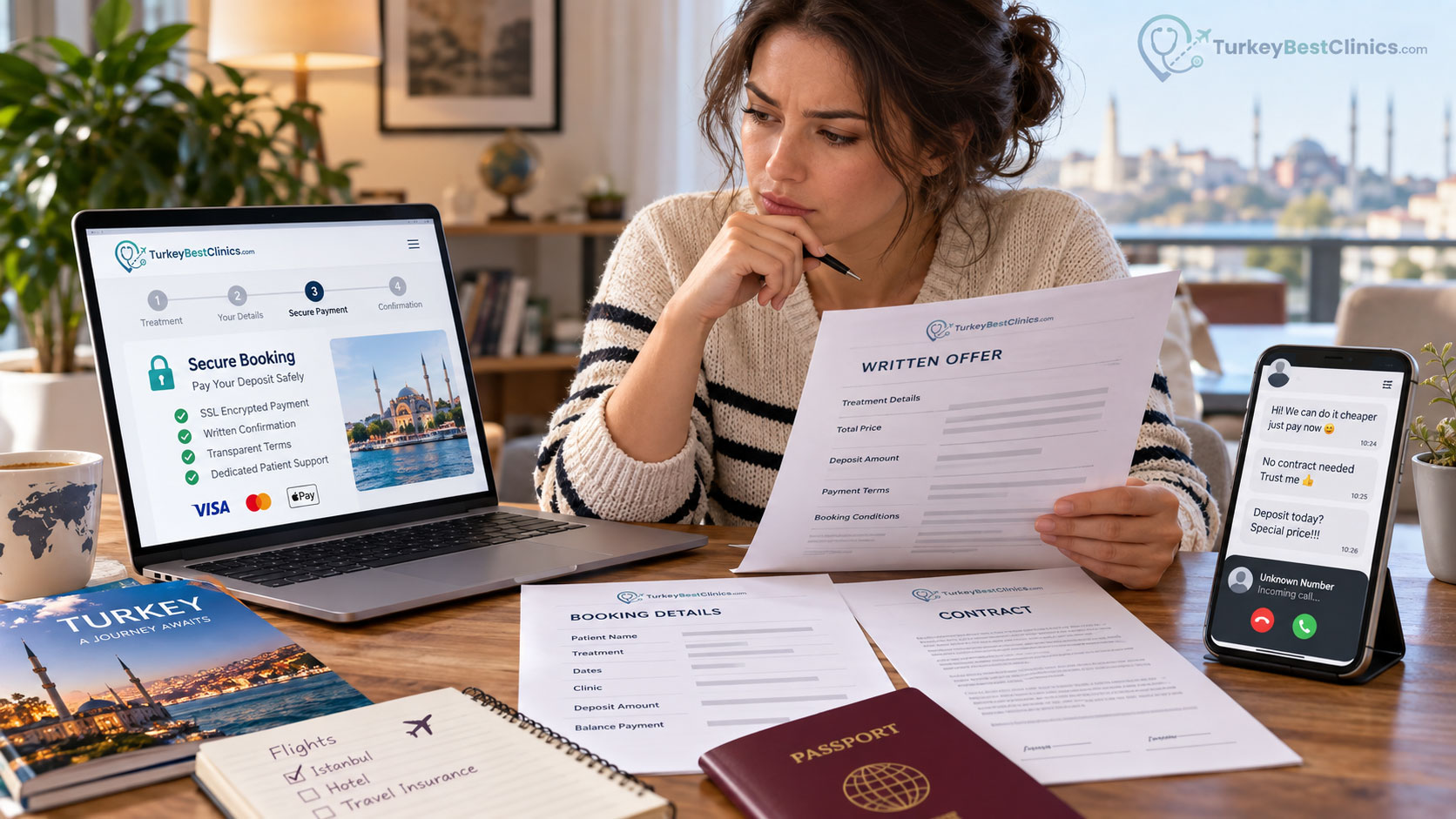
Short answer: It may be safe depending on the circumstances, but you should verify the provider, treatment plan, contract, and payment terms before making any advance payment. A deposit requested before traveling to Turkey may be part of the appointment or planning process; nevertheless, paying based solely on a phone call, social media message, or verbal assurance is not a safe approach.
The identity of the party receiving your payment, the service for which the money is being collected, what will happen in the event of cancellation, and the circumstances under which the treatment plan may change should all be clearly stated in written documents. If this information cannot be verified, it is more protective to delay sending the deposit and request independent confirmation.
Factors that determine whether to pay a deposit before traveling to Turkey
Whether a deposit is safe does not depend solely on the payment method. The legal identity of the healthcare provider or intermediary company, the clear identification of the doctor and clinic that will actually provide the treatment, the scope of the price quote, and the wording of the contract should all be assessed together.
Some payments may be requested in advance during the healthcare tourism process. For example, a fee may be requested for planning, reserving a surgery date, interpretation, transfers, or arranging a specific service. However, it should be clear why the fee is being charged, whether it will be deducted from the total price, and under what conditions it will be refunded if the service is not provided.
Statements such as “guaranteed results,” “fixed price,” “full refund under all circumstances,” or “guaranteed revision” are not, by themselves, signs of reliability. The scope of healthcare services may change after medical evaluation; therefore, the quotation should separately explain the responsibilities relating to pre-treatment assessment, the possibility of additional procedures, accommodation, transfers, interpretation, follow-up care, and potential complications.
Documents to check before paying a deposit
Before deciding to pay, it is useful to collect the documents in one file and check whether they are consistent with one another. The following elements may not appear in exactly the same form in every transaction; however, you should ask about any missing points in writing.
- Full identity of the provider: The healthcare provider’s or intermediary company’s legal name, complete contact details, and role in the service should be clear. The intermediary company and the clinic providing the treatment may not be the same entity; this distinction should be explicitly stated.
- Authorization and business information: You should verify through official channels and directly with the provider whether the organization providing healthcare services operates within the relevant official regulations. If intermediary services are involved, ask what responsibilities the intermediary assumes.
- Medical quotation: The proposed procedure, pre-assessment requirements, specialty of the professional performing the procedure, and the conditions under which the treatment plan may change should be provided in writing.
- Price breakdown: The deposit amount, remaining balance, currency, taxes, and services said to be included in the package should be listed separately.
- Cancellation and refund terms: The applicable conditions should be clearly stated for situations including your cancellation, a date change by the clinic, a finding that the procedure is medically unsuitable, travel restrictions, and failure to provide the service.
- Invoice or proof of payment: You should know in advance which legal entity or individual will issue your payment document after payment. A payment made to a personal account does not carry the same risk profile as a payment made to the official account of a registered organization.
- Contact and complaints channel: The contract or information documents should state whom to contact, through which channel, and in which language if you experience a problem.
Practical checklist for safer payment
Apply the following steps to your own documents before sending a deposit. This is not an official application procedure; it is a practical framework you can use to reduce payment risk.
- Verify the payment recipient. Ask whether the organization named in the quotation matches the owner of the bank account. If payment will be made to an intermediary company, request that this relationship be expressly stated in the contract.
- Clarify the location where treatment will be provided. The sales representative handling your communication may be different from the clinic or doctor performing the procedure. The clinic’s full name, treatment location, and responsible contact person should appear in the written documents.
- Put the quotation in writing. Do not pay until prices and promises made in social media messages or instant messaging applications have been incorporated into the contract. Verbal explanations can make it more difficult to prove the scope of the agreement later.
- Read the refund clause carefully. Ask which services are covered by the phrase “non-refundable,” what will happen if medical suitability is not established, and how a date change will affect the deposit. Do not assume that you have a right to a refund in every situation.
- Make sure the payment method creates a record. Bank transfers, cards, and online payment services may involve different dispute and documentation procedures. Ask your bank and payment provider in advance what options are available in the event of a dispute; remember that no payment method automatically guarantees a refund.
- Keep documents and correspondence. Retain copies of the quotation, contract, invoice, payment receipt, medical information, cancellation terms, and correspondence. You may need to keep these documents even after treatment is completed.
- Obtain an independent opinion. If the contract involves a substantial amount or you do not understand the medical or legal wording, ask a consumer adviser, legal professional, or healthcare professional in your own country for clarification. This assessment should not be limited to a person recommended by the clinic.
Red flags relating to payment security
The following situations are not, by themselves, proof of fraud; however, they are strong warnings that you should seek further verification before paying:
- Insisting on communicating only through a messaging application instead of providing documents.
- Requesting payment to a personal account, to another country, or to a person whose name does not appear in the contract.
- Applying pressure to pay the deposit quickly and saying that the price will change if you take time to consider it.
- Failing to provide written answers to questions about refunds, cancellations, additional fees, or medical suitability.
- Deferring disclosure of the name of the doctor or provider performing the procedure until after payment.
- Promising unlimited services, guaranteed results, or unconditional protection against complications alongside an unusually low price.
- Failing to explain why identity documents, passports, or health data are requested, or asking you to send them through insecure channels.
Considerations regarding cancellation, refunds, and medical suitability
Paying a deposit does not mean that the procedure has been medically confirmed. A remote preliminary assessment may be incomplete or limited; the plan may change after an in-person examination, tests, or clinical evaluation. Therefore, ask in writing in advance how the deposit will be handled if the procedure is found to be unsuitable or if the scope of treatment changes.
Refund terms may depend on the contract, the clinic’s policy, the nature of the payment, and the specific circumstances. Whether an amount called a “deposit” is considered payment for reserving a service, consultancy, organization, or another item may affect the outcome. Rather than assuming that you have a definite right to a refund, it is safer to see each scenario clearly set out in the documents.
If a dispute arises after you have paid, first request a written explanation and transaction breakdown through the provider’s official communication channel. You may also confirm current options for submitting a complaint through the official channels of your bank, card issuer, or relevant consumer and healthcare authorities. As deadlines and requirements may vary depending on the country, payment method, and nature of the incident, you should not assume a specific legal outcome.
Additional protection for health data and identity documents
During the deposit process, you may be asked for a passport, photograph, medical report, or imaging results. Before sharing these documents, ask how they will be used, who will have access to them, how long they will be stored, and whether they will be transferred to other organizations.
Do not immediately enter your card or identity details simply because a payment link appears secure. Check the domain name, recipient information, and whether the document is consistent with the provider through independent channels; do not share unnecessary personal data. Remember that data protection practices in Turkey and the rules in your own country may both be relevant.
Five questions to ask yourself before paying
- Exactly what service is the money being requested for?
- Can the identity of the payment recipient and their relationship with the organization be verified in writing?
- Are the conditions for cancellation, medical unsuitability, date changes, and additional fees clear?
- Will I receive an invoice or official proof of payment after paying?
- In the event of a dispute, do I know the responsible person and official communication channel to contact?
If even one of these questions cannot be answered clearly and with supporting documentation, postpone your decision to pay the deposit. In a safe process, it should be normal for you to ask reasonable questions; requests for written information should not be met with pressure or threats.
Other patient rights questions related to this topic
- How can the authorization of a healthcare provider and healthcare tourism intermediary in Turkey be verified?
- Which clauses should be included in a healthcare tourism treatment contract?
- Which official channels can I contact if I experience a problem with healthcare services received in Turkey?