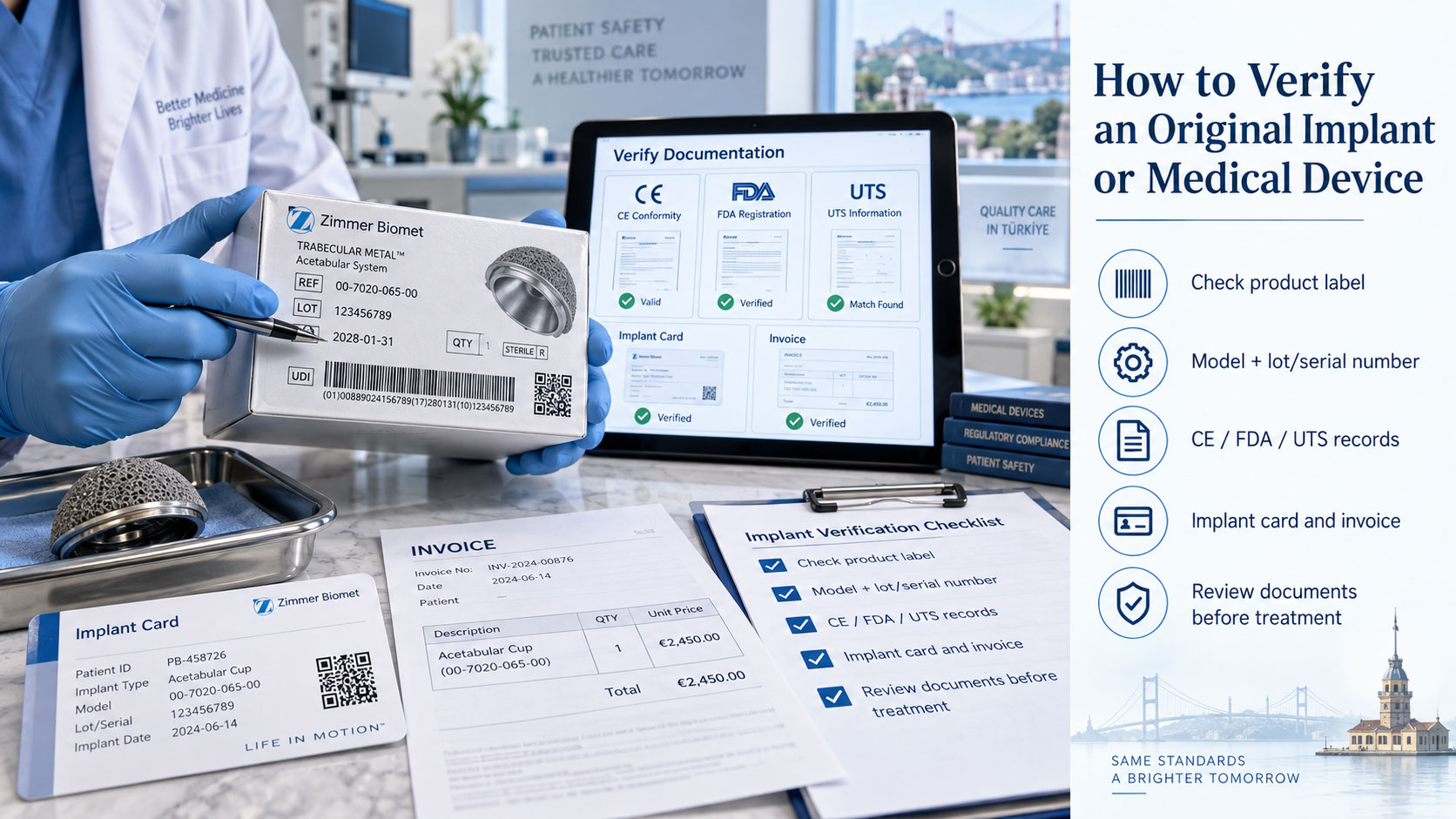
Short answer: The presence of an FDA or CE mark alone does not prove a product’s authenticity or suitability for your treatment. For reliable verification, ask the clinic in writing for the brand, product name, model or catalogue number, lot/serial number and manufacturer details. You can compare this information with the product’s official documents, authorised supplier records and, where necessary, relevant official systems.
FDA and CE markings do not mean the same thing. In addition, not every implant needs to be “FDA approved”; some products may undergo a different regulatory process. Therefore, instead of accepting the terms “FDA approved” or “CE certified” on their own, verify the exact identity of the product to be used and the scope of its documentation.
What Do FDA and CE Marks Mean for an Implant?
The CE mark is a conformity marking indicating that a product meets the conformity requirements set out in European Union medical device legislation. Depending on the product’s risk class and assessment method, this may involve the manufacturer’s declaration of conformity, technical documentation or an assessment by a notified body. Some products may display a four-digit notified-body number next to the CE mark; however, whether this number is present depends on the product’s classification and the applicable assessment process.
The FDA process is a separate regulatory framework used in the United States. A product may be “FDA cleared,” “FDA approved” or covered by another FDA authorisation category. “Cleared” generally refers to a 510(k) process, while “approved” refers to a more comprehensive approval process for certain higher-risk products. These terms should not be used interchangeably.
The fact that an implant carries a CE mark does not automatically mean that it has been approved by the FDA. Likewise, a product with an FDA record should have its European conformity process and supply status in Turkey reviewed separately. Verification should be based not on general brand information but on the exact product model and the medical purpose for which the product will be used.
Verifying Product Identity Through Documentation
The first step is to ask the clinic for detailed product identification for each material to be used, not just the brand name. The model information may differ for an implant, prosthesis, graft, screw, abutment, lens or other medical device. If multiple products will be used, each should be listed separately.
- Manufacturer’s full legal name: The brand name and the manufacturer’s legal company name may not be the same.
- Product name and model: The product’s generic name, series name or product family alone is not sufficient.
- Catalogue or reference number: Different sizes, materials or intended uses may exist within the same product family.
- Lot, serial or production number: Single-use products may have a lot number, while devices subject to serial tracking may have a serial number.
- Expiry date and sterilisation information: For sterile and single-use products in particular, check the information on the packaging.
- Place of manufacture and distributor details: Compare the information on the packaging or accompanying documents with the invoice and delivery records.
Where possible, request this information before treatment and before deciding to make a payment, together with readable photos of the packaging or official product documents. If product information is provided only verbally, verifying it later may be more difficult.
Documents and Records to Check
CE Conformity Documents
For a product bearing a CE mark, you may request a declaration of conformity, relevant certificate or manufacturer’s documentation. Check whether the document includes the product’s exact model, manufacturer, scope and validity information. The fact that a certificate belongs to the same brand does not mean that every model or product group is covered by it.
The product name, model number and manufacturer shown on the document should match the information on the packaging. If the document covers a different product group, this should be clarified. The certificate’s current validity and the authority of the issuing organisation can also be confirmed through official and reliable channels.
FDA Records and Authorisation Information
For FDA-related verification, use the product’s full commercial name, manufacturer and model information. The FDA’s official databases may contain device listings, 510(k) numbers, PMA information or other types of records for certain products. However, the appearance of a business or product in a database does not mean that the specific product to be used in your treatment is genuine, current, stored under appropriate conditions or suitable for your clinical circumstances.
The product name and manufacturer in the FDA record should match the information provided by the clinic. There is a difference between the phrase “FDA registered” used in advertising and FDA clearance or approval for a specific product. Therefore, do not base your decision solely on the phrase “FDA registered”; ask for clarification about the type of authorisation and its connection to the product model.
Product Tracking and Supply Records in Turkey
Turkey has official systems that support the tracking of medical device product and supply-chain information. Product details may be linked to the relevant records by the clinic or an authorised supplier. These systems are intended to support the tracking and traceability of products on the market; however, a record does not demonstrate that a treatment choice is clinically correct or guarantee any outcome.
You may ask the clinic to confirm in writing that the product was obtained through a lawful supply channel in Turkey and that the record information for the material used will be entered into your file. Since the current access method and scope of official systems may change, it is safer to verify information through the official channels of the Ministry of Health or the relevant authorised institutions.
Checklist to Use Before Treatment
- Request the manufacturer, model, catalogue number and lot/serial number in writing for every implant or device to be used.
- Check that the information on the packaging matches the information in the quotation, treatment plan, contract and invoice.
- Ask whether the CE conformity certificate or manufacturer’s declaration of conformity is valid for the relevant model.
- If an FDA claim is made, clarify whether it refers to “cleared,” “approved,” “registered” or another status.
- Request the product’s official instructions for use, material information, sterilisation status and storage conditions.
- Ask for an invoice or supply document showing that the product was obtained by the clinic or an authorised distributor.
- Before the implant is used, ask whether you can receive an implant card, product label or traceability document that can be added to your patient file.
- If a document is in another language, request an explanation of important technical and contractual information in a language you understand.
- Consider adding a contractual provision stating that any change of brand or model may only be made with your prior written approval.
From a practical perspective, it may be helpful to see the product packaging before treatment, check that it is sealed and undamaged, and ask for the label information to be recorded in your file after the procedure. If the packaging has been opened, the label cannot be read or the lot number is not entered into your file, ask for an explanation.
Authenticity and Clinical Suitability Are Not the Same
The fact that a product is genuine does not automatically mean it is the most suitable option for you. Implant selection may vary according to anatomical features, existing health conditions, imaging results, the treatment method, the surgeon’s assessment and the product’s intended use. Therefore, document verification does not replace clinical assessment or the informed-consent process.
In addition, incorrect storage of a genuine product, damage to its packaging or expiry of its use-by date may create separate risks. Ask for confirmation that the product has been stored according to the manufacturer’s instructions and is in suitable condition for use during the procedure.
What Should You Do If Documents Are Missing or Suspicious?
If documents are not provided, model information does not match or only advertising images are shared, request a written explanation before making payment or proceeding with treatment. The clinic should be able to explain why the product was changed, which document is valid and how the material to be used will be recorded in your file.
If you are unsure whether a document is genuine, verification can be sought through the manufacturer’s official contact channel, an authorised distributor or the relevant regulatory authority’s official channels. Do not accept a questionable document based solely on a screenshot sent by the clinic. In the event of a dispute, contracts, invoices, correspondence, packaging photographs and product labels may be important records.
Important Rights and Contractual Points
Check whether the brand and model are clearly stated in the contract you sign. If it contains phrases such as “similar product,” “equivalent material” or “may be changed when necessary,” clarify in writing the circumstances in which a change may be made and how you will be informed in advance.
Refunds, revisions, additional fees, complications and warranties are separate issues from product authenticity. They may depend on the clinic’s policy, the terms of the contract, applicable regulations and the specific medical circumstances; do not assume a definite outcome or refund guarantee. If necessary, seek advice from an independent healthcare law specialist or the relevant official advisory channel in your country.
Related Questions
- Why is it important to include the implant brand and model in a treatment contract in Turkey?
- Should the clinic record the lot or serial number of the implant used in the patient’s file?
- How can post-treatment complications and revision terms be checked in writing when undergoing medical treatment in Turkey?