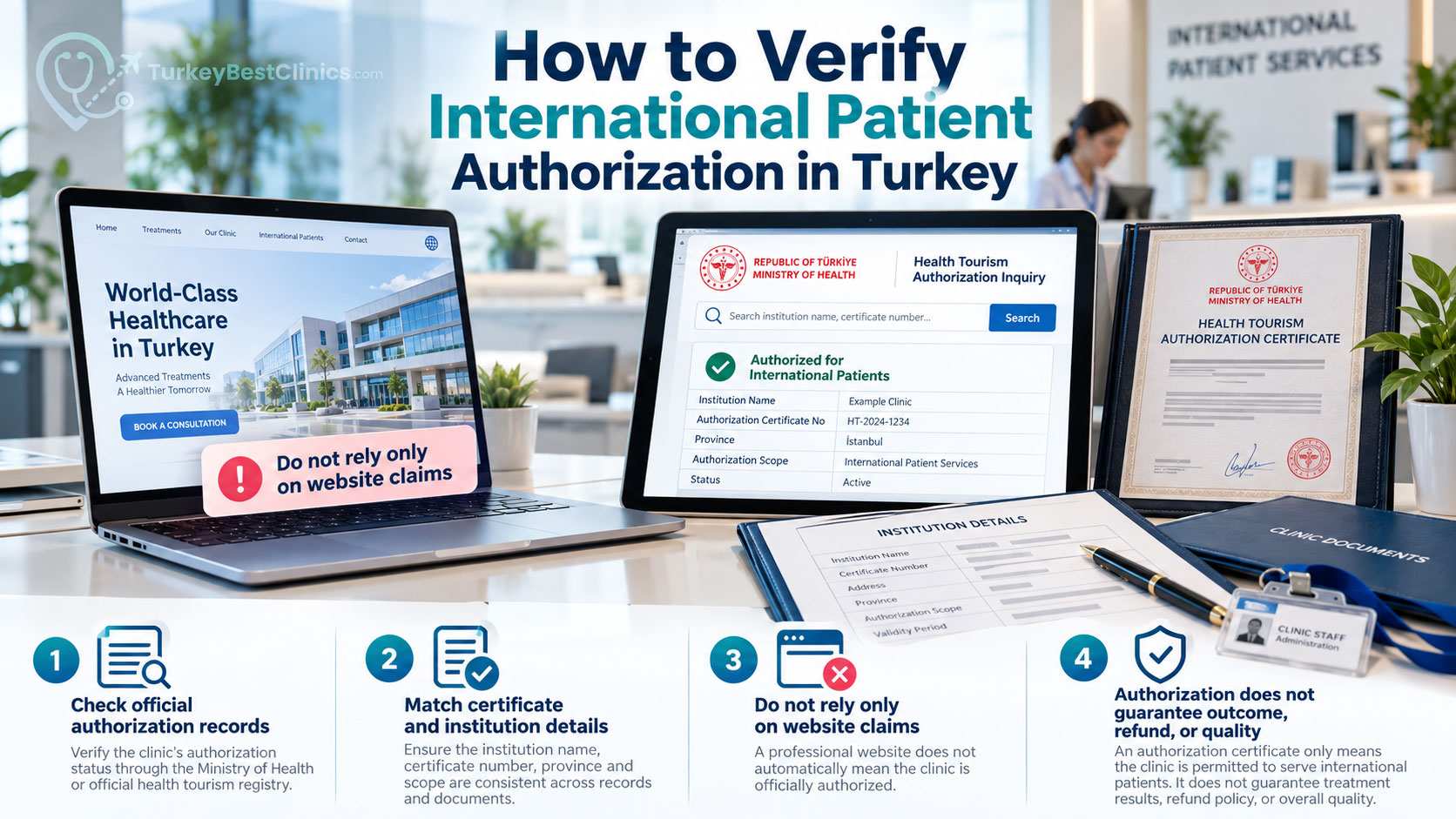
It depends on the circumstances: You can determine whether a clinic in Turkey is authorized to serve international patients under the scope of health tourism by requesting its International Health Tourism Authorization Certificate and verifying the related records through official channels. A statement such as “we treat foreign patients,” a social media post, a foreign-language website, or an accreditation logo alone is not proof of legal authorization.
The key points to check are the clinic’s legal entity name, operating address, the scope of its authorization certificate, and which party is providing the service. Before deciding on treatment, payment, or travel, compare this information in writing and confirm its current status with the relevant official institutions.
What Does an International Health Tourism Authorization Certificate Mean?
Turkey has an authorization system established under Ministry regulations for healthcare providers serving people living in foreign countries within the scope of health tourism. A hospital, medical center, outpatient clinic, or other relevant healthcare provider may obtain an authorization certificate by meeting the requirements for international health tourism activities.
The certificate indicates that the institution provides international healthcare services within a specific regulatory framework. However, holding the certificate does not automatically guarantee a particular doctor’s expertise, the suitability of the recommended procedure for you, clinical outcomes, pricing policies, or the steps that will be taken in the event of complications.
You should also distinguish between a healthcare provider and a health tourism intermediary. An intermediary may arrange transportation, accommodation, interpretation, appointments, or coordination, but may not be the organization performing the medical procedure. Clarify which legal entity holds the certificate and which services the party offering you a contract is responsible for.
Records to Check When Verifying an Authorization Certificate
Requesting a copy of the certificate from the clinic is a useful first step; however, you should also check that the file is current and belongs to a genuine institution. Compare the following information at the same time:
- Legal entity name: The company or healthcare provider name on the certificate should match the name shown on the quotation, contract, invoice, and bank account.
- Operating address: The address on the certificate should correspond to the physical address of the clinic, hospital, or medical center where treatment will take place. If the procedure is planned at a different branch, ask about that branch separately.
- Scope of the certificate: Find out whether the certificate belongs to a healthcare provider or an intermediary, which activity it covers, and whether any limitations apply.
- Current status: Verify the certificate’s validity, suspension, cancellation, or amendment status through official sources. Do not accept an outdated certificate as proof of current authorization.
- Doctor providing the service: The name of the doctor performing the procedure, their specialty, and their relationship with the institution where they work should be explained in writing.
- Parties to the invoice and contract: If the company receiving your payment differs from the organization assuming medical responsibility, request a separate explanation of each party’s duties and responsibilities.
Checklist for Official Verification
This process helps you confirm that information from different sources is consistent rather than relying on a single document. Keeping screenshots or written responses at each stage may help you maintain a document trail if a dispute arises later.
- Request the institutional details in writing. Ask for the clinic’s full legal entity name, complete operating address, the scope of its authorization certificate, and the details of the doctor who will provide the service. Obtain the official company name, not just the brand name.
- Request a legible copy of the certificate. The name, address, certificate type, and date should be visible. Sensitive personal information may be redacted, but essential details needed for verification should not be removed.
- Search official Ministry channels. Check the institution’s registration or authorization status on the Ministry of Health’s official channels and relevant official health tourism platforms. As platform layouts and search methods may change over time, confirm the current process through official channels.
- Match the institution’s registration details. Compare the name and address in the official record with the information on the clinic’s website, contract, and invoice. Matching only the brand name is not sufficient.
- Separate the intermediary’s role, if applicable. Ask whether the intermediary is arranging transportation and coordination or organizing healthcare services. Have it stated in writing which organization is responsible for the medical assessment, informed consent, procedure, follow-up, and complication management.
- Obtain confirmation through an official channel. If you have doubts about the certificate’s validity or scope, request verification through the relevant public institution’s current contact channels. Do not rely solely on a telephone number provided by the clinic or an explanation sent through a messaging app.
- Compare the documents before signing. The names of the parties in the healthcare contract, consent form, price quotation, invoice, and travel package should not contradict one another.
Do Not Confuse Authorization with Proof of Quality
An authorization certificate concerns regulatory eligibility to provide services to international patients. Accreditation certificates, quality management systems, and memberships in professional organizations may have different purposes and assessment criteria.
For example, if an institution states that it holds accreditation such as JCI, you should separately verify which organization, campus, and period the accreditation applies to. References to CE or FDA do not directly demonstrate that a clinic is authorized for international health tourism; they may relate to specific products or medical devices. Displaying a logo on a website does not prove that the certificate is current or valid for the procedure in question.
Reducing Uncertainty and Dispute Risks
If you cannot see the certificate, the institution does not share its full legal name, you are later told that treatment will take place at a different address, or payment is requested to an account belonging to another party that does not provide the medical service, you should proceed carefully. These circumstances may not, by themselves, prove unlawful conduct, but they are important signs that further verification is needed before making a decision.
If you have been verbally promised a “guarantee,” “certain results,” “unlimited revisions,” or a “refund under all circumstances,” look for these terms clearly in the contract. Conditions concerning refunds, revisions, follow-up care, complications, additional procedures, hospitalization, interpretation, transfers, and accommodation may depend on the clinic’s policy, the contract you sign, and your specific medical circumstances.
Ask in advance in which language your medical documents will be explained, whether qualified interpretation support will be available during the consent process, and whom you should contact in an emergency after the procedure. Do not sign a consent form you do not understand; state in writing that you require an explanation and translation.
Relevant Questions to Ask Before Making a Decision
- What risks should I consider if I communicate with an organization in Turkey that does not have an international health tourism authorization certificate?
- Which clauses should I check in the clinic’s price quotation and healthcare services contract?
- If a complication or follow-up need arises after the procedure, whom should I contact in Turkey and through which channel?
This content is provided for general informational purposes and does not constitute legal advice. Review current official records regarding authorization status, contracts, and application options; depending on your circumstances, consider obtaining independent legal or medical advice.