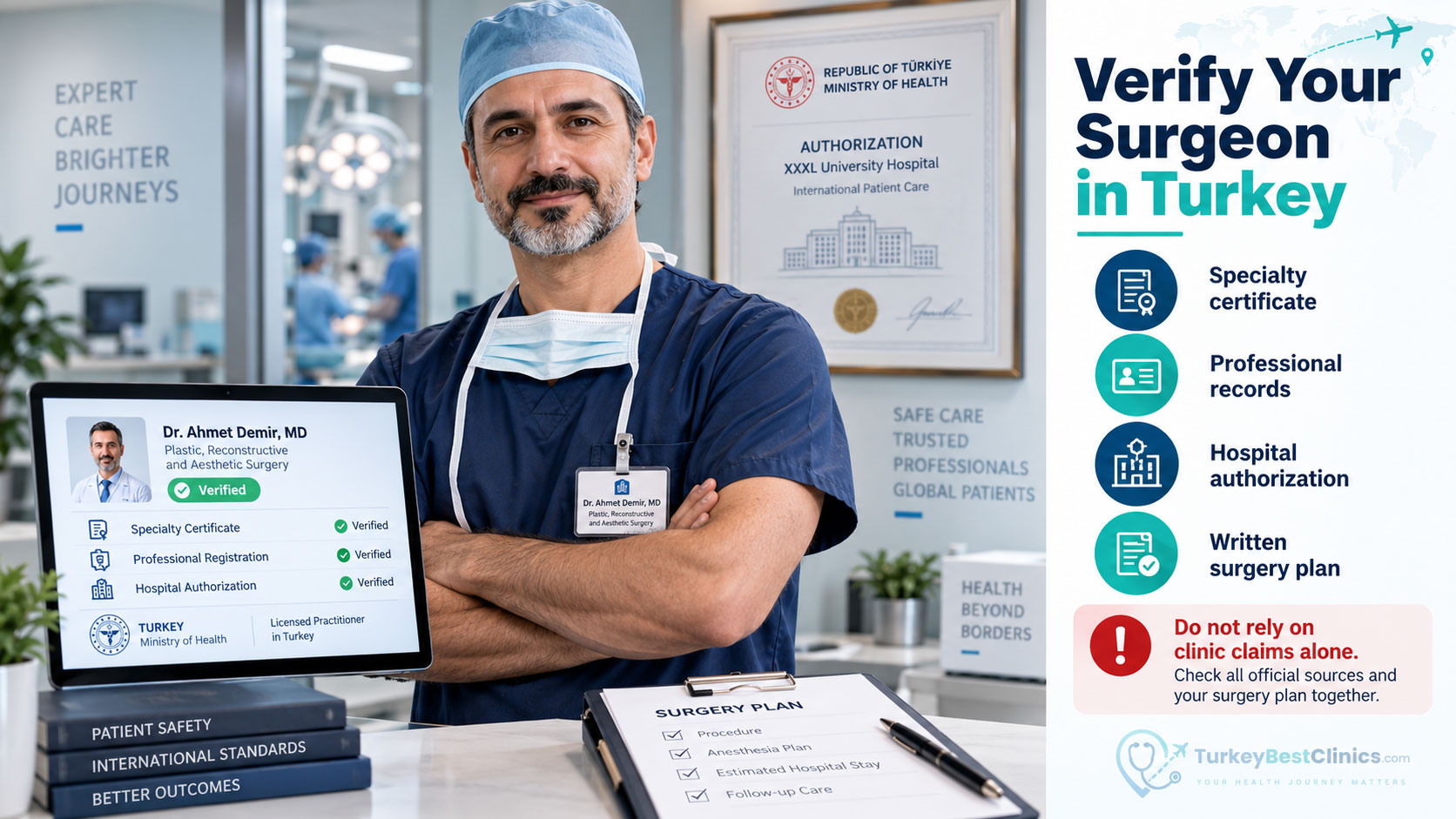
Verification may be possible depending on the circumstances; however, a single online record cannot by itself prove a surgeon’s complete professional history or suitability for a specific procedure. First, compare the surgeon’s name, diploma details, specialty, affiliated institution, and any subspecialty information with official sources. Then review the documents provided by the clinic, the authorization of the hospital where the surgery will be performed, the surgeon’s experience with the relevant procedure, and post-operative responsibilities in writing.
As you are applying from outside Turkey, it is important to request up-to-date copies of the documents and, when necessary, explanations in English or a language you understand. This information does not replace legal or medical advice; if uncertainty remains, obtain confirmation through the current official channels of the relevant authorities.
How should a surgeon’s specialty registration and surgical authorization be assessed?
The first distinction to understand is that a medical degree and a specialist qualification are not the same thing. A doctor’s graduation from medical school does not necessarily mean that they have completed specialist training in a particular surgical field or regularly perform the planned procedure. Therefore, do not look only at the doctor’s title; also consider whether their specialty is directly related to your surgery.
Using the surgeon’s first and last name and, if possible, the registration details on their diploma or specialist certificate, you may consult the Ministry of Health’s current information sources for physicians and healthcare institutions. Because the names of official platforms, search methods, and accessible fields may change over time, verify the current link directly through the Ministry of Health’s official channels. If the record shown in the search results does not match the document provided by the clinic in terms of name, specialty, or affiliated institution, request a written explanation.
The healthcare authorization of the hospital or clinic where the surgeon works should also be assessed separately. Clarify the relevant authorization of the organization providing services במסגרת medical tourism and identify the hospital where the surgery will take place. The role of an intermediary company in medical tourism does not verify the surgeon’s qualifications; make sure the contract clearly states which doctor and healthcare institution hold medical responsibility.
Documents and verification records to request
Requesting documents is not a sign of distrust; it is a reasonable transparency step in international healthcare. Rather than simply collecting photographs of documents, compare the information on them with one another.
- Medical school diploma: The name, surname, and graduation details on the document should match the surgeon’s identity information.
- Specialist certificate: Check the specialty, the institution that issued the certificate, and its registration details. Assess separately whether general surgery, plastic, reconstructive and aesthetic surgery, otorhinolaryngology, or another field is relevant to the planned procedure.
- Subspecialty or additional qualification certificates: If the surgeon claims a particular subspecialty, ask which institution issued the certificate and what it covers.
- Workplace and surgical institution: Clarify whether the examination address and the hospital where the surgery will be performed are the same. If they differ, obtain the role of each institution in writing.
- Updated résumé: Education, the start of specialist practice, academic positions, professional organization memberships, and experience with the relevant procedure should be presented under separate headings.
- Informed consent and surgical plan: The scope of the procedure, alternatives, potential risks, follow-up period, and the department to contact in an emergency should be explained clearly.
Do not limit verification of these documents to a statement from a clinic staff member. If the public authority, university, professional organization, or healthcare institution that issued the document has an official verification channel, request confirmation through that channel. Record any points that receive no response or are dismissed with only a verbal explanation in your decision notes.
What evidence is meaningful when reviewing professional history?
Professional history is not measured solely by total years in practice or visibility on social media. Training related to the planned surgery, regular performance of the procedure, complication management, and the organization of post-operative follow-up are more meaningful indicators. You can ask the surgeon directly approximately how many similar procedures they perform each year, at which hospital they perform them, and what follow-up plan they use if complications occur.
Remember that such figures cannot always be independently verified. Before-and-after images, procedure numbers, or success rates shared by a clinic should not be the sole evidence guiding your decision. Consider whether the images belong to the stated patients, when and under what conditions they were taken, that outcomes may vary from person to person, and that the images may represent selected examples.
University profiles, scientific publication databases, and professional conference records may indicate a surgeon’s academic interest in a particular field. However, publishing research does not mean that the surgeon is the most suitable option for every procedure. Records from the Turkish Medical Association or the relevant local medical chamber may assist with reviewing professional registration; however, these records alone do not recommend a specific surgical procedure or guarantee clinical success.
Checklist to use before surgery
- Request the exact medical name of the planned procedure and the surgeon’s specialty relevant to that procedure in writing.
- Confirm the name, specialty, and hospital position of the person who will actually perform the surgery; ask whether the person conducting the initial consultation differs from the surgeon who will operate.
- Record which institution issued the specialist certificate and, if applicable, the subspecialty certificate.
- Obtain the name of the hospital where the surgery will take place, confirmation that the relevant department is available, and details of the post-operative follow-up arrangements in writing.
- Check that the contract states how many days or weeks follow-up examinations will continue, whom you will contact after returning to your country, and which healthcare institution you should contact in an emergency.
- Do not rely solely on a sales representative’s verbal explanation of the conditions for complications, additional procedures, revisions, cancellations, and refunds; request that these conditions be clearly included in the documents you sign.
- Have the documents reviewed by your own doctor or an independent healthcare adviser before traveling. If translation is needed, confirm the meaning of the medical terms.
- When sharing identity and medical documents, send only the information that is necessary. Ask the clinic to explain how your personal data will be stored and with whom it will be shared.
Limits regarding disciplinary records and a surgeon’s actual medical history
You may generally be unable to access all complaints, disciplinary matters, malpractice cases, or insurance files concerning a surgeon online. Such information may be subject to restrictions relating to personal data, professional confidentiality, and ongoing proceedings. Therefore, not finding a record online does not conclusively show that there is no problem; seeing an allegation online does not mean that the allegation has been verified.
If you have concerns about a specific disciplinary matter or lawsuit, you may request a written explanation from the surgeon and the healthcare institution. If official records cannot be shared, ask the relevant medical chamber, the Ministry of Health, or an authorized legal adviser what verification process may be available. Before reaching a firm conclusion, assess the document’s source, date, and scope.
The term medical history here refers to the surgeon’s professional history. You may not have the right to access a surgeon’s private health information, personal medical records, or private life. The matters you should assess are the training, authorization, experience, and follow-up capacity required to perform the planned surgery safely.
If you encounter document discrepancies or pressure
If the specialist certificate is not shared, it is unclear who will perform the surgery, or you are pressured to make a quick decision in order to pay, pause the process and request further clarification. You are not required to accelerate a medical decision because of a passport, flight ticket, or deposit.
If a document contains a different name, institution, or specialty, request a written correction. If the responses are contradictory, do not proceed with payment, travel, or consent until you have obtained confirmation through the current official channels of the relevant authorities. If a problem arises, keeping the contract, correspondence, invoices, and shared documents may be useful for subsequent applications or complaints.
Questions related to this topic
- How can I check whether the hospital where I will have surgery in Turkey is authorized to provide medical tourism services?
- If I experience a complication after surgery, how should follow-up be planned in Turkey and after I return to my country?
- How should I review payment, cancellation, revision, and additional procedure terms in a medical tourism contract?