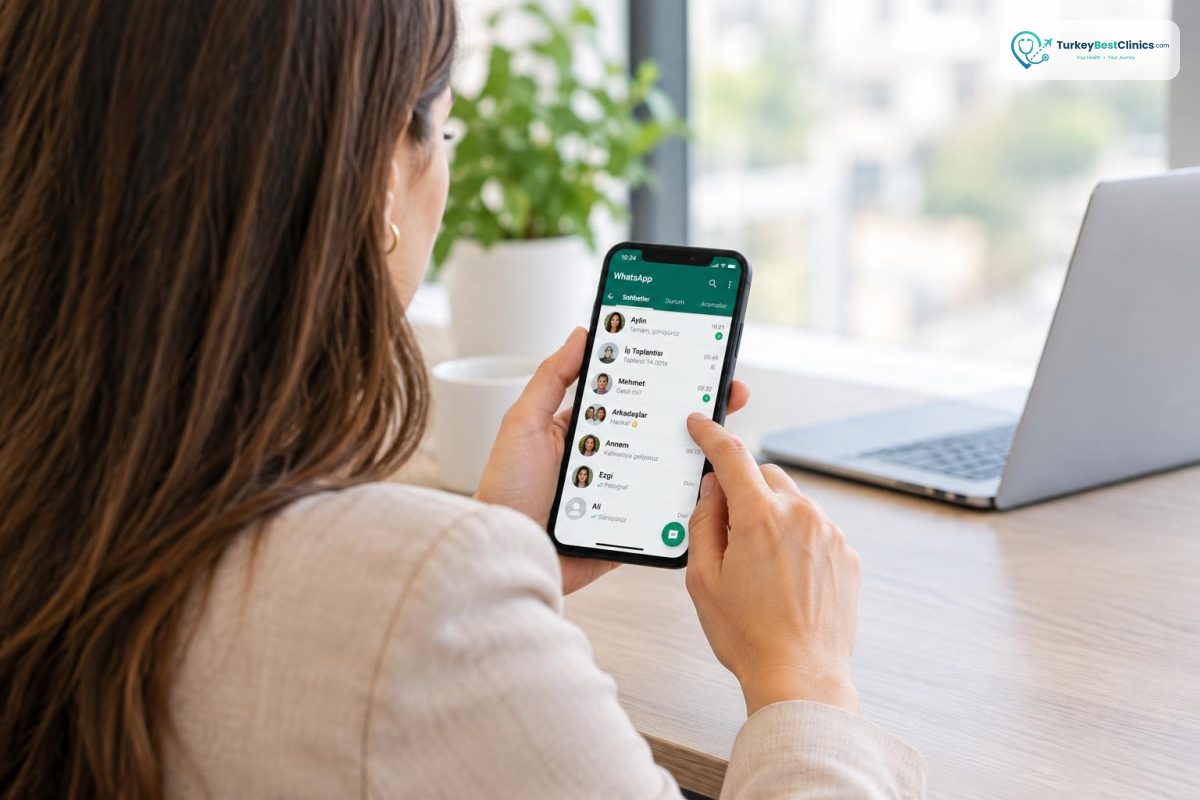
Verification may be possible depending on the circumstances, but viewing only the WhatsApp profile, hospital logo, or documents sent to you is not sufficient. You must confirm through an independent and official hospital channel that the person you are communicating with actually works at the relevant hospital or is authorized to conduct healthcare tourism communications on the hospital’s behalf. A WhatsApp conversation alone should not be considered proof of institutional authority.
The safest approach is to find the hospital’s contact information through its own official sources and contact the hospital directly, rather than calling back the number that contacted you. During the conversation, you can ask the hospital to confirm in writing the person’s full name, position, department, contact number, and authority regarding your case.
Key Criteria for Verifying a WhatsApp Representative
The presence of the hospital’s name, logo, location, or a doctor’s photo on a WhatsApp account does not prove that the account genuinely belongs to the hospital. Likewise, photographs of the hospital building, a video call, or a PDF bearing the hospital’s name do not, by themselves, provide sufficient assurance.
For verification, assess several independent indicators together. The information provided by the person you are contacting should be consistent with the information available through the hospital’s official communication channels. The person’s name and position should be verifiable by the hospital’s international patient department or relevant administrative department.
- Find the contact channel listed on the hospital’s official website yourself; do not use a link sent to you via WhatsApp as your only source of verification.
- Contact the hospital switchboard or official email address independently and ask about the person’s name and position.
- Clarify whether the representative is a hospital employee, an external service provider, or simply someone making referrals.
- Request a current, verifiable written document showing authorization to communicate on behalf of the hospital.
- Compare the names of the organizations shown on the quotation, medical plan, payment instructions, and contract to ensure they are consistent.
Practical Steps for Independent Hospital Confirmation
As a first step, ask the person continuing the WhatsApp conversation for the hospital’s full legal or registered business name, physical address, affiliated department, and corporate email address. Check this information through the hospital’s independent official sources, not through the phone number or link sent directly by that person.
Next, send a short and clear confirmation request to the hospital’s official communication channel. Explain that a specific person has contacted you via WhatsApp about healthcare services, and ask whether this person is acting on behalf of the hospital and whether the quotation provided is connected to the institution. If possible, obtain the confirmation in writing and keep the correspondence.
If the hospital’s official channel cannot verify the WhatsApp contact’s name or states that it has no connection with that person, stop the communication. Statements such as “the system has not been updated,” “the head office is unaware,” or “we operate through this private channel” do not eliminate the need for independent confirmation.
Information You Can Request to Confirm Representative Authority
- The person’s official position at the hospital and their department
- The corporate email address used by the hospital
- The full legal or registered business name of any external service provider or intermediary
- The nature of the relationship between the intermediary and the hospital
- Which organization is responsible for the quotation and payment process
- Which doctor or hospital department will answer medical questions
Providing this information alone is not conclusive proof of authority. The key point is whether the information can be verified through the hospital’s independent official channel.
What to Check in Corporate Emails, Phone Numbers, and Documents
Check whether the corporate email address matches the hospital’s official domain name. Addresses from free email services do not always mean that the sender is fraudulent; some intermediary organizations may use them. However, in such cases, the intermediary’s relationship with the hospital must be verified separately.
The country code of a phone number, the WhatsApp profile name, or the organization name displayed on the caller ID does not establish reliability on its own. A number can be spoofed, belong to another country, or redirect to a personal line. Find the hospital’s official phone number through an independent source and compare it with the information provided by the WhatsApp contact.
Carefully review PDF quotations, letterhead documents, and documents containing stamps or signatures. The organization name, tax or company details, payment recipient, hospital address, and contact information shown on the document should not contradict one another. A document’s professional appearance does not prove that its contents are genuine.
Red Flags During Payment and Contracting
A payment request is one of the most critical stages in verifying a representative. The name of the person or company receiving payment should be clearly linked to the organization named in the contract and to the healthcare service said to be provided. Requests to pay into a personal bank account, to an unrelated company in another country, or to an unexplained third party are significant warning signs.
- Before making any payment, request a written price breakdown and a clear description of the services included.
- Check the contract for deposit, cancellation, refund, date-change, and additional-fee conditions.
- Ask which organization or company will receive the payment and who will issue the invoice.
- Do not treat pressure statements such as “the price will be invalid if you do not pay today” as a valid reason to make a decision.
- If the bank account holder, contracting party, and healthcare provider are different, request a written explanation.
Do not rely on verbal promises regarding refunds or treatment outcomes. These matters generally depend on the contract, the clinic’s or hospital’s policies, and the specific circumstances. Before making a payment, ask for clarification of any provisions you do not understand; if necessary, seek advice from an independent legal or consumer adviser.
Protecting Your Personal and Medical Data
Do not send a passport image, identity document, detailed medical report, imaging files, bank details, or a photograph of a payment card before the representative has been verified. Medical information may be necessary for treatment planning, but it should be clear who is collecting it, which organization it will be shared with, the purpose for which it will be used, and how long it will be retained.
The security features of messages and files sent via WhatsApp do not, by themselves, explain the hospital’s responsibilities for processing your data. Ask whether your personal data will be shared with the relevant healthcare provider, an intermediary company, or another service provider abroad. Do not provide approval until you understand the privacy notice provided to you and, where required, the explicit consent process.
What to Do If Authority Cannot Be Confirmed
If the hospital does not verify the WhatsApp contact’s name, no official channel can be found, no contract is provided, or payment is requested by a different person, slow down the process. Unless you have a medical emergency, it may be more prudent to avoid making payments or travel arrangements until independent verification is complete.
Keep screenshots of suspicious conversations, the phone number, documents sent to you, payment requests, and relevant dates. If you need to contact official authorities or the relevant platforms, these records may help clarify what happened. Check healthcare tourism authorization and institutional information through current official sources and the verification channels of relevant public authorities; separately confirm the current status of any lists or procedures that may change.
Final Check: Before Continuing the Conversation
- Has the person’s name and position been confirmed through the hospital’s official channel?
- Has it been explained in writing whether this person is a hospital employee or an authorized intermediary?
- Are the healthcare provider, contracting party, and payment recipient clearly identified?
- Are the medical scope, additional fees, cancellation terms, and refund conditions in the quotation clear?
- Have you been informed about how your personal and medical data will be used?
- Are you being pressured to make a payment, or is independent verification being obstructed?
If several of these questions cannot be answered, do not accept the WhatsApp account as an institutional representative. Until verification is complete, share only general information and request further confirmation through the official channel.
Related Questions You May Ask After This Topic
- How can a hospital or healthcare provider in Turkey be checked before receiving treatment?
- Which payment, cancellation, and refund clauses should be reviewed in a healthcare tourism contract?
- How can I protect my data when sharing my medical reports with a clinic or intermediary organization in Turkey?