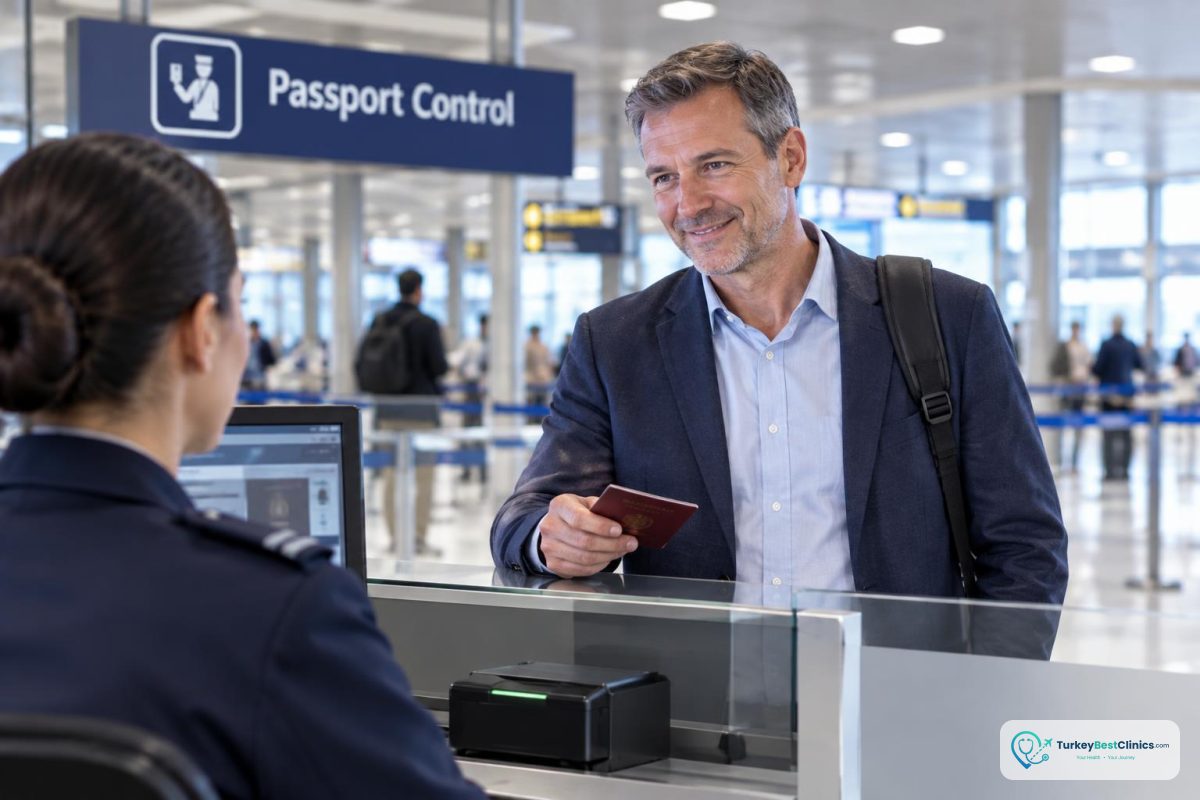
The best approach is to state clearly and truthfully that you are visiting Türkiye to receive healthcare services. At border control, you can use the expression that best matches your plans, such as “treatment,” “medical consultation,” “preoperative assessment,” or “follow-up appointment.” If you are asked about the name of the healthcare provider you will visit, your appointment date, your estimated length of stay, or your accommodation, explain these details consistently.
You do not need to prolong your answers with unnecessary details; however, concealing your treatment purpose, saying that you are visiting solely as a tourist, or giving an explanation that conflicts with your documents may cause problems. Since visa, passport, entry requirements, and border assessments depend on the applicable rules and your specific circumstances, the information on this page does not replace official immigration or legal advice.
How should you describe your treatment purpose at border control?
Answer the officer’s question directly. For example, you could say, “I have come to Türkiye for a planned consultation and treatment process at a healthcare facility.” If your procedure has been confirmed, add the name of the healthcare provider and your appointment date. If you are visiting only for an assessment or second opinion, state this just as clearly.
If you need to communicate in English or another language, it may be helpful to prepare a short sentence in advance: “I am travelling to Türkiye for a medical consultation and treatment evaluation.” Use this sentence only if it accurately reflects your actual travel purpose. If you need translation assistance, do not hesitate to say so; do not approve a document or statement you do not understand without receiving an explanation.
Key information that may be included in your answer
- Your reason for visiting Türkiye: consultation, diagnostic assessment, treatment, surgery, rehabilitation, or follow-up.
- The name of the hospital, clinic, doctor, or healthcare provider you will visit.
- The appointment or planned procedure date; if it has not been finalized, state that it is still at the assessment stage.
- The approximate length of your planned stay in Türkiye.
- Where you will stay and your plans for your return or onward journey.
You generally do not need to provide the border officer with every detail of your medical history when describing your health condition. Give brief, clear information that is relevant to the question asked, and share private medical documents only when necessary and in a secure manner.
Documents you can prepare for border control
Carrying documents does not mean that entry will be approved with certainty; nevertheless, they may make it easier to explain your travel purpose. It is practical to ensure that your documents are up to date, consistent with one another, and, where possible, available in a form that can be shown without electronic access.
Appointment and healthcare provider records
- Appointment confirmation or an acceptance letter from the healthcare provider.
- A record showing the provider’s name, address, and appointment date.
- A general description of the planned service; for procedures that have not yet been finalized, wording such as “initial assessment” or “treatment planning.”
- If applicable, a summary of correspondence with an authorized medical tourism intermediary.
The name, passport details, dates, and provider name on these documents should be consistent with your travel plans. If you are using an intermediary, understand the nature of its relationship with the healthcare provider and the service for which you were referred; do not rely solely on the intermediary’s verbal explanation.
Accommodation, return, and financial preparation documents
- A hotel reservation, residential address, or verifiable information about where you will stay.
- A ticket or plan for your return or onward journey; this document should not be assumed to be mandatory in every situation.
- Documents showing sufficient financial means to cover your stay, to the extent required under the relevant entry conditions.
- Suitable travel or health insurance documentation; check its coverage and exclusions in advance.
If your accommodation and return plans have not yet been finalized, explain your situation openly rather than concealing it. If your healthcare process may take longer, understand that the planned period is approximate and that you may need to arrange additional accommodation or amend your ticket.
Medical documents and language arrangements
Previous test results, imaging reports, discharge summaries, and information about the treatments you use may be helpful to the healthcare provider. These documents are carried to support clinical assessment, not for presentation to the border officer; share your personal health information only to the extent necessary.
If your documents are in another language, ask the healthcare provider in advance which translation format it accepts. Whether an official translation, apostille, or notarization is required may vary according to the document type, country, and nature of the procedure. Rather than assuming a specific requirement, confirm this with the relevant healthcare provider and official authorities.
Checklist to complete before border control
Before going to the airport, complete the following preparations according to your travel plans:
- Passport and entry requirements: Check through official channels whether your passport is valid and whether you need a visa or electronic travel authorization.
- Appointment details: Keep the healthcare provider’s name, address, contact details, and appointment date on your phone and, if possible, in printed form.
- Prepare one consistent explanation: Describe your treatment or consultation purpose, length of stay, and accommodation consistently with one another.
- Organize your documents: Keep your passport, visa, appointment, accommodation, and return documents in an easily accessible folder.
- Plan translation support: If you do not understand a question, ask for it to be repeated or request appropriate communication assistance.
- Explain your accompanying person: If you are travelling with an accompanying person, accurately state your relationship and the reason for travelling together.
- Children or special support needs: If you are travelling with a minor, check the relevant requirements in advance regarding parental, accompanying-person, and consent documents.
Although having your documents on your phone can be useful, do not rely on an internet connection. Check your battery level and keep readable copies of important records in a secure place.
Statements and inconsistencies to avoid
Giving different accounts of your purpose to different officers, not knowing your appointment date, or providing contradictory information about your accommodation plans may lead to additional questions. This does not by itself mean that the outcome will be negative; however, it is important that your explanation is truthful and consistent with your documents.
- If you are travelling for treatment, do not present your travel purpose entirely as tourism.
- Do not describe an unconfirmed surgery as if it were definitely going to take place.
- Do not describe a contract, payment term, or treatment outcome as “guaranteed” without understanding it.
- Do not make assumptions about your visa period, length of stay, or right to work.
- If you are carrying prescription or controlled medicines, review the country and airline rules for transporting them in advance, and keep the relevant medication documents available for presentation if necessary.
Important limitations regarding entry permission and the treatment process
Accurately explaining your travel purpose does not mean that entry into the country will automatically be approved. The final decision rests with the border authorities, and additional documents may be requested regarding your passport, visa, security, purpose of stay, or other entry requirements.
An invitation or appointment letter from a healthcare provider alone does not guarantee a visa or entry. Before travelling, check through the relevant country’s diplomatic missions and Türkiye’s official channels whether your visa type is appropriate in terms of treatment, consultation, accompanying persons, length of stay, and work restrictions.
If your appointment is cancelled, your treatment is postponed, or your health condition changes, your travel and accommodation plans may be affected. In such cases, proceed after obtaining written confirmation from the healthcare provider, insurer, airline, and relevant official authorities.
Short example for explaining your entry to Türkiye
“I have come to Türkiye for a planned consultation and treatment assessment at a healthcare provider. I have an appointment with [name of provider] on [date]. I will stay for approximately [duration] and will be staying at [accommodation address]. I can provide my appointment and accommodation details.”
Complete this example only with your own accurate information. If the procedure has not been finalized, saying “I will evaluate consultation and treatment options” may be more accurate than saying “I will receive treatment.” If you also plan to visit as a tourist, explain this together with your actual dates without concealing your healthcare purpose.
What questions are important in relation to this topic?
- Which visa or entry requirements should I check for treatment in Türkiye?
- Which written documents should I request from the healthcare provider for border control and my visa application?
- If my treatment takes longer, how should I confirm my lawful stay status in Türkiye?