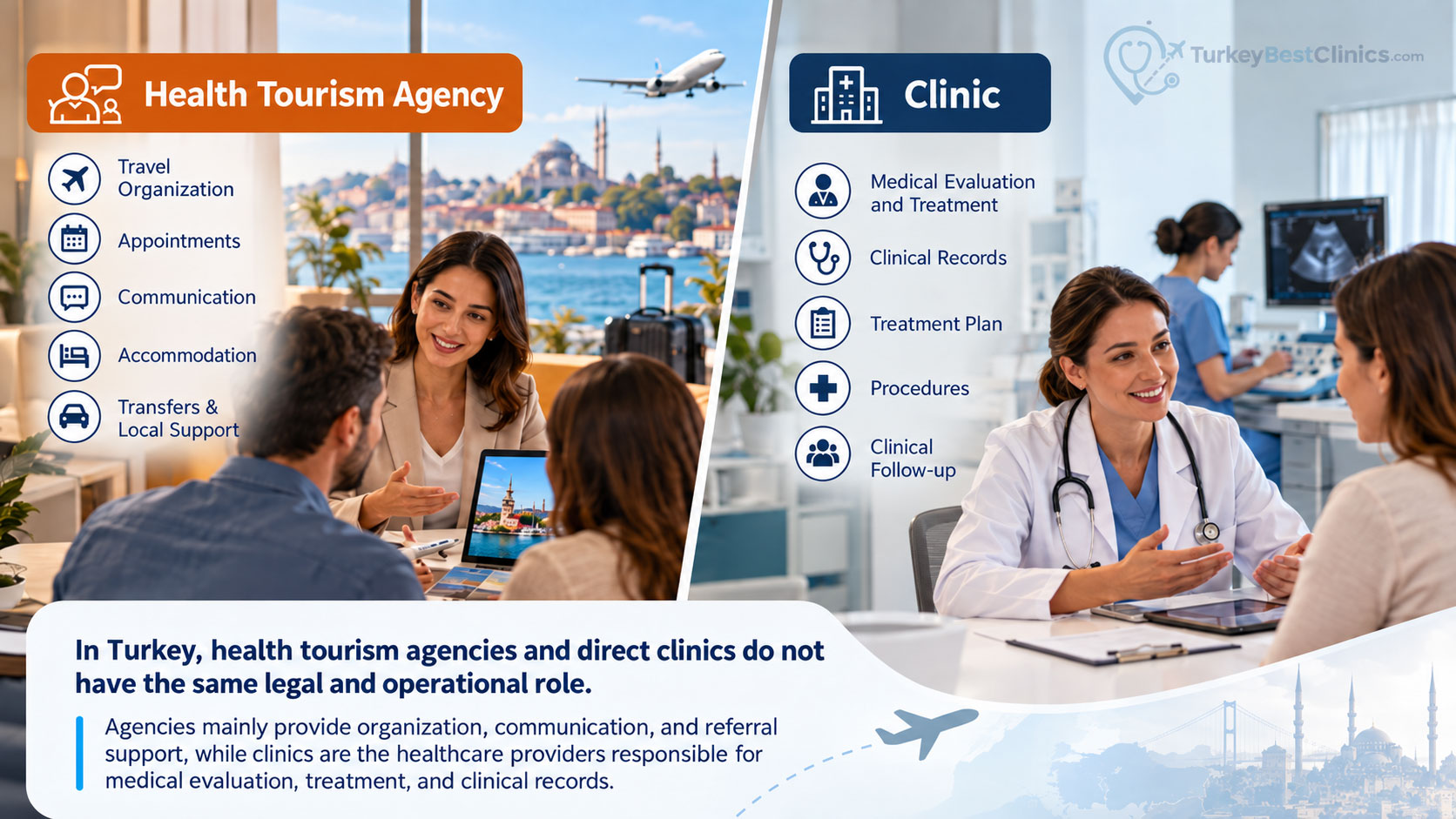
Short answer: A health tourism agency or intermediary organization generally manages the organization and communication of applications from abroad and coordinates with the healthcare provider; a direct clinic is the organization responsible for medical assessment and the delivery of healthcare services. Even when both structures operate within the same company, their authority, responsibilities, and positions in the documents you sign may differ.
This distinction cannot be understood simply by looking at how the business describes itself. Authorization documents, contracts, invoicing arrangements, who makes medical decisions, and which party is responsible for which service in the event of a complaint should all be examined together. The information below is provided for general informational purposes; specific circumstances should be assessed separately based on current regulations, the documents of the relevant organization, and the contract you sign.
How do the legal roles of an agency and a clinic differ?
In most cases, a health tourism agency does not provide the healthcare service itself. It may handle international communications, assist in finding a suitable healthcare provider or doctor, and organize non-medical or healthcare-support services such as interpretation, transfers, accommodation, and appointment coordination. The agency’s responsibilities may vary depending on the scope of the contract, so read carefully which services are included in the offer sent to you.
A direct clinic, hospital, or medical center, on the other hand, carries out the core healthcare services, including examinations, tests, medical assessments, treatments, surgery, follow-up care, and clinical records. Medical decisions should be made not by the agency but by authorized healthcare professionals working at the relevant healthcare organization. An agency may convey a recommendation or preliminary assessment, but it should not replace the clinic or doctor in matters concerning diagnosis, treatment selection, medical necessity, or complication management.
In Turkey, intermediary organizations and healthcare facilities operating within health tourism may be subject to different authorization and regulatory frameworks. An agency’s authorization to provide services in the field of health tourism does not, by itself, mean that it is authorized to perform medical treatment. Likewise, a clinic’s authorization to provide healthcare services does not always mean that it organizes transfers, accommodation, or international patient services in its own name.
What question does an authorization document answer?
An authorization document may show that the business is recognized under the relevant legislation to carry out a specific activity; however, it does not by itself prove the quality of treatment, the experience of a particular doctor, or the outcome promised to you. Therefore, when you see such a document, do not look only at whether it exists. Check which organization it was issued to and which activity it relates to.
- Check through relevant official sources whether the intermediary organization is authorized to operate in the field of health tourism.
- Ask the clinic or hospital to provide its identity and licensing information as an organization authorized to provide healthcare services.
- Check whether the document belongs to the same legal entity as the company you are communicating with.
- Do not treat documents issued in the name of a clinic, doctor, or hospital used by an agency as if they were the agency’s own authorization.
How should the parties’ responsibilities appear in the contract?
The most important distinction appears in the contracts and payment documents sent to you. You may sign a separate organization agreement with the agency, and a healthcare services agreement or treatment consent documents with the clinic. Sometimes one company offers multiple services as a package; in that case, it should be clearly stated in writing which legal entity provides each service.
In the offer document, check the company’s full legal trade name, address, how its tax or registration details can be verified, the scope of services, and the items included in the total fee. Disputes may arise later if the clinic fee, agency service fee, interpretation, transfers, accommodation, tests, anesthesia, medication, companion, and follow-up services are not itemized separately.
Also check whether the account to which you make payment belongs to the same party named in the contract. A payment made to an agency and a payment made directly to a clinic may not have the same implications for refunds and invoicing. Request the applicable conditions for deposits, cancellations, date changes, medically necessary postponement of treatment, additional procedures, complications, revisions, and unused services in writing.
Medical responsibility and organizational responsibility
Decisions made during a medical procedure, the performance of the procedure, clinical follow-up, and medical records are generally connected with the healthcare organization and healthcare professionals who perform the procedure. By contrast, issues such as a failed airport transfer, an error in an accommodation reservation, failure to provide an interpreter, or incorrect transmission of appointment details generally concern organizational services.
This distinction does not automatically lead to the same result in every case. The way the agency markets the healthcare service, the responsibilities it undertakes in the contract, the extent to which it selects the clinic or manages the medical process, and the specific circumstances of the case are all important. If a problem occurs, keep the offers, messages, invoices, consent forms, and clinical records instead of relying only on verbal discussions.
Documents to check before traveling to Turkey
Before making a decision, try to collect the following documents in the same written file. Consistency between the company names used in the documents and clarity about who provides the medical service may make it easier to assert your rights.
- Organization details: The agency’s and clinic’s full legal trade names, physical addresses, and official communication channels.
- Authorization details: Verification through official channels of the relevant authorization information belonging to the health tourism intermediary organization or healthcare facility.
- Treatment plan: Confirmation that the medical assessment will be performed in person, identification of the doctor who will make the recommendation, and clarification that a preliminary consultation does not constitute a final decision.
- Fee breakdown: How the clinic service and intermediary service are priced, separately or together, and which items are not included.
- Consent and information: The risks, alternatives, expected follow-up, communication method, and scope of interpretation support.
- Data processing information: Information about which organizations your medical reports may be shared with, for what purposes, and for how long.
- Complaint channel: How to contact the clinic regarding medical matters, the agency regarding organizational matters, and the relevant official institutions when necessary.
What should applicants from abroad pay closer attention to?
An online review of photographs or medical reports does not always replace an in-person examination and the necessary tests. If you are promised a definite result, a risk-free procedure, an unchanging price, or free corrective treatment in every situation, ask in writing about the scope and exceptions of these statements.
An agency’s social media account, a communication channel that appears to be operated on behalf of a clinic, or promotional material prepared in a foreign language is not, by itself, proof of official authorization. Independently verify the clinic and doctor details and, where possible, direct your medical questions to the healthcare team that will perform the procedure.
If you have difficulty understanding the documents because you do not speak Turkish, ask for an explanation before signing and, if necessary, request translation support in a language you understand. It is important to determine whether the translation is adequate not only during sales discussions but also for consent, fees, risks, follow-up, and complaint documents.
Steps to take in the event of a dispute or safety concern
First, determine whether the issue concerns a medical matter, an organizational matter, a financial matter, or data sharing. In a medical emergency, your priority is to access emergency healthcare services where you are; a contract or complaint process does not replace medical assistance.
Afterward, submit a written application to the relevant clinic or agency, clearly stating the date of the incident, your request, and the documents you have. Keep responses, payment records, travel documents, medical reports, and messages. The current application channels of official health authorities in Turkey and other relevant institutions should be checked separately according to the nature of the case; verify official contact details only through authorized sources.
In such processes, you should not assume that a definite refund, automatic compensation, or a specific outcome is guaranteed. The assessment may depend on the contract terms, who actually provided the service, the relevant records and documents, current regulations, and the details of the incident. When necessary, seek advice from an independent legal or healthcare services adviser.
How can you use this distinction when making a decision?
The safest approach is not to view the agency as the provider of the healthcare service or the clinic as merely a provider of accommodation and transfers. Separate the services undertaken by each party in writing; clarify before the procedure who will make the medical decision, to whom you will make payment, and which channel you should use if a problem occurs.
Considering the authorization document, clear contract, understandable fee breakdown, direct medical communication, and accessible complaint channel together can help you make a more informed choice. If the documents are inconsistent or important questions receive only vague verbal answers, postponing your decision and requesting independent verification is a reasonable safety measure.
Related health tourism questions
- How can the health tourism authorization of a healthcare organization in Turkey be verified?
- What fees and refund conditions should be included in a health tourism service contract?
- Which records should I keep if I experience a medical or organizational problem during treatment in Turkey?