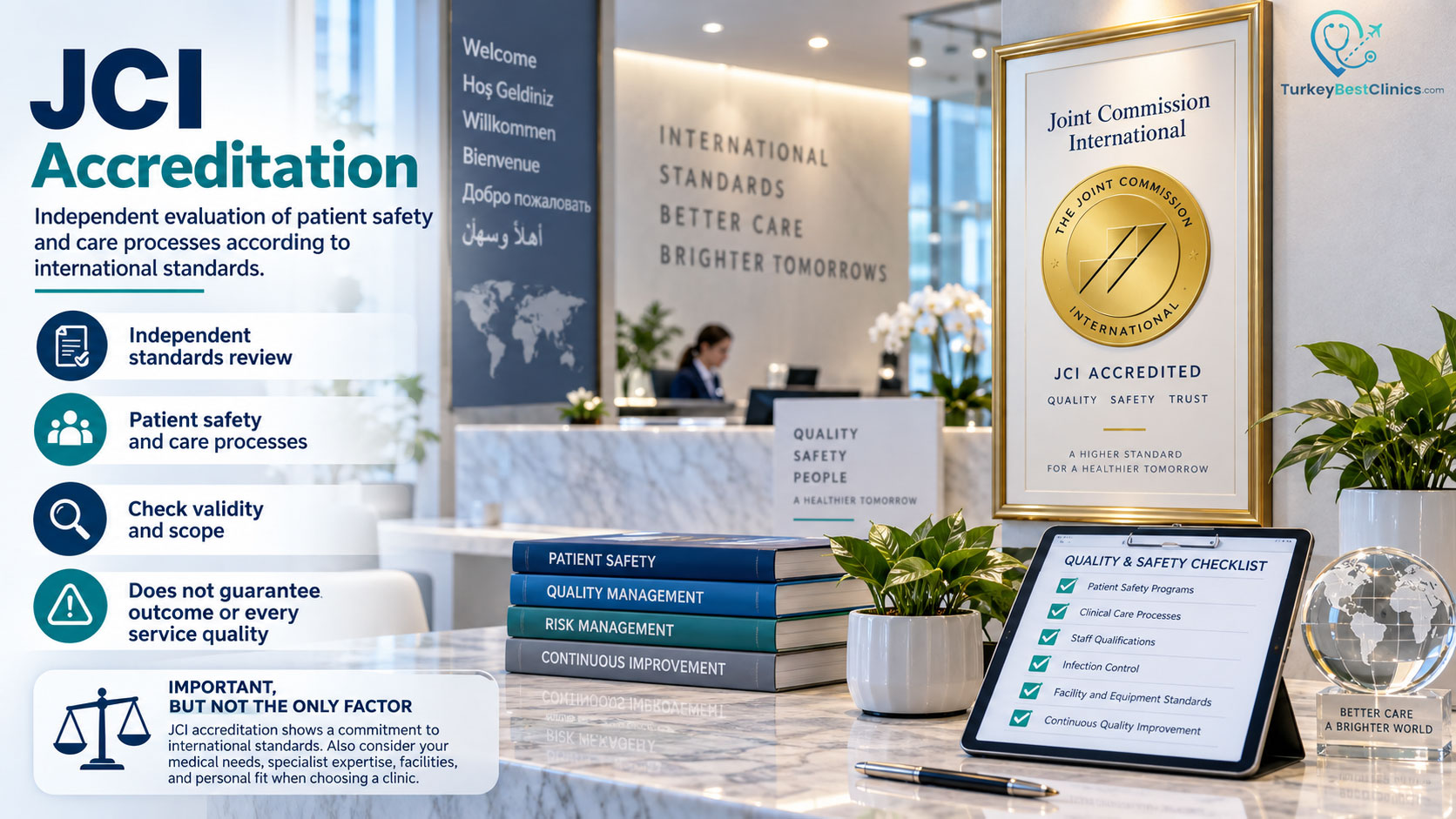
Choosing a hospital with JCI accreditation means that the organization has been evaluated against international criteria in areas such as patient safety, clinical processes, infection control, medication management, and organizational governance. This accreditation is an important indicator that the hospital has been assessed against specific standards; however, it does not guarantee a successful treatment outcome, a complication-free process, or an automatic assurance of quality in your individual case.
When making a healthcare tourism decision in Turkey, it is safer to assess JCI accreditation alongside the doctor’s experience in the relevant field, whether the planned procedure is actually offered at the hospital, the written medical and financial plan, available communication services, and the arrangements for follow-up after discharge.
What assurance does JCI accreditation provide when choosing a hospital?
Joint Commission International is an independent accreditation organization that evaluates healthcare organizations against specific international standards for patient safety and quality of care. The assessment does not focus only on the presence of the hospital building or medical equipment; it also covers how care is planned, how records are maintained, how risks are managed, and the extent to which teams follow safe working procedures.
JCI accreditation indicates that the organization has sought to meet certain criteria during the assessment process and that these criteria have been examined through an independent review. Nevertheless, you should always check which campus, department, or service area the accreditation covers. Accreditation held by one branch of a hospital group may not automatically apply to another branch of the same brand or to a different medical center.
Key processes that accreditation may cover
- Patient identification: Checks designed to ensure that the right person is matched with the right service before a procedure, medication, or diagnostic test.
- Communication and transfer of records: The complete and understandable transfer of medical information between members of the care team.
- Medication safety: Processes for storing and administering medications, recording allergy information, and preventing potential errors.
- Infection control: Monitoring hand hygiene, sterilization, isolation, and infection risks.
- Surgical or interventional procedure safety: Practices such as pre-procedure verification and confirmation of the correct site and procedure.
- Staff competence: Monitoring the training, authorization, and performance processes of doctors and healthcare professionals in relation to their duties.
- Patient rights and information: Addressing consent, privacy, complaints, interpretation, and access to health information through institutional processes.
How JCI standards affect everyday care
From your perspective, the most meaningful aspect of accreditation is that healthcare is not viewed as consisting solely of a medical procedure. Risks are expected to be identified at different stages, from the first communication through post-discharge recommendations, while information is documented and responsibilities are clearly defined.
For example, if surgery is planned, the preoperative assessment, documentation of allergies and existing medical conditions, clear consent procedures, postoperative monitoring, and discharge instructions are all important. The presence of these processes does not mean that you will not experience a complication in your particular situation; however, it may indicate that an institutional framework exists for addressing risks systematically.
The JCI approach also encourages healthcare organizations to monitor incidents and near misses and to develop corrective measures when necessary. If you experience a problem, you can request information not only about an individual explanation but also about the organization’s complaint-handling and incident-review mechanisms.
Checklist for verifying JCI accreditation
The presence of a JCI reference on an organization’s website or promotional materials does not mean that the verification process is complete. Before making a decision, check the following points in writing:
- Check the exact name of the organization: Ask which legal entity and physical address the accreditation applies to.
- Request validity and current-status information: Ask the organization when the accreditation was issued and whether it is currently valid; try to confirm the current information through JCI’s official channels.
- Clarify the scope: Ask in writing whether the accreditation covers the entire hospital, a specific service area, or a particular program.
- Distinguish it from the doctor’s qualifications: JCI accreditation concerns the hospital’s institutional processes. It does not show that a particular doctor will achieve the same result in every procedure or has equal experience in every specialty.
- Confirm the planned procedure: Find out whether the diagnosis, procedure, anesthesia, intensive care, rehabilitation, or follow-up you require is available at the relevant campus.
- Understand the consent documents: Ask for the medical consent form, financial quotation, and terms for additional services to be explained in a language you understand. Do not sign sections you do not understand.
- Ask about the communication plan: If you do not speak Turkish, find out in advance at which stages an interpreter or multilingual coordination support will be available, whether it is chargeable, and how medical interpreting will be provided.
- Obtain discharge and follow-up arrangements in writing: Clarify follow-up appointments, how reports will be shared, which channel to use in an emergency, and how communication will continue after you return to your country.
- Review data use: Check the organization’s privacy and information notices to understand the purposes for which your medical records, images, and passport details will be processed and with whom they may be shared.
What does the JCI logo not prove on its own?
JCI accreditation is a framework for assessing an organization’s compliance with certain quality and safety standards; it is not a document that guarantees all medical outcomes in advance. Treatment success may vary depending on your initial health status, the nature of the procedure, the doctor’s assessment, the method used, the recovery process, and adherence to recommendations.
The accreditation also does not show that the price is fair, that the package includes all costs, that every complication will be managed free of charge, or that you will automatically receive a refund if you are dissatisfied. Payment, cancellation, revision, additional procedure, accommodation, transfer, and interpretation terms are separate from accreditation. Review these matters through a written contract and a detailed financial quotation.
Accreditation does not determine whether a doctor is medically suitable for you. During your consultation, provide complete information about your health, medications, allergies, previous procedures, and expectations. It is not appropriate to make a decision based solely on an accreditation logo without an assessment of your suitability.
What you should not overlook before making a decision
If you cannot verify that the accreditation is current and applies to the relevant organization, do not treat it as an absolute guarantee of quality. Ask the organization for information explaining the certificate’s scope, validity, and applicable campus; verify any points of concern through JCI’s official sources and the current channels of the relevant health authorities in Turkey.
If you experience a problem, you can first request a written explanation from the organization’s patient relations or complaints department. Official complaint options may vary depending on your location, the nature of the service, the contract, and applicable regulations. For a specific situation, it may therefore be necessary to seek information from the relevant authority or an independent legal professional.
Related questions about JCI accreditation
- How can I verify the JCI accreditation of the hospital I have chosen in Turkey?
- What is the difference between JCI accreditation and a doctor’s specialty and experience?
- Which terms should I check before signing a treatment contract for medical tourism?