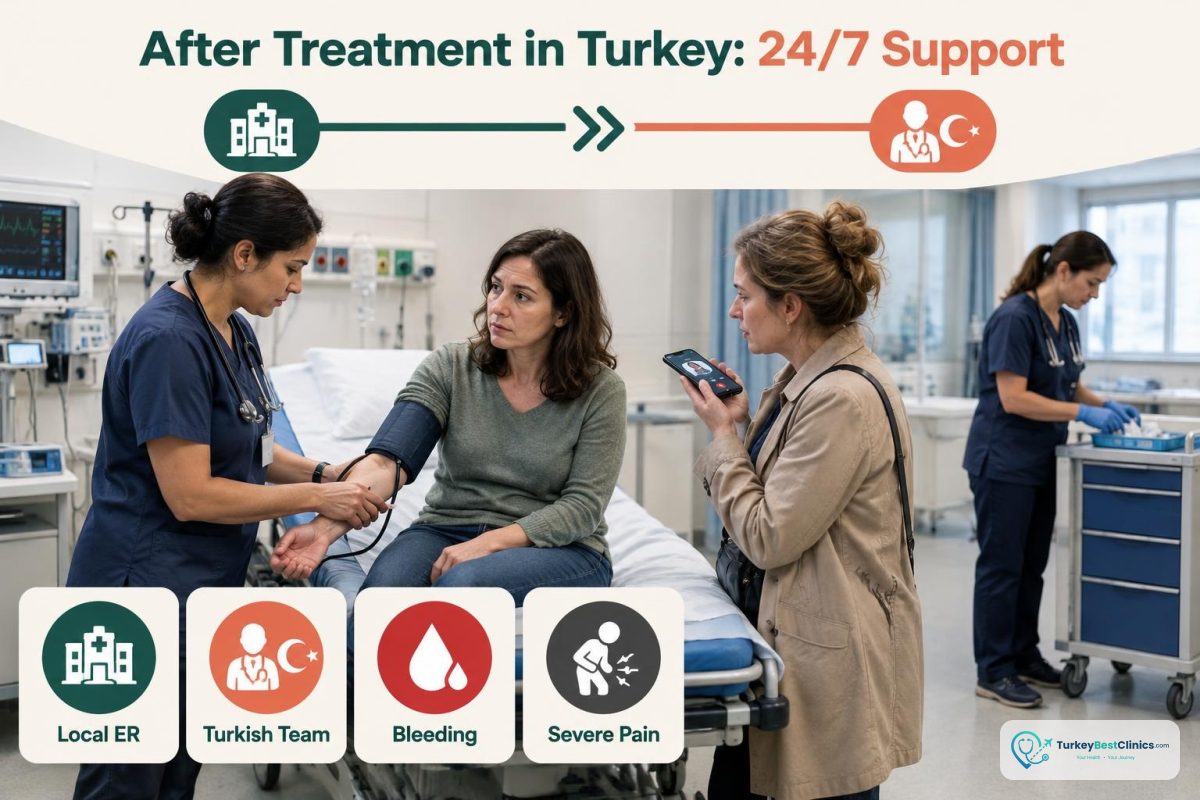
Emergency Support Framework After Returning to Your Country
Bleeding, signs of infection, or pain that develop after you return abroad may not be conditions that can be safely managed through remote communication alone. The team in Turkey will usually try to determine the next safe step by assessing when the symptoms began, their severity, the procedure performed, any available medical reports, and the products or medications you are using.
This assessment does not replace a medical examination. Especially after gynecological, childbirth-related, breast, aesthetic, or other surgical procedures, a physical examination, blood tests, ultrasound, or other imaging may be required at a local healthcare facility.
Priority: Local Emergency Medical Services
- Call your local emergency number if you have uncontrolled or rapidly increasing bleeding.
- Seek emergency care if you experience fainting, significant dizziness, cold sweats, palpitations, shortness of breath, or confusion.
- Request medical evaluation on the same day if you have a high fever, chills, foul-smelling discharge, or rapidly increasing swelling or redness.
- Do not monitor severe or worsening pain, especially abdominal or pelvic pain, through remote messaging alone.
Provide local emergency teams with the date and type of your procedure and the contact details of the clinic in Turkey. If possible, have someone accompany you. If you are alone, clearly share your address and location with emergency service personnel.
The Actual Scope of a 24/7 Communication Line
The phrase “24/7 emergency communication line” does not always mean that a physical emergency team will be sent from Turkey to your country. In practice, the line may cover initial contact by telephone, secure messaging, video consultation, or an on-call coordinator; triage of the emergency; and referral to an appropriate healthcare facility.
When assessing the scope of the service, review not only the advertising copy but also the treatment and medical tourism documents you sign. The documents should explain in writing the hours during which the service is active, whether support is available in Turkish or other languages, how response times are defined, and who is on duty at weekends or on public holidays.
What Information Is Collected During the Initial Consultation?
- Your name, date of birth, and the country or city where you are located
- The name and date of the procedure performed in Turkey
- When the bleeding, fever, discharge, swelling, or pain began
- Whether the symptom is worsening and whether it affects your daily activities
- Any temperature, blood pressure, pulse, or similar observations, if available
- Your discharge summary, procedure note, laboratory results, and imaging records
- Whether you have visited a local healthcare facility and any documents provided there
If you are asked to share photographs or videos, ask whether they will be sent through a secure channel and who will have access to them. Before signing consent forms for the transfer, storage, or sharing of your personal health data with healthcare providers abroad, clarify anything you do not understand.
Emergency Plans for Bleeding, Infection, and Pain
A standard emergency plan progresses in stages according to the urgency of the symptom. Rather than making a definitive diagnosis remotely, the team in Turkey may classify the symptoms and refer you for a local examination. The final assessment must be made by an authorized healthcare professional in the country where you are located.
In Case of Bleeding
Light spotting is not assessed in the same way as rapidly increasing bleeding. The amount of bleeding, whether clots are present, whether dizziness or weakness accompanies it, and the type of procedure performed are important. If the bleeding increases, large clots appear, or your general condition deteriorates, seek care at a local emergency department without waiting for emergency assistance.
The team in Turkey may help you share your procedure reports with a local doctor. Because the source and cause of bleeding cannot be determined without an examination, it is not appropriate to provide definitive remote reassurance that it is “normal.”
When There Are Signs of Infection
Fever, chills, foul-smelling discharge, redness spreading around a wound, increased warmth, pus-like discharge, or a progressively worsening general condition may require assessment for infection. If these signs are present, visit a local healthcare facility for an examination and any necessary tests.
The team in Turkey may communicate with the doctor reviewing the reports requested by the local healthcare professional. Medication or treatment recommendations should not be finalized remotely without assessing the examination findings and medical records.
In Case of Pain and Loss of Function
There is a difference between expected post-procedure pain and pain that is progressively worsening, newly developing, or preventing normal movement. Emergency assessment is required if the pain is accompanied by fever, heavy bleeding, abdominal rigidity, inability to urinate, fainting, or shortness of breath.
Tell the team in Turkey where the pain is located, how severe it is, when it began, and whether it changes with movement. Do not make decisions about prescriptions or medication changes based solely on remote messages; coordinate with a doctor in your country and the team that performed the procedure.
Practical Checklist: What Should You Request Before Returning?
- Obtain the 24/7 line’s telephone number, alternative communication channel, and on-call contact in writing.
- Clarify the order in which you should contact local healthcare services and the team in Turkey in an emergency.
- Keep your procedure report, discharge summary, test results, and imaging records in both digital and printed formats.
- Ask which language the documents will be prepared in and how professional translation support will be provided if necessary.
- Obtain written confirmation of how the doctor in Turkey will communicate with a local hospital if you seek care there.
- Check the coverage for emergency examinations, hospital admission, ambulance services, interpretation, additional procedures, and travel changes under your insurance policy and clinic contract.
- Find out whether follow-up examinations will take place online, at a local healthcare facility, or by requiring you to return to Turkey.
- Review the data protection and consent documents explaining with whom and for what purposes your health records will be shared.
Online Follow-Up and Coordination with a Local Doctor
After returning to your country, online follow-up usually involves regularly sharing the progression of symptoms, the results of local examinations, and the course of recovery. The frequency and scope of these consultations may vary according to the type of procedure, current findings, and clinical protocol; a fixed schedule should not be assumed in advance.
Your explicit consent may be required for information to be exchanged between the local doctor and the team in Turkey. Since you may need to send the reports yourself, it is useful to request them in PDF or another format accepted by the clinic. If there is a language barrier, make sure the interpreter conveys the medical information completely and accurately.
Important Limitations and Patient Rights
No communication line replaces a physical examination or local emergency care. A clinic’s reference to “24/7 support” does not automatically guarantee a particular outcome, free treatment of a complication, or coverage of all expenses.
Payment, refunds, revision procedures, additional surgery, extended accommodation, and travel expenses may depend on applicable regulations, the contract you signed, the clinic’s policy, and the specific medical circumstances. Request written confirmation rather than relying on verbal explanations, and seek advice from an independent legal or insurance adviser when necessary.
Verify through the relevant official channels whether the organization in Turkey is authorized to provide healthcare services for medical tourism. Accreditation or a quality certificate does not mean that every complication will be prevented or that an individual treatment outcome is guaranteed; the certificate’s scope and validity should also be reviewed.
Related Questions You May Have After Reading This
- In what format should I request my procedure reports and discharge documents from the clinic in Turkey?
- How is communication between a local hospital and the doctor in Turkey documented when a complication develops abroad?
- How can emergency care, additional treatment, and travel expenses be checked in a medical tourism contract?