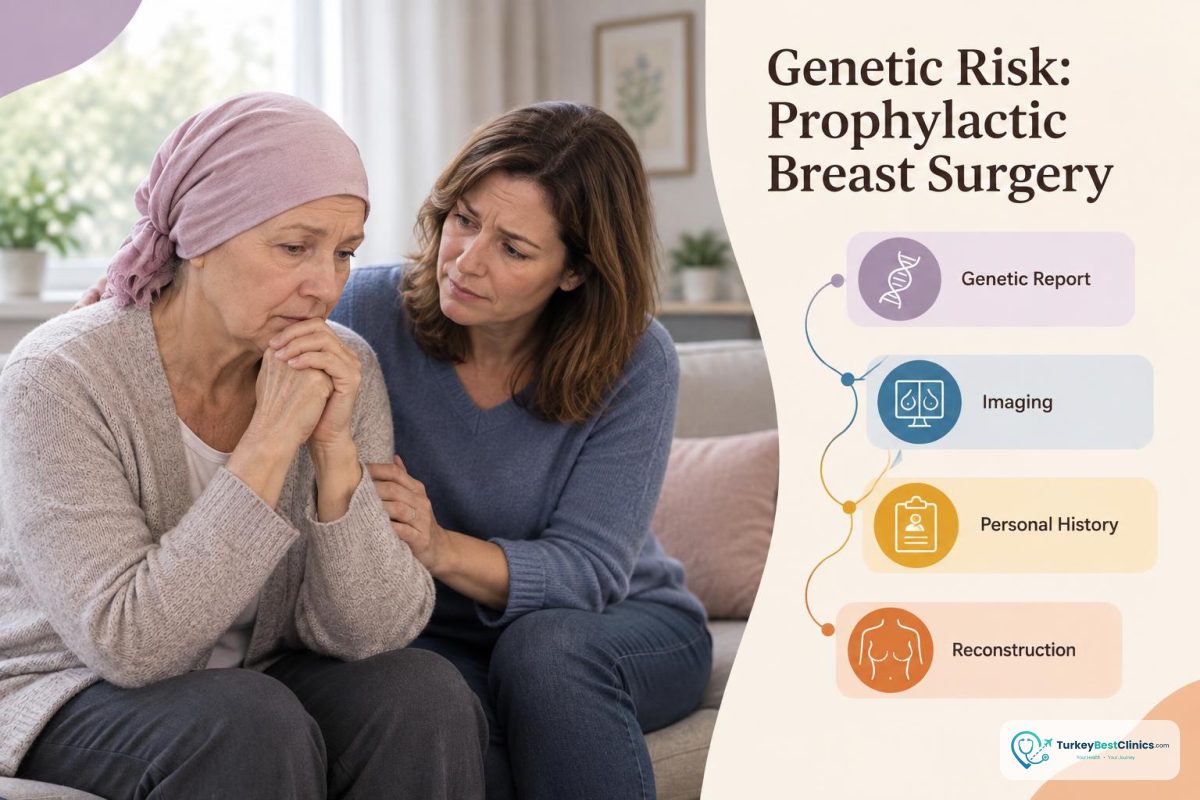
What is the aim of preventive breast surgery for genetic risk?
A family history of breast or ovarian cancer, particularly when a pathogenic gene alteration has been identified, may indicate that your lifetime risk of breast cancer is higher than that of the general population. Unlike treating a diagnosed cancerous tumor, prophylactic or risk-reducing bilateral mastectomy aims to reduce the risk in breast tissue where cancer has not yet developed.
Remote assessment does not mean that surgery is automatically recommended. First, the clinical significance of the genetic finding, your existing breast imaging results, age, childbirth and breastfeeding history, previous biopsies, and expectations regarding reconstruction are considered together.
The aim is not simply to choose surgery, but to compare the benefits and limitations of risk-reducing surgery, close imaging surveillance, or both options in a clear way based on your individual circumstances.
Safety framework for BRCA and breast surgery in Turkey
In Turkey, surgical planning should take place at facilities holding a Health Tourism Authorization Certificate issued by the Ministry of Health and supported by a fully equipped hospital infrastructure with operating rooms, intensive care, radiology, pathology, and plastic surgery services. It is important to verify in writing that the facility's authorization is current and confirm the scope of the hospital where the surgery will be performed.
Genetic risk management requires joint evaluation by breast surgery, medical genetics, radiology, pathology, medical oncology, and, when necessary, plastic and reconstructive surgery specialists. When assessing Turkish surgeons' experience in breast-conserving and risk-reducing surgery, do not rely only on the phrase “experienced team.” Look for specific experience with nipple-sparing or skin-sparing mastectomy, the need for sentinel lymph node assessment, implant-based or autologous tissue reconstruction, and revision surgery.
A personalized surgical decision should not be made solely during a video consultation. The full genetic report, breast MRI or mammography reports, imaging discs, biopsy and pathology documents if available, previous operative notes, and current medical history should be reviewed by the multidisciplinary surgical board.
Remote assessment and companion planning for a prophylactic mastectomy package
Organizational services may include VIP airport-to-hospital transfers, accommodation, interpreter support, and the logistical guidance required during the initial care period; the scope and limitations should be specified in the written quotation. Before traveling to Turkey, an online surgical consultation, genetic counseling, and preliminary review of imaging documents are conducted. Final surgical eligibility is determined only after an in-person examination and the necessary hospital tests.
It can be planned in advance whether your companion may stay with you in the hospital, what rules apply to the selected ward, and whether your hotel is within walking distance or a short transfer from the hospital. In line with your postoperative movement restrictions, quiet park walks near the hospital, wellness areas, or low-intensity relaxation options may be arranged for your companion. Long excursions and crowded environments should be avoided during the first few days.
Essential documents required for remote file review
- The complete genetic test report, including the gene alteration, variant classification, and laboratory interpretation.
- Your most recent breast MRI, mammography, and ultrasound reports, along with DICOM images where possible.
- Needle biopsy results, pathology reports, immunohistochemistry results, and previous surgical records, if available.
- A summary of breast, ovarian, prostate, or pancreatic cancer in your family tree, including approximate ages at diagnosis.
- Previous surgeries, chronic conditions, allergies, smoking status, and previous anesthesia experiences.
In-person process protocol in Turkey
After arrival, a breast examination, anesthesia assessment, blood tests, and, if necessary, new imaging are scheduled. If the genetic report contains uncertainty, reinterpretation of the variant or additional genetic counseling may be recommended; directing a patient toward surgery based solely on family history is not appropriate.
Depending on the extent of surgery and the reconstruction method, you may need to stay in the hospital for approximately 2 to 5 nights; this is not a guaranteed timeframe. Before discharge, written information about wound care, drain monitoring, arm movements, the follow-up date, and signs requiring urgent medical attention is provided to you and your companion.
After returning to your home country, follow-up may continue through online consultations, secure review of wound photographs, explanation of the pathology results, and coordination with your local physician. Online follow-up does not replace an in-person examination. If you develop a fever, rapidly increasing swelling, shortness of breath, uncontrolled pain, or wound separation, you should contact emergency medical services in the country where you are located.
Comparison of the two surgical approaches for your situation
- Skin-sparing mastectomy with implant-based reconstruction: The breast tissue is removed while most of the breast skin is preserved. In suitable anatomy, this may allow for a shorter and staged reconstruction plan. Hospitalization is commonly approximately 2–4 nights, while recovery time varies according to the implant, tissue expander, and surgical findings.
- Nipple-sparing mastectomy with implant-based or autologous tissue reconstruction: The nipple-areola complex may be preserved when the risk profile and anatomy are suitable. However, blood supply, skin thickness, breast ptosis, and any suspicion of cancer must be assessed in detail. With autologous tissue reconstruction, recovery may take longer and a second surgical site is created in the abdomen or back.
The suitability of either approach is not determined by the genetic result alone. Breast volume, degree of ptosis, skin and nipple blood supply, previous surgeries, history of radiotherapy, body structure, and aesthetic expectations all influence the decision.
Cost of prophylactic breast surgery in Turkey and country comparison
The total package cost for bilateral risk-reducing mastectomy and implant-based reconstruction in Turkey may range from approximately €12,000–€22,000. This range varies according to the scope of surgery, implant or tissue selection, single-stage or staged reconstruction, hospital stay, pathology, and the extent of follow-up after returning home.
- Turkey: Approximately €12,000–€22,000; the surgical, hospital, reconstruction, and logistical inclusions vary between quotations.
- United Kingdom: Approximately £18,000–£35,000; private healthcare fees, the reconstruction method, and hospital charges determine the total.
- Germany: Approximately €18,000–€30,000; surgeon, hospital, implant, and follow-up costs may be priced separately.
- United States: Approximately $30,000–$60,000 or more; insurance coverage, the surgeon, and the hospital network can make a substantial difference.
These figures are indicative international ranges. Genetic counseling, additional MRI, pathology review, possible revision surgery, travel, companion expenses, and follow-up costs in your home country may not be included in the package. Ask for every item to be identified in the written quotation as included, excluded, or subject to conditions.
Factors that affect the cost and process of a genetic surgery plan
- The physician's expertise and experience: It is important to consider the surgeon's specific experience in managing breast surgery and plastic reconstruction within the same plan, including nipple-sparing mastectomy, skin-preserving techniques, and the management of complications or revision surgery.
- Technology, techniques, and materials: Implant-based reconstruction, tissue expanders, silicone implants, fat grafting, a DIEP flap using abdominal tissue, or a latissimus dorsi flap using back tissue can affect both the cost and recovery time.
- Clinic and hospital location: Internationally well-connected centers such as Istanbul may offer broader logistical options; however, the distance between the hospital, hotel, and transfer points affects the total cost. Proximity to a tourist area is not, by itself, an indicator of medical quality.
Three rational steps after remote assessment
- Is the variant in my genetic report truly high risk? How does the difference between a pathogenic variant in BRCA1, BRCA2, PALB2, or another gene and a variant of uncertain significance affect my surgical decision?
- Could nipple-sparing mastectomy be suitable for my anatomy? How would nipple blood supply, breast ptosis, imaging findings, and the reconstruction option change the surgical plan?
- How will reconstruction and genetic follow-up continue after I return from Turkey? How will the pathology result, drain removal, online check-ups, and communication with a breast surgeon in my home country be coordinated if needed?
To make remote assessment safer, share your complete genetic report and imaging documents. Base the surgical decision not only on an initial online consultation, but also on an in-person examination, multidisciplinary evaluation, and a clear discussion of risks and benefits.