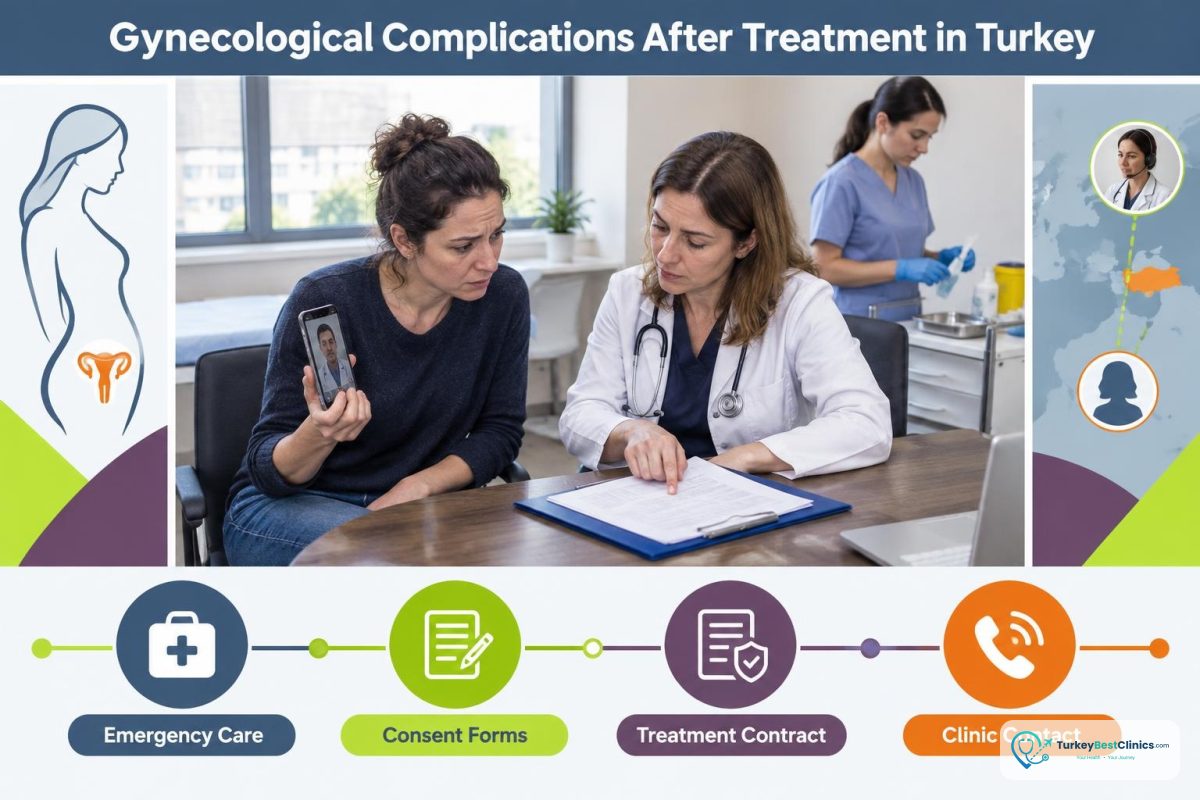
Basic liability framework after returning home following a gynecological complication
If symptoms such as bleeding, infection, severe pain, inability to urinate, fever, shortness of breath, or fainting occur after gynecological surgery or a procedure in Turkey, your first priority should be obtaining an emergency medical assessment in the country where you are located—not discussing legal liability. These symptoms can develop for different reasons after laparoscopy, hysteroscopy, uterine or ovarian surgery, vaginal surgery, and fertility treatments.
The occurrence of a complication alone does not mean that the doctor or clinic was negligent. Liability is determined by considering together whether the expected risks were explained to you, whether accepted medical standards were followed during the procedure, whether discharge instructions were provided, and whether reasonable follow-up was made available after the procedure.
Returning to your home country does not automatically end the healthcare provider’s responsibilities in Turkey; however, the local emergency care team must also provide any necessary medical intervention without delay. Which party is responsible for which damage is assessed based on the specific medical records and contractual provisions.
Gynecological safety and follow-up responsibilities in Turkey
Health Tourism Authorization Certificate and the treatment process
When receiving healthcare services in Turkey under medical tourism arrangements, choosing providers holding a Health Tourism Authorization Certificate issued by the Ministry of Health shows that the institution is authorized to provide international healthcare services and is subject to certain administrative standards. This certificate alone does not guarantee that complications will not occur or automatically create an entitlement to compensation.
When investigating a gynecological complication, the operative report, anesthesia record, pathology result, ultrasound or CT images, laboratory results, discharge summary, and follow-up plan are important. The Turkish obstetrician-gynecologist’s experience with laparoscopic suturing, hysteroscopic procedures, pelvic surgery, or the management of postoperative bleeding should be assessed not merely through the phrase experienced team, but through the type of procedure performed and the documented scope of cases.
Four separate areas in assessing liability
- Medical complication: It is assessed whether bleeding, infection, organ injury, or anesthesia-related problems are known risks associated with the procedure.
- Standard of care: The examination, tests, surgical technique, sterilization, medication management, and discharge process are reviewed for compliance with accepted practices.
- Informed consent: It is important to determine whether the risks, alternatives, recovery period, and signs requiring emergency care were explained clearly and understandably.
- Follow-up and communication: It is considered whether a contact number for suspected complications, a follow-up plan, remote assessment, and referral to a local healthcare provider when necessary were provided.
Coordination package and return plan after a gynecological complication
As part of medical tourism coordination, VIP transfers, hotel arrangements, interpreter support, and logistical assistance relating to initial care or prescriptions may be planned. The scope of these services should be checked clearly in the written contract and price quotation; logistical support does not mean an assumption of medical liability or a compensation commitment.
The required length of stay in Turkey varies according to the type of gynecological procedure. A brief follow-up may be sufficient after a simple hysteroscopic procedure, while a blood count, ultrasound, wound check, and clinical assessment may be required before discharge after laparoscopic surgery, fibroid surgery, endometriosis surgery, or ovarian surgery. Before flying, bleeding, fever, hemoglobin levels, bowel or urinary function, and pain control should be reassessed.
A companion may plan a quiet, indoor museum visit in Istanbul, a short Bosphorus tour, or a calm gastronomic experience near the hotel on the day of the procedure and during the early recovery period; long walks should be avoided. In Antalya, a short, shaded period of seaside rest may be preferable, while in Izmir, a brief historical route by car may be considered. If you have an open wound, bleeding, or dizziness, activities involving the sea, swimming pools, hot environments, and strenuous sightseeing should be postponed.
Complication assessment and expected costs in Turkey
This issue concerns not the price of a single operation, but the cost of post-procedure medical assessment and liability review. The ranges below are only approximate market indications; emergency treatment, hospitalization, imaging, repeat surgery, legal services, and care costs in your home country may be calculated separately.
| Service or process | Approximate cost in Turkey | Note |
|---|---|---|
| Specialist consultation and basic assessment after a complication | €150–500 | Varies according to the consultation, basic laboratory tests, and clinical opinion |
| Imaging and advanced diagnostic assessment | €150–800 | The scope depends on ultrasound, CT, or other examinations |
| Independent medical record review | €300–1,200 | Varies according to the number of documents and area of expertise |
| Legal liability and case assessment | €500–2,500 | Fees depend on the legal services agreement and the nature of the dispute |
| Country | Approximate range for a similar medical assessment | Currency |
|---|---|---|
| Turkey | €150–1,200 | EUR |
| United Kingdom | £500–2,500 | GBP |
| Germany | €400–2,000 | EUR |
| United States | $1,000–5,000 | USD |
A higher or lower price in Turkey is not, by itself, an indicator of quality or liability. Ask for written clarification in the quotation about whether emergency follow-up, ultrasound, laboratory tests, interpreter services, record delivery, readmission, and possible revision procedures are included.
Criteria affecting a liability claim and the process after returning home
The doctor’s qualifications and procedural experience
The assessment considers the doctor’s specialization in obstetrics and gynecology, experience with procedures such as laparoscopy or hysteroscopy, preoperative risk analysis, and capacity to intervene if a complication develops. Requesting surgical video, the operative report, and details of the technique used is more informative than relying on abstract assurances of expertise.
Method used and medical materials
Depending on the nature of the complication, details such as laparoscopic or open surgery, a hysteroscopic procedure, the use of electrocautery, suture material, hemostatic products, and any intrauterine device used may be reviewed. The choice of method should be considered in relation to anatomical findings, previous surgeries, pregnancy plans, and the circumstances observed during the procedure.
Clinic location and continuity of care
For providers located in medical tourism centers such as Istanbul, Antalya, and Izmir, access to the airport, emergency services, and intensive care facilities; the follow-up plan before you return home; a 24-hour communication channel; and the international patient department’s document-sharing procedure are important. Location alone does not create liability, but it may affect the organization of safe follow-up in the event of a complication.
Documents, contract, and continuing care in your home country
Keep the treatment contract you signed, informed consent form, payment records, travel dates, message records, and written instructions provided to you. Give your doctor at home the date of the procedure performed in Turkey, the method used, and all available reports; record telephone conversations with the Turkish clinic, including their dates and content.
Next step: three critical questions to ask after returning home
- After the laparoscopy or hysteroscopy performed in Turkey, is the symptom an expected sign of recovery or a complication requiring urgent assessment?
- In what format and within what time frame can I request the operative report, pathology report, imaging results, and informed consent documents from the clinic in Turkey?
- Which documents should I use to apply to the clinic, doctor, intermediary organization, or insurance company in Turkey for additional treatment costs incurred at a local healthcare provider?
If you have severe or increasing bleeding, a high fever, unbearable abdominal pain, fainting, shortness of breath, foul-smelling discharge, or an inability to urinate, seek emergency medical care in the country where you are located. After the medical assessment is complete, notify the clinic in Turkey in writing and seek advice from an independent legal professional familiar with the laws of both your country and Turkey regarding any liability claim; this page is not a substitute for legal advice or a medical diagnosis in a specific case.