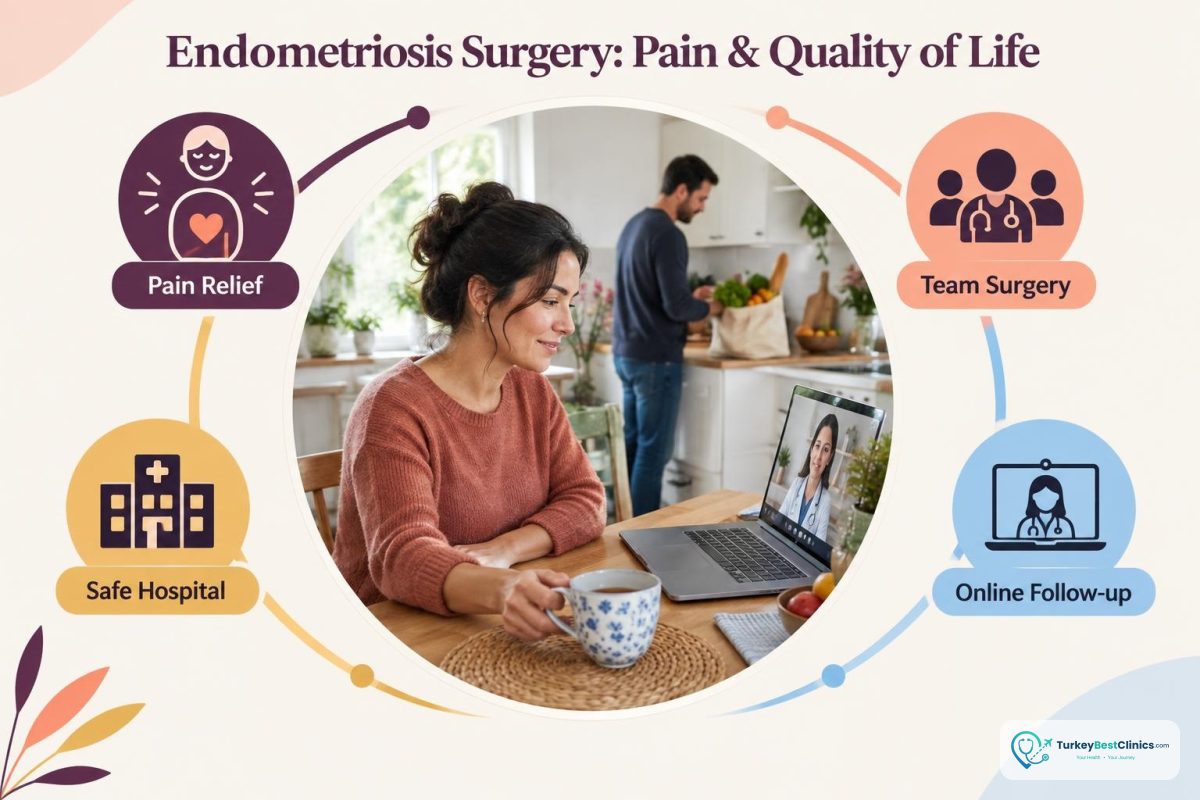
Setting Realistic Expectations for Pain After Advanced Endometriosis Surgery
Advanced endometriosis can cause a complex condition involving deeply located lesions and adhesions around the uterus, ovaries, bowel, bladder, connective tissues, or pelvic nerves. The aim of surgery is not only to remove visible lesions, but also to assess the source of pain in detail, preserve organ function, and reduce symptoms that limit daily life.
Complete disappearance of pain after surgery cannot be guaranteed. Even when deep endometriosis tissue is removed, protective tightening of the pelvic floor muscles, increased sensitivity in the nervous system, coexisting bowel or bladder problems, and the risk of recurrence may affect the recovery process.
For this reason, success is assessed not only by a reduction in pain scores, but also by quality-of-life measures such as the ability to walk, sleep, return to work, engage in sexual activity, and experience bowel and bladder comfort. Expected benefits and symptoms that may continue should be clearly documented before surgery.
When can pain reduction be assessed?
Pain during the first few days is usually related to surgical incisions, tissue healing, and temporary changes in bowel movements; this period alone does not indicate the long-term outcome of endometriosis-related pain. Physical recovery is generally monitored during the first 2-6 weeks, but a more reliable assessment of deep pelvic pain, pain during intercourse, or bowel-related symptoms may take several months.
Recovery may not progress linearly. Pain may increase on some days, which does not by itself mean that the surgery was unsuccessful. The surgical team evaluates symptoms together with a pain diary, physical examination, imaging when necessary, and quality-of-life questionnaires.
Safety and Hospital Standards for Deep Endometriosis Surgery in Turkey
When planning this type of surgery in Turkey, it is important to choose facilities holding a Ministry of Health-approved Health Tourism Authorization Certificate. Performing the procedure in a fully equipped hospital with access to anesthesia, intensive care, radiology, pathology, general surgery, urology, and, when needed, colorectal surgery support is a fundamental part of the safety plan.
Experience in advanced endometriosis surgery should not be measured solely by the number of gynecological laparoscopic procedures performed. The surgeon’s experience with bowel wall or rectovaginal involvement, disease around the ureters, bladder lesions, ovarian endometriomas, dense adhesions, and organ-preserving dissection is particularly important.
Preoperative assessment may include high-resolution pelvic MRI, transvaginal ultrasonography, blood tests, an anesthesia consultation, and a review of existing medical reports. If bowel involvement is suspected, a colorectal surgery consultation may be recommended; for lesions close to the urinary tract, a urology consultation and an appropriate assessment of ovarian reserve may also be considered.
Specific steps followed for surgical safety
- Reassessment of preoperative MRI or specialist ultrasound images by the surgical team.
- Evaluation of anesthesia risk, anemia, clotting status, and coexisting conditions.
- Including general surgery, urology, pain management, and pelvic floor physiotherapy teams in the plan when necessary.
- Examination of tissue removed during surgery in a pathology laboratory.
- Applying hospital protocols for infection prevention, sterilization, thrombosis prevention, and discharge criteria.
When evaluating Turkish physicians’ experience in endometriosis, you can request written information about annual case volume, the proportion of deep endometriosis surgeries involving bowel or urinary system involvement, complication management, and procedures for postoperative re-evaluation.
Endometriosis Surgery Packages and Planning the Process in Turkey
The planned package may include airport-to-hospital transfers, accommodation near the hospital, medical interpreting, and coordination for initial post-discharge care and prescription arrangements; the scope should be clarified in the written offer from the selected healthcare provider. For advanced endometriosis surgery in Turkey, planning commonly covers approximately 7-14 days, including preoperative assessment and postoperative observation; the stay may be longer if bowel or bladder surgery is added.
Before surgery, you should share MRI images, previous laparoscopy reports, pathology results, a summary of treatments received, menstrual and pain diaries, bowel and bladder symptoms, and fertility goals. After discharge, online follow-up may cover wound checks, explanation of pathology results, activity restrictions, fitness to return home, and a plan for contacting a local healthcare provider if unexpected symptoms occur.
Whether your companion can stay with you in the hospital should be confirmed in advance, as this depends on the room type and hospital policy; staying at a hotel close to the hospital can reduce the burden of transportation during the first few days. While you rest, your companion may spend quiet time in the hotel wellness area or take short, non-strenuous walks in a park, in accordance with your surgical restrictions.
Postoperative follow-up schedule
- First 24-72 hours: Pain control, urinary and bowel function, fever, bleeding, and mobility are monitored.
- First 1-2 weeks: Wound healing, daily mobility, and adherence to discharge instructions are assessed.
- 4-8 weeks: Return to work, exercise, sexual activity, and ongoing pelvic pain are reassessed.
- 2-6 months: Changes in endometriosis-related pain, quality of life, menstrual symptoms, and pelvic floor rehabilitation when needed are evaluated.
Cost of Advanced Endometriosis Surgery in Turkey and Country Comparison
In Turkey, the approximate total cost of advanced or deep infiltrating endometriosis surgery may commonly be planned within the range of €6,000-€14,000. This range is an approximate marketing comparison reflecting the scope of surgery, any bowel or urinary system intervention, length of hospital stay, and the need for a multidisciplinary team; it does not replace an individual quotation.
| Country | Approximate surgical cost | General inclusions related to the price |
|---|---|---|
| Turkey | €6,000-€14,000 | Advanced laparoscopic surgery, hospital stay, and basic postoperative checks; inclusions vary by provider. |
| United Kingdom | £12,000-£25,000 | Surgery and hospital stay in private healthcare facilities; additional organ surgery may be charged separately. |
| Germany | €12,000-€25,000 | Advanced surgery covered under private payment; costs vary according to the team and hospital services. |
| United States | $25,000-$60,000 | Hospital, surgeon, anesthesia, and imaging fees may be listed as separate items. |
When comparing quotations, look beyond the total price and check whether MRI assessment, anesthesia, pathology, additional surgical teams, hospital days, interpreting, transfers, and online follow-up consultations are included. Travel, a companion’s expenses, a potentially extended hospital stay, and follow-up costs in your home country may not be included in most packages.
Factors Affecting the Price and Recovery Process of Endometriosis Surgery
Surgeon’s expertise and experience: The price may vary according to the surgeon’s experience with procedures such as deep infiltrating endometriosis surgery, ureteral dissection, bowel shaving, or segmental bowel resection. More complex anatomy may increase the duration of surgery and the number of specialists required.
Technique and surgical scope: Robotic surgery or advanced laparoscopy may offer three-dimensional imaging and precise dissection; however, a robotic approach is not necessary in every anatomical situation. Endometrioma removal, adhesiolysis, excision of deep nodules, intervention on the bowel wall, or use of a ureteral stent may result in different costs and recovery times.
Clinic and hospital location: Hospital prices in Istanbul, Ankara, Izmir, and other healthcare centers may vary according to operating room capacity, access to intensive care, accommodation costs, and multidisciplinary team organization. When choosing a city, consider not only accommodation prices but also rapid access to the relevant specialists if complications occur.
Laparoscopic excision and open surgery
| Options compared for you | Key potential advantage for you | Your recovery and hospital stay |
|---|---|---|
| Advanced laparoscopic excision | Smaller incisions, detailed pelvic visualization, and, when anatomically suitable, faster wound healing | Usually 1-4 days in hospital; return to daily activities in approximately 2-6 weeks, with longer recovery as the scope increases. |
| Open surgery | May facilitate surgical access in cases of extensive adhesions, large lesions, or selected bowel surgeries. | Usually 3-7 days or longer in hospital; physical recovery may take approximately 6-12 weeks. |
The choice of technique is based on MRI findings, previous surgeries, the relationship between lesions and organs, overall health, and the surgeon’s safety assessment. A smaller incision alone does not mean a better result; adequate and safe removal of lesions, preservation of organ function, and balancing the risk of complications are essential.
Questions to Ask and Next Steps Before Applying for Treatment in Turkey
Before requesting a quotation, ask for your medical records to be reviewed by a team experienced in deep endometriosis and for your expectations to be explained in a written plan. The following questions can help make the assessment more concrete and guide you toward more detailed information on related topics:
- Is laparoscopic excision suitable for my anatomy in advanced endometriosis involving the bowel or ureter, and what findings would lead to conversion to open surgery?
- If chronic pelvic pain continues after surgery, in what order will pelvic floor physiotherapy, a pain clinic, and online follow-up be planned?
- How will the effect of endometrioma removal or ovarian surgery on ovarian reserve and fertility plans be assessed?
The most reliable expectation is one that accepts that pain may decrease significantly, but not all pain mechanisms may be eliminated by a single operation. When making a decision in Turkey, compare the authorization certificate, hospital infrastructure, multidisciplinary team, written scope, complication plan, and online follow-up after returning home in the same file.