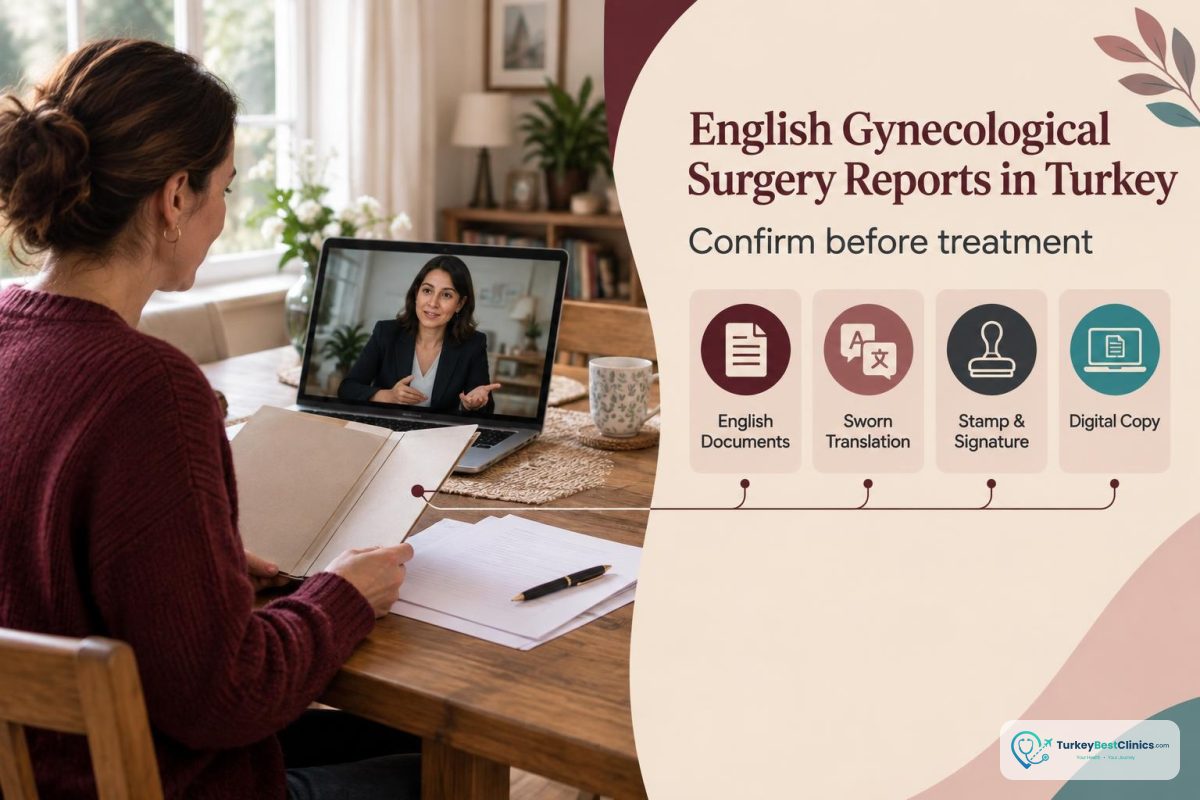
Short answer: It depends. If you undergo gynecological surgery in Turkey, you can request your discharge summary, operative report, and pathology results in English. However, whether the documents will be issued directly in English depends on the hospital, physician, pathology laboratory, and the scope of your medical tourism package. Some institutions prepare documents in English, while others provide an English medical translation in addition to the original Turkish documents.
For your gynecologist in your home country to make a reliable assessment, the best approach is to request signed documents that include the reason for the operation, the method used, tissue samples taken, pathology findings, and discharge recommendations rather than only a brief summary.
What English documentation may include for gynecological surgery
Submit your request for English documents before surgery, preferably while the price quotation and treatment plan are being prepared. Preparing a document directly in English is not the same as translating a Turkish document into English. You should clarify in advance which language the document will be prepared in, whether the original and translated copies will both be provided, and who will carry out the translation.
Key medical documents you may request
- Discharge summary or epikrisis: This may include the reason for admission, initial assessment, procedure performed, hospital stay, condition at discharge, and follow-up recommendations.
- Operative report: This may describe the date of surgery, surgical approach, observations, procedures performed, samples taken, whether any complications occurred, and details of the surgical team.
- Pathology report: This includes the macroscopic and microscopic evaluation of the tissue or material removed, diagnostic findings, and, where necessary, recommendations for additional testing.
- Anesthesia and postoperative records: These may contain information about the anesthesia approach used, important observations during surgery, and the recovery process.
- Laboratory and imaging results: Blood tests, ultrasound, magnetic resonance imaging, or other relevant examinations may be requested in report form and, where possible, with the corresponding image files.
- Discharge and follow-up plan: This may include the timing of follow-up appointments, wound care, physical activity restrictions, and follow-up notes addressed to your doctor in your home country.
Not every document is necessary for every operation. For example, a pathology report may not be issued if no tissue was removed. However, if a biopsy, fibroid, polyp, endometrial tissue, or ovarian tissue was taken, it is important to follow up separately on the pathology document.
The difference between an English document and a medical translation
A report issued directly in English by the hospital is a medical record prepared by the relevant specialist. Translating a Turkish discharge summary or pathology report into English is a separate translation process and should be performed by someone familiar with medical terminology.
Your gynecologist in your home country may also want to see the original document as an official medical record. Therefore, it is safer to keep the Turkish original together with the English version rather than retaining only the translated file. Check whether the English translation is signed, stamped, dated, and linked to the document number.
Points requiring particular attention in pathology reports
Unlike an operative report, a pathology report is based on the assessment of a pathologist. During translation, the meaning of the medical terms must not change. The sample type, the site from which it was taken, measurements, microscopic findings, diagnosis, and any recommendations for additional tests must be conveyed completely.
An English translation does not replace the pathologist’s assessment. If your gynecologist or, when necessary, a pathologist in your home country sees an unclear statement, they may request the original Turkish report, slides, or paraffin blocks. Sending these materials depends on the institution’s procedures, personal data protection requirements, and the healthcare regulations of the relevant country.
Practical checklist for requesting documents
Confirming the following points in writing before surgery can reduce the likelihood of missing documents after you return home:
- Ask whether the discharge summary, operative report, and pathology result will be prepared directly in English or whether the Turkish documents will be translated.
- Confirm whether the English documents will include the surgery date, hospital name, physician’s specialty information, signature, stamp, and document number.
- Clarify whether the pathology report will be provided as a separate document and how it will be delivered once the result is ready.
- Ask for the surgical method used, the tissue or organ removed, and the samples taken to be clearly stated in the operative report.
- For imaging results, ask not only for the written report but also for a digital image format that can be used in your home country.
- Find out in writing whether the cost of the English translation is included in the package and who will perform the translation.
- Determine whether the documents will be sent via secure email, a patient portal, or encrypted file sharing.
- If the documents are intended to be sent directly to your gynecologist, check that your explicit consent and the correct contact details will be used.
- For online postoperative follow-up appointments, find out which documents will be shared with your doctor and whom to contact if an additional report is needed.
Contracts and patient rights within medical tourism
When receiving medical tourism services in Turkey, you can verify through official channels whether the institution operates under a Health Tourism Authorization Certificate issued by the Ministry of Health. This certificate shows that the medical tourism activity is conducted within a specific administrative framework; it does not mean that every document will automatically be prepared in English or that a specific translation standard will apply.
If the offer or contract does not clearly state the language in which medical documents will be delivered, request written confirmation before surgery. It is clearer to specify separately the scope of the pathology result, operative report, discharge summary, and follow-up plan.
Because personal health data is considered sensitive, the communication channel used to send documents abroad, the identity of the recipient, and the consent you provide are important. If the English report is intended to be sent to your gynecologist in your home country, ask the institution to explain which data will be shared and for what purpose.
Risks to consider
Providing an English document does not mean that it will automatically be sufficient for all official or insurance procedures in your home country. Some institutions may require a certified translation, a sworn translator’s declaration, an apostille, or a specific format they accept. Confirm these requirements in advance with your healthcare provider, insurer, or relevant official authority in your home country.
If a report contains an abbreviation, diagnosis, or follow-up recommendation that you do not understand, it is safer to request a medical explanation from the relevant gynecology or pathology specialist rather than asking the translator to interpret it. A translation does not replace medical decision-making or personalized treatment advice.
If the pathology result is not yet ready after surgery, ask for this to be clearly noted in your file and find out how the result will be delivered once issued. If you need to return home before the result is finalized, record in writing the expected date range for sharing the report during online follow-up and the responsible contact person.
What questions should you ask next?
- Which surgical findings and details about the tissue removed will be included in the operative report for my gynecological surgery?
- Will the pathology result be prepared directly in English, or will an additional medical translation be provided alongside the signed Turkish report?
- Which reports and imaging files should I send to my gynecologist in my home country for postoperative online follow-up?
Obtaining written answers to these questions before surgery can help ensure that your medical records are prepared completely and in a usable format. Since the document language, type of translation, delivery time, and official acceptance requirements may vary between institutions and countries, you should obtain final confirmation from the relevant hospital and healthcare provider in your home country.