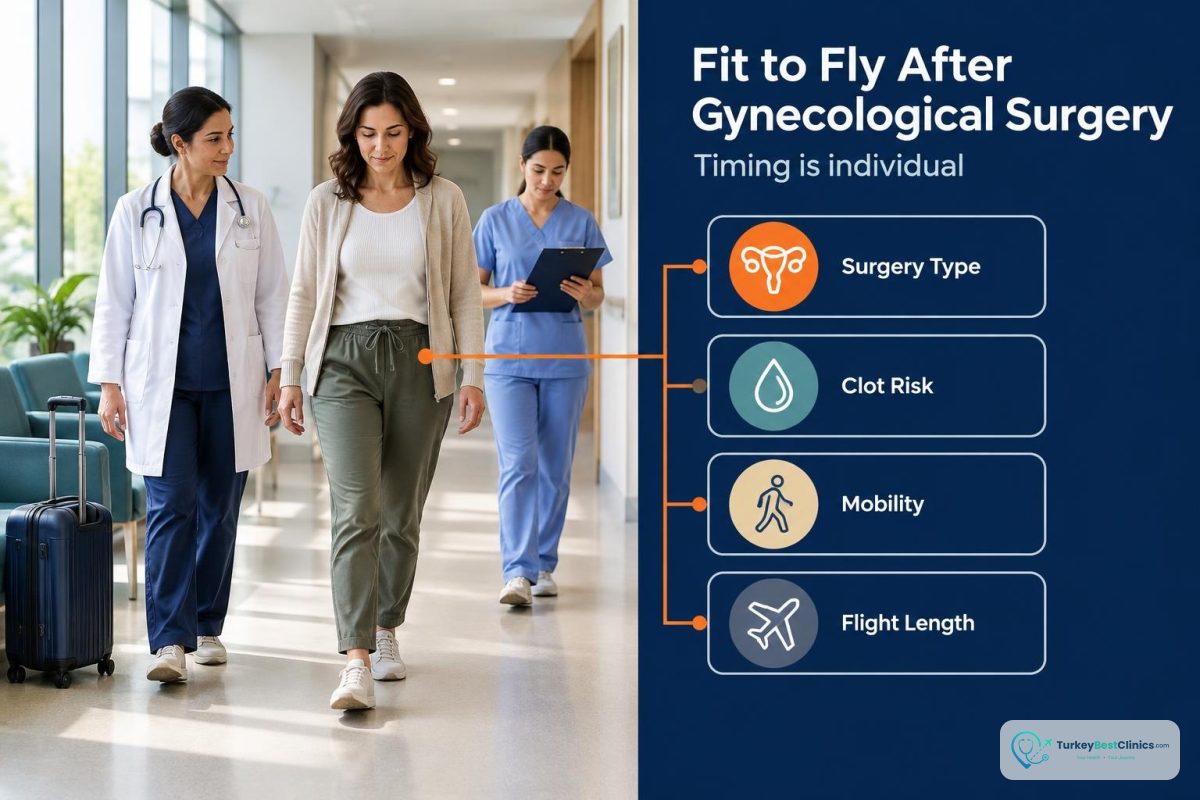
Short answer: A Fit to Fly certificate is not issued on a fixed, unchanging day after gynecological surgery. For someone recovering without complications, assessment may be possible within a few days after minor procedures, whereas open or intra-abdominal gynecological surgeries may require a longer waiting period. Decisions are often more cautious for long-haul flights.
The certificate is not prepared solely according to the number of days since surgery. Your surgeon will assess bleeding, fever, wound condition, pain control, ability to walk, swelling or tenderness in the legs, existing clotting risks, and the flight conditions together. For this reason, it is important to confirm your travel plans in writing with both the clinic and the airline before surgery.
Key factors determining whether you can fly after gynecological surgery
During air travel, deep vein thrombosis, or DVT, becomes particularly important when a person remains inactive for long periods. Recent surgery, the body's healing process, and reduced mobility may increase this risk. Cabin pressure is not the main issue by itself; prolonged sitting, inability to move sufficiently, fluid loss, and individual risk factors are assessed together.
A “Fit to Fly” certificate is generally a clinical assessment stating that there is no medical contraindication to traveling on the flight. It is not a guarantee that complications will not occur or an assurance that DVT will not develop during the flight.
Why does the type of surgery matter?
- Hysteroscopic procedures: Recovery may be faster after some short procedures performed inside the uterus. However, the certificate should not be issued without assessing bleeding, the effects of anesthesia, and the flight duration.
- Laparoscopic surgery: Although performed through small incisions, it may involve gas being introduced into the abdomen, abdominal pain, shoulder pain, or restricted movement. The flight decision should not be based solely on the small size of the incisions.
- Vaginal gynecological surgery: Bleeding, sitting comfort, urination, and the ability to walk should be checked.
- Open abdominal surgery: Because of the larger surgical area, longer recovery period, and restricted mobility, the Fit to Fly assessment is generally postponed to a later date.
This classification is for general information only. The scope of the procedure, additional interventions, and recovery course may vary even for surgeries with the same name. Therefore, your discharge notes and your surgeon’s examination should be the basis for the decision.
On which day can the certificate be issued?
It is not medically accurate to specify one standard day. Some airlines may require a doctor’s report from passengers who have recently undergone surgery, while others may request an additional form for certain procedures or flight durations. These practices may vary depending on the airline, the length of the flight, and the nature of the surgery.
In general clinical practice, an early check-up may be possible after minor, uncomplicated procedures, while open gynecological surgery may require a longer recovery interval. Particularly for international or long-duration flights, the focus is usually on whether the patient’s postoperative condition is sufficiently stable rather than simply on a check-up a few days later.
Practical conclusion: Asking for a Fit to Fly certificate to be prepared well before the flight without an examination is not a safe approach. The most appropriate time is generally the discharge assessment or a surgical follow-up scheduled close to the flight. However, the exact date must be determined by your doctor based on your findings and the details of the flight.
Which findings are assessed?
- Body temperature, general condition, and signs suggestive of infection
- The appearance of the surgical incisions or wound area
- Whether there is more vaginal or surgical bleeding than expected
- Whether pain prevents you from walking or sitting in a seat
- Whether you can walk comfortably and use the restroom when necessary
- Swelling, increased warmth, redness, or marked tenderness in one leg
- Symptoms that may require urgent assessment, such as shortness of breath, chest pain, a feeling of faintness, or palpitations
- Personal risk factors such as a previous clot, a clotting disorder, severe varicose veins, obesity, pregnancy, or the postpartum period
- The total flight duration, number of connections, and ability to move during the flight
Practical steps for obtaining a Fit to Fly certificate in Türkiye
If you have come to Türkiye for treatment, schedule your flight, whenever possible, after your postoperative follow-up appointment. Before surgery, ask the clinic in writing about the estimated hospital stay, the follow-up date, possible flight restrictions, and the language in which the certificate can be prepared.
- Keep medical documents stating the exact name of the surgery, the technique used, and the date of discharge.
- Tell your surgeon the flight number, departure date, total travel time, and any connections.
- Confirm the airline’s policies on post-surgery travel, doctor’s reports, and special assistance through official channels.
- Check whether the certificate includes the surgery date, current clinical condition, date of the flight-related assessment, and the doctor’s signature and contact details.
- Ask in advance whether the certificate must be submitted in a language accepted by the airline or with a required translation.
- Ask only the doctor supervising your care whether movement, fluid intake, compression stockings, or anticoagulant treatment are needed during the flight.
- Request written information about how an online follow-up will be conducted after returning to your country and when you should contact a local healthcare provider.
Having a certificate does not mean that airport staff or the airline will not request additional medical documents. Therefore, the document provided by the clinic should be checked together with your ticket and insurance conditions.
Warning signs to watch for before flying
If you develop new or worsening swelling in one leg, marked pain, increased warmth of the skin, or a change in skin color after surgery, contact your surgical team before requesting a Fit to Fly certificate. If you experience shortness of breath, chest pain, coughing up blood, fainting, or sudden severe weakness, do not wait to proceed with your flight plans; seek urgent medical assessment.
These symptoms may also have causes other than DVT or a clot traveling to the lungs; a definitive diagnosis cannot be made online. The important point is not to make your travel decision independently while these findings are present.
Travel companion and comfort during the journey
Having a travel companion on your first flight may provide support with luggage, walking, and connections. However, a companion does not eliminate medical flight risks. Follow your surgical team’s instructions regarding prolonged sitting, standing up, and moving around.
For your accommodation, it may be helpful to choose a place that offers easy access to the airport and healthcare facilities and is suitable for resting. Before the flight, choose a calm schedule appropriate to your postoperative restrictions instead of strenuous sightseeing, carrying heavy luggage, or standing for long periods.
Related questions you may have after reading this page
- What personal measures may help reduce the risk of DVT during a long-haul flight after gynecological surgery?
- How does the length of hospital stay in Türkiye differ between laparoscopic and open gynecological surgery?
- What medical information should a Fit to Fly certificate include, and how should it be submitted to the airline?
This information is for general health education and does not replace an examination by your surgeon. Obtain an up-to-date assessment from your surgical team before finalizing your flight date, and separately confirm the airline’s official rules and the post-surgery coverage provided by your travel insurance.