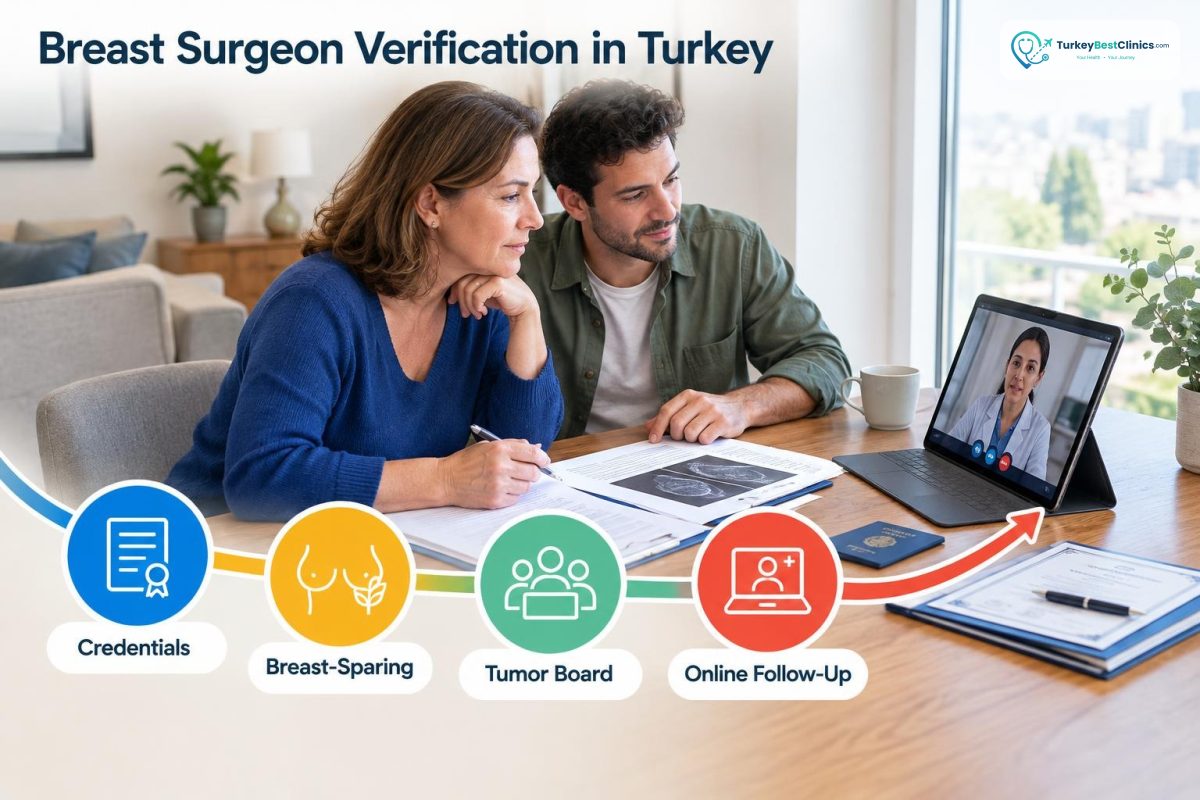
Getting Started with the Remote Assessment of Breast Surgery Qualifications
When choosing a doctor for breast cancer surgery in Turkey, it is not enough to consider only their specialist title or clinic promotional materials. You should review concrete documentation showing the scope of their experience with procedures such as breast-conserving surgery, sentinel lymph node biopsy, axillary surgery, and, when necessary, mastectomy.
A remote assessment considers the physician’s diploma and specialist registration, the authorizations held by the hospital where they work, the authenticity of their international certifications, the operation of the tumor board, and the postoperative follow-up plan. No online review can replace an in-person examination and pathology assessment; however, asking the right questions can help you make a more reliable preliminary evaluation of your surgical decision-making process.
Key evidence to review
- General surgery specialist registration and professional training related to breast surgery
- Experience with breast-conserving surgery, sentinel lymph node biopsy, and axillary dissection
- The hospital’s Ministry of Health Health Tourism Authorization Certificate
- The issuing organization, certificate number, and validity period of any international certification
- The tumor board process conducted with pathology, radiology, medical oncology, and radiation oncology teams
- The online follow-up and communication protocol with a local doctor after you return to your country
Hospital and Authorization Checks for Breast Cancer Surgery
Check official sources to confirm whether the institution where the surgery will be performed holds a Health Tourism Authorization Certificate issued by the Ministry of Health of the Republic of Türkiye. This certificate concerns the institution’s ability to provide international healthcare services; by itself, it does not prove a particular physician’s experience in breast surgery or their surgical outcomes.
Also assess the hospital’s operating room, intensive care, pathology, breast imaging, and emergency care capacity. You can request written information about international sterilization standards, imaging or marking methods to be used during surgery, the availability of frozen-section examination, and access to plastic surgery support when necessary.
Steps for official verification
- Request the clinic’s or healthcare provider’s full legal trade name and authorization certificate details.
- Do not verify the certificate solely through a PDF sent by the clinic; check it through the Ministry of Health’s current health tourism authorization records or other relevant official channels.
- Compare the physician’s specialist and employment records with independent sources such as the Turkish Medical Association, relevant physician registries, and the hospital’s official staff page.
- Obtain written confirmation of the hospital where the physician is authorized to operate, the team that will perform the surgery, and the department responsible for postoperative care.
When evaluating Turkish breast surgeons’ experience, do not rely only on phrases such as “highly experienced” or “international specialist.” Request anonymized, aggregated, and verifiable information about breast-conserving surgery, sentinel lymph node procedures, reoperation rates, and participation in multidisciplinary tumor boards in recent years.
Breast Surgery Packages and Remote Process Planning
A health tourism package may include airport-to-hospital transfers, accommodation, interpreter support, and arrangements for initial care or necessary medication; check the scope, duration, and additional fees in the written contract. For breast surgery specifically, mammography, breast ultrasound, breast MRI when necessary, biopsy material review, blood tests, anesthesia assessment, and prior review of pathology reports should be planned in advance.
Ask in advance whether your companion can stay with you at the hospital, how far your hotel is from the hospital, and which quiet options are suitable given your postoperative movement restrictions; short walks in a park or resting areas at the hotel may be appropriate. During the first few days, a low-intensity companion plan near the hospital is safer than a busy city itinerary because of limited arm movement, drain care, and fatigue.
Surgical preparation step by step
- Remote preliminary review: Pathology reports, imaging records, biopsy results, and previous treatment information are assessed through a secure system.
- In-person assessment in Türkiye: The surgeon, breast radiologist, and, when necessary, the oncology team review the examination and imaging results together.
- Tumor board: Breast-conserving surgery, mastectomy, the sentinel lymph node approach, or the need for neoadjuvant treatment is discussed through a multidisciplinary assessment.
- Surgery and hospital stay: The length of stay varies according to the procedure. If drains are placed, discharge criteria and the conditions for returning to your country should be documented in writing in advance.
- Online follow-up: Secure video consultations and report sharing are planned for wound checks, pathology results, drain or suture monitoring, and coordination with a local doctor after you return to your country.
Comparing Breast Surgery Approaches and Verification Costs
When assessing a physician’s qualifications, ask under which clinical conditions the statement “breast-conserving surgery is available” applies. The choice is determined by the tumor’s size and location, the breast-to-tumor ratio, multifocality, genetic risk, imaging findings, and oncological safety criteria.
| Surgical approach compared | Potential key benefit | Recovery and hospital stay |
|---|---|---|
| Breast-conserving surgery and sentinel lymph node biopsy | Potential to preserve the appearance of the breast; a more limited surgical area in suitable cases | Usually a shorter hospital stay; additional planning may be needed depending on the need for radiotherapy and the pathology results |
| Mastectomy and necessary lymph node surgery | Removal of all breast tissue; may be an appropriate option for extensive or multifocal disease | Longer recovery depending on the extent of the procedure; additional surgical planning if reconstruction is performed |
The figures below are not treatment prices. They are approximate market ranges that may be seen for services such as document review from abroad, online second opinions, and translation. The surgical decision and total treatment cost are calculated separately according to the pathology, imaging, scope of surgery, hospital stay, and additional treatments.
| Service or preliminary assessment | Türkiye | United Kingdom | Germany | United States |
|---|---|---|---|---|
| Remote breast surgery second opinion | €150–€500 | £250–£800 | €300–€900 | $400–$1,500 |
| Pathology and imaging file review | €100–€400 | £200–£700 | €250–€800 | $300–$1,200 |
| Certified translation and medical file preparation | €50–€250 | £100–£400 | €100–€450 | $150–$600 |
These ranges may vary according to the institution, file volume, report language, and number of specialists involved in the assessment. If a surgical package price is offered, verify item by item whether pathology, sentinel lymph node examination, additional nights, drain monitoring, complication management, and online follow-up are included.
Checklist for Verifying Oncology Experience, Certifications, and Documents
The physician’s breast surgery experience
Ask the physician for anonymized volume data from the last three to five years, preferably broken down by procedure type rather than only the total number of breast surgeries. Experience with breast-conserving surgery, sentinel lymph node biopsy, axillary dissection, mastectomy, and oncoplastic surgery should be presented under separate headings.
- Annual breast surgery volume and distribution by procedure type
- Aggregated data on the rate of positive surgical margins requiring reoperation after surgery
- Which specialties participate in tumor board meetings
- At which laboratory and under which quality processes pathology reports are assessed
- The communication plan for postoperative complications and readmissions
Verifying international certifications
Review the name of the organization shown on the certificate, the certificate number, issue date, validity period, and scope of the certification. Some organizations, such as EUSOMA, may indicate a center or unit standard; this type of accreditation does not mean that every surgeon has an individual certification.
Membership in professional organizations based in Europe or the United States does not automatically constitute proof of surgical competence. Use the verification page on the organization’s official website or contact its institutional email address to confirm the certificate number; a social media image, logo, or participation certificate alone is not sufficient evidence.
Factors that change the price and scope of the process
- Physician’s specialty and experience: The breast surgery focus, oncoplastic training, procedure volume, and tumor board experience affect the scope of the assessment.
- Technical approach and materials: Sentinel lymph node mapping, intraoperative imaging, frozen section, oncoplastic reshaping, and the use of a breast implant or tissue expander may change the overall plan.
- Clinic location: Hospital fees in Istanbul, Ankara, İzmir, or another city may vary together with accommodation, transfers, interpretation, and additional follow-up costs.
Three Critical Questions to Ask After Verification
- Is breast-conserving surgery oncologically appropriate in my case? Ask which criteria will be assessed together with the tumor size, multifocality, imaging findings, and radiotherapy plan.
- How could the sentinel lymph node result change the surgical plan? Find out under which conditions additional axillary surgery may be required during the procedure or after the pathology results are available.
- How will pathology and wound follow-up be managed after I return to my country? Obtain written information about how many days it will take to share the final pathology report, how many online follow-up appointments are included, and who will coordinate communication with your local oncology team.
Before making a decision, keep all documents together in one file: the physician’s résumé, specialist registration, authorization certificate, certification verification, itemized price breakdown, consent form, and online follow-up plan. If you find inconsistencies in the documents, pressure to make an urgent payment, a lack of clear contractual details about the procedure, or reluctance to verify a certification, seek an independent second opinion.