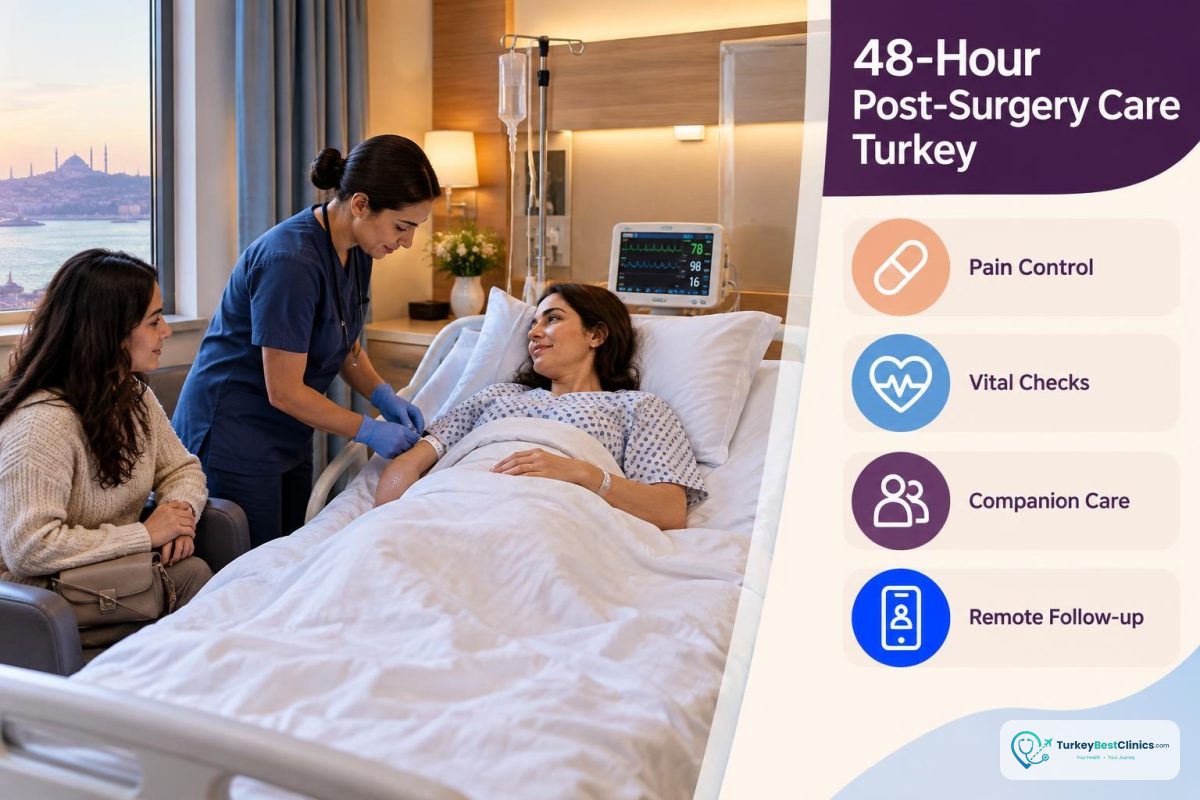
The Most Sensitive Stage of Surgical Recovery: The First 48 Hours
The first 24–48 hours after surgery are an acute period during which pain, nausea, restricted movement and fatigue are closely monitored. During this time, the aim is not only to reduce pain but also to assess breathing, circulation, the surgical site, urination, mobility and overall comfort together.
Care planned in Turkey is personalized according to the type of surgery you have undergone, the anesthesia method, your current health status and your pain threshold. Discharge is generally considered when pain is under control, basic movements can be performed safely, fluids are tolerated and the surgical team considers the clinical findings appropriate.
Acute Surgical Care and Women-Specific Safety Standards in Turkey
When you choose an institution holding a Ministry of Health-approved Health Tourism Authorization Certificate, postoperative care is expected to be provided under the supervision of an authorized healthcare institution. In a fully equipped hospital, nursing observation, vital-sign monitoring, sterile dressing procedures and, when necessary, assessments by the anesthesia or relevant surgical team are coordinated within the same system.
Women-specific comfort may include protecting privacy, personal-care assistance, safe support during toileting and mobilization, hospital clothing in an appropriate size and cut, and consideration of breastfeeding or menstrual needs. You can clearly communicate requests such as a female nurse, a private room, companion arrangements, and keeping the curtain or door closed during care before admission.
Key Areas Monitored During the First Hours
- Pain level: The location and intensity of pain, changes with movement and response to the method used are assessed at regular intervals.
- Breathing and circulation: Pulse, blood pressure, oxygenation, respiratory rate and level of consciousness are monitored.
- Surgical site: The dressing, drain, swelling, signs of bleeding and unexpected discharge are checked.
- Mobility and urination: Standing up, walking short distances and the need to urinate are assessed safely.
- Nausea and fluid intake: Post-anesthesia nausea, vomiting and the ability to tolerate oral fluids are monitored.
Processes such as international sterilization practices, separation of operating-room and care areas, appropriate management of single-use materials and surgical hand hygiene are carried out within the institution’s quality procedures. For transparency, ask in advance in writing for the clinic’s authorization certificate, the name of the hospital where the surgery will take place, the department to contact at night and the procedure to follow in case of complications.
Postoperative Pain Control and the Women’s Comfort Package
As part of the organization, airport-to-hospital transfers, accommodation, language support and coordination of the initial care process may be arranged. Any care products that may be needed after surgery and discharge documents are explained by the team according to the nature of the operation; you should not start any product on your own.
Whether your companion can stay with you in the hospital depends on the hospital’s room policy and clinical conditions. Accommodation within a short distance of the hospital may be beneficial for overnight checks and the day of discharge. While you rest, your companion may take a walk in a quiet nearby park, use the hotel’s wellness area or spend time at a nearby café that does not require strenuous activity; however, the care team determines any visitor and outdoor activity restrictions according to the type of surgery.
Multimodal Pain Management
Pain control is often planned using more than one method. Depending on the surgical team’s assessment, regional anesthesia techniques, intravenous or oral pain control, cold applications, appropriate positioning, controlled movement and breathing exercises may be used together.
It is important to fully disclose any painkillers you already use, your history of chronic pain, medication or substance sensitivities, gastrointestinal problems, kidney or liver conditions, and any difficulties you previously experienced during anesthesia. Do not change the timing or dosage yourself. Inform the nurse and surgical team immediately if your pain is higher than expected, appears in a new area or does not decrease despite treatment.
Women-Specific Privacy and Care Details
- You may request that only essential staff remain in the room during body cleansing, dressing, toileting and getting out of bed.
- After gynecological, breast, abdominal or pelvic procedures, assistance with repositioning and walking is adapted according to the incision site.
- It is helpful to inform the care team about your menstrual cycle so that menstrual bleeding is not confused with surgical bleeding.
- If you are breastfeeding or need to express milk, discuss the anesthesia and pain-control plan with the surgical and anesthesia teams based on this information.
- You may ask for an explanation about a urinary catheter, drain or feeling of intra-abdominal pressure; you should not decide on its removal time yourself.
Acute Care Costs in Turkey and International Comparison
The figures below are general, approximate ranges for hospital care during only the first 24–48 hours after surgery. The surgery itself, operating room, intensive care, imaging, additional procedures, a private room, companion accommodation and complication management may be priced separately in most quotations.
| Country | Approximate acute care cost | Items that may be included |
|---|---|---|
| Turkey | €300–900 | 24–48 hours in a room, nursing observation, basic pain control and routine discharge assessment |
| United Kingdom | GBP 1,000–2,500 | Private hospital room, clinical observation and standard care services |
| Germany | EUR 900–2,000 | Hospital stay, nursing monitoring and routine checks by the surgical team |
| United States | USD 2,000–6,000 | Private hospital care; physician, facility and consumable charges may be calculated separately |
Assessing the approximate average cost of care in Turkey using a single figure can be misleading. In cities such as Istanbul, Ankara, İzmir and Antalya, the hospital category, room type and complexity of the surgery affect the price. In your written quotation, try to see the acute-care duration, overnight nursing, pain-control methods, female nurse or companion requests, interpreter support and any possible additional overnight charges listed separately.
Surgical Factors Determining Cost and Care During the Acute Period
- Physician’s specialization and experience: After major abdominal surgery, pelvic surgery, breast surgery or advanced laparoscopic procedures, the care plan may vary according to the scope of the procedure in the relevant specialty and the physician’s experience managing follow-up in such cases.
- Technique and technology used: Laparoscopic or robotic approaches may differ from open surgery in incision size, drain requirements, movement restrictions and length of hospital stay. Techniques such as regional nerve blocks, patient-controlled analgesia and advanced vital-sign monitoring may also affect the quotation.
- Clinic location: Private hospitals in central cities may charge differently because of private-room standards, access to specialists at night, foreign-language support and international-patient coordination.
Each of these criteria should be assessed specifically for you before surgery. Focus not only on a low package price, but also on whether 24-hour clinical support is available if pain cannot be controlled or if unexpected bleeding, fever, breathing difficulty, fainting or severe vomiting occurs.
Before Leaving Turkey and After Returning Home
A Transparent Discharge Protocol
Before discharge, wound or dressing care, showering and movement restrictions, fitness to fly, the follow-up date and an emergency contact number should be explained in writing. If you are planning a long flight, discuss sitting, short walks, the need for assistance and surgery-related travel restrictions with the surgical team.
After returning home, online follow-up can continue through video consultations, secure document sharing and, when necessary, communication between the team in Turkey and your local physician. This communication does not replace an in-person examination. If you experience emergency symptoms such as fever, rapidly increasing pain, shortness of breath, altered consciousness or uncontrolled bleeding, seek emergency medical care in the country where you are located.
Three Specific Topics to Explore After This Page
- How does pain control vary according to the type of surgery? Compare the effects of incisions, drains and movement restrictions during the first 48 hours after laparoscopic, open and robotic surgery.
- How should privacy and breastfeeding plans be prepared for women after surgery? Have requests for a female nurse, milk-expression arrangements and gynecological care details added to the protocol before admission.
- Which discharge documents and online follow-up steps are needed before flying? Clarify in advance your fitness-to-fly documentation, follow-up imaging, emergency contact line and the contents of the medical discharge summary to be sent to your physician at home.