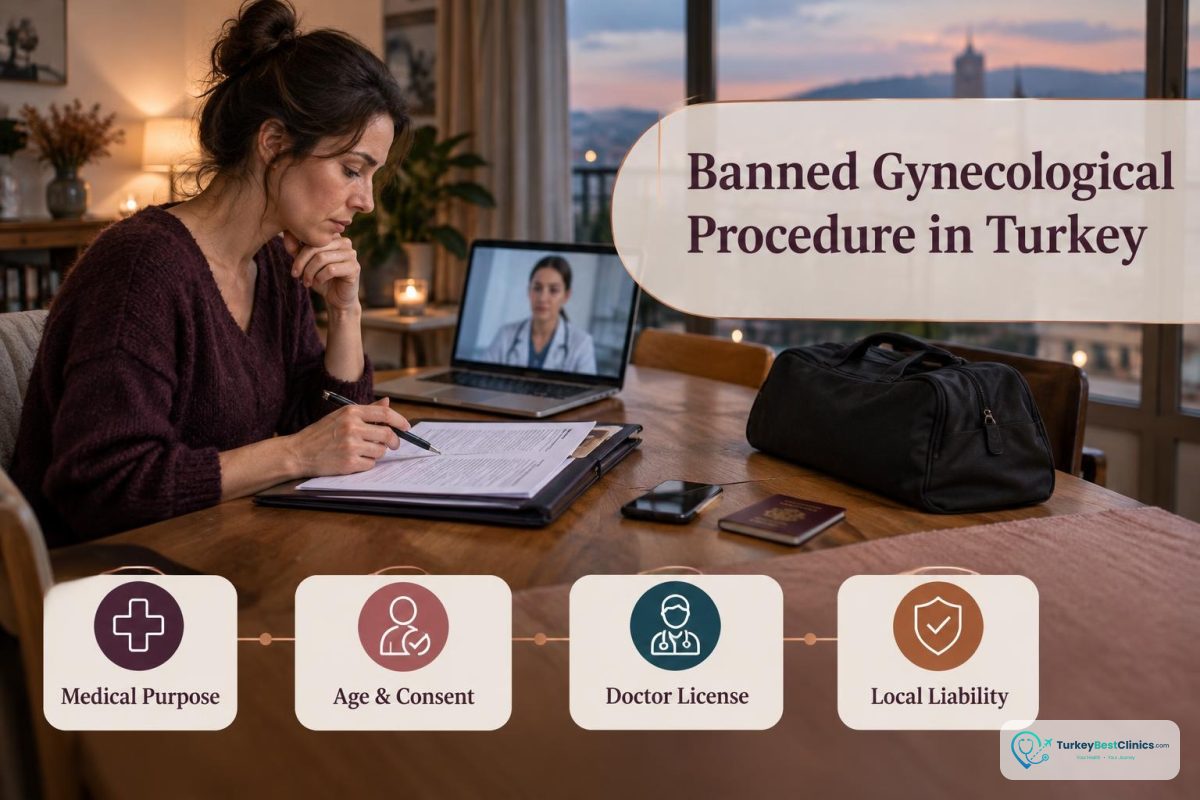
The Actual Legal and Medical Context of Gynecological Procedures in Turkey
If you are considering having a gynecological procedure that is banned in your country performed in Turkey, the first step is to clarify its medical purpose and the technique to be used rather than relying on its commercial name. The same term may refer to reconstructive surgery, an aesthetic procedure, a fertility-related intervention, pregnancy termination, or another procedure involving the genital area.
Whether a procedure can be said to be “permitted” in Turkey depends on conditions including compliance with Turkish law, planning by an authorized physician at a licensed healthcare facility, assessment of medical necessity and risks, obtaining informed consent, and ensuring safe follow-up care. Having a procedure that is banned in your country performed in Turkey does not automatically eliminate potential consequences upon your return relating to customs, criminal law, family law, insurance, or professional reporting obligations.
For this reason, the information below is for general guidance only. Before making a final decision, the exact name of the procedure, your age, medical history, country of residence, and the follow-up plan after travel should be assessed together.
Gynecological Safety and Authorization Under Turkish Law
Ministry of Health Authorization and Choosing a Facility
When applying for treatment under health tourism in Turkey, an important first step is to choose a facility holding a Health Tourism Authorization Certificate issued by the Turkish Ministry of Health. This certificate alone does not demonstrate that a specific procedure is appropriate for your circumstances; it indicates that the facility is authorized to provide health tourism services and is subject to certain administrative standards.
The procedure should be assessed by a specialist in obstetrics and gynecology with the relevant qualifications or, where appropriate, by a specialist in plastic, reconstructive and aesthetic surgery. When researching the physician’s specific experience, do not rely solely on phrases such as “experienced team.” Look for clear information about the number of stages involved, the type of anesthesia to be used, complication management, the possibility of revision, and the duration of follow-up.
Consent, Age, and Medical Necessity
Informed consent freely given by an adult is one of the essential elements. The purpose of the procedure, its temporary or permanent effects, risks such as bleeding and infection, sensory changes, possible effects on sexual function, alternatives, and the course of action if you decide not to proceed should be explained clearly.
If you are under 18, the consent of a parent or accompanying person alone may not be considered sufficient; depending on the type of procedure, Turkish rules on child protection, medical consent, and ethics must also be examined. Turkey also imposes serious legal and ethical limits regarding genital mutilation, coercive procedures, interventions without consent, or harmful procedures without a medical justification.
Procedure-Specific Travel Packages and Preparation in Turkey
Health tourism coordination may include airport or VIP transfers, suitable hotel accommodation, a professional interpreter where necessary, and basic support required during the initial care period. Review the package in writing, specifying which services are included and excluded; ask whether medication, additional tests, revision procedures, emergency consultations, and companion expenses are charged separately.
Depending on the nature of the gynecological procedure, a preoperative examination, pregnancy test, complete blood count, coagulation assessment, infection screening, ultrasonography, or anesthesia consultation may be required. The length of your stay in Turkey after the procedure should be determined according to the type of anesthesia, suture checks, bleeding risk, ability to urinate, and the physician’s approval for air travel; there is no single standard number of days that is reliable for every procedure.
On the day of the procedure and during the early recovery period, your companion may prefer a quiet indoor museum visit, a short café break, or resting at the hotel in Istanbul; a brief walk away from direct sunlight in Antalya; or an easy, non-strenuous food experience in Izmir. In particular, if you have bleeding, pain, dizziness, or restricted mobility, you should avoid long walks, Turkish baths and saunas, swimming pools, the sea, sexual activity, and crowded schedules.
Differences Between Two Basic Approaches
Because the exact name of the procedure has not been specified, the table below compares only two general approaches commonly seen in gynecological interventions. The choice between a surgical or energy-based method cannot be made without a diagnosis and examination.
| Methods Compared | Key Advantage That Makes a Difference | Effect on Recovery Time |
|---|---|---|
| Reconstructive surgical approach | Allows direct repair and structural correction of damaged or altered anatomical tissue | May generally require longer follow-up, suture checks, and physical restrictions |
| Minimally invasive or energy-based approach | A smaller treatment area and, in some selected cases, a shorter procedure time | Recovery may be shorter; however, effectiveness and suitability vary according to the purpose of the procedure |
Gynecological Procedure Costs in Turkey and International Comparisons
Providing a single “average price in Turkey” without specifying the procedure, its scope, and its medical purpose would be misleading. The table below shows broad reference ranges for 2026 that may be used only for health tourism planning; examinations, imaging, anesthesia, accommodation, interpreting, pathology, additional nights, and complication management may not be included.
| Service or Procedure Scope | Turkey (€) | United Kingdom (GBP) | Germany (€) | United States (USD) |
|---|---|---|---|---|
| Specialist assessment and basic tests | 100–500 | 250–900 | 250–800 | 400–1,500 |
| Outpatient, limited-scope gynecological procedure | 800–2,500 | 2,000–5,000 | 2,000–5,500 | 3,000–8,000 |
| Comprehensive procedure requiring an operating room and anesthesia | 2,500–6,500 | 6,000–12,000 | 5,000–12,000 | 8,000–20,000 |
These ranges are not a substitute for a quotation and do not indicate that a procedure banned in your country can necessarily be performed in Turkey. The written quotation should clearly state the medical name of the procedure, surgical scope, type of anesthesia, hospital or clinic, follow-up examinations, pathology, potential additional procedures, and the center to contact in an emergency.
Key Factors That Affect the Price and Legal Process
- Physician’s specialization and experience: Training in reconstructive surgery, vulvovaginal surgery, pelvic floor medicine, or a relevant subspecialty, as well as the complexity of the procedure and the need for revision, may affect the price.
- Technology, technique, and materials: Depending on the procedure, actual technical elements such as hysteroscopic systems, laparoscopic equipment, electrocautery, lasers, or suture materials may be used. The terms “laser” or “non-surgical” alone are not evidence of safety or effectiveness.
- Clinic location: In health tourism centers such as Istanbul, Antalya, and Izmir, hospital capacity, operating room standards, intensive care access, accommodation, and transfer costs may change the total price.
- Legal classification of the procedure: Medical necessity, aesthetic purpose, fertility, pregnancy, age, and consent status may change how the same procedure is assessed. A procedure that is legal in Turkey may not be risk-free under the citizenship or criminal laws of your country of residence.
- Follow-up and return plan: Flight duration, suture checks, the possibility of bleeding or infection, communication with a physician in your home country, and the ability to reach Turkey again in an emergency are all part of the decision.
What to Clarify Before Making a Decision
Before requesting a quotation, ask in writing for the medical name of the procedure in both Turkish and English, the specialty that will perform it, why it is being recommended, and what alternatives are available. For your legal situation abroad, consult a lawyer in your country; for the procedure in Turkey, consult the authorized healthcare facility directly and, where necessary, an independent legal professional.
- Which medical and legal category does this procedure fall into in Turkey? How do the authorization and consent requirements change if it is classified as reconstructive surgery, an aesthetic procedure, a pregnancy-related intervention, or another category?
- How long will restrictions on sexual intercourse, tampon use, swimming pools, flying, and exercise last after the procedure? On which days will follow-up examinations take place, and which documents will be sent to your physician in your home country?
- What legal or insurance consequences could arise when you return to your country? How will the connection between the procedure and the ban in your country, travel insurance coverage, and responsibility for costs in the event of complications be confirmed in writing?
For a safe decision, do not assess the procedure solely on the basis of price or travel convenience. The procedure date should not be scheduled until legal compliance, free and informed consent, specialist qualifications, access to emergency care, and follow-up after your return home have all been verified.