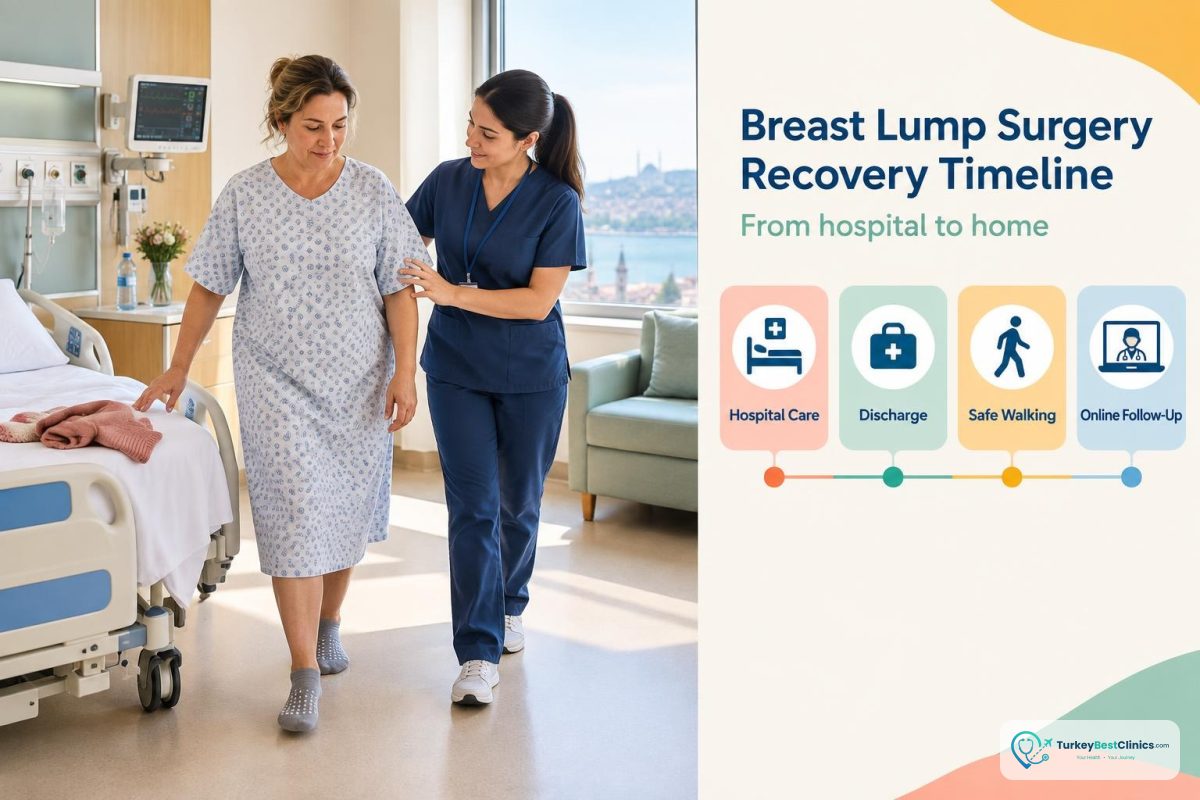
What to Expect During the First Days After Breast Lump Surgery
Breast lump surgery is planned to surgically remove a specific lesion in the breast, which is often then sent for pathological examination. The scope of the procedure may vary depending on the lump’s size and location, imaging findings, and the results of any previous needle biopsy.
After surgery, the main goals are to control pain, monitor the incision and any possible drain site, begin safe walking, and clarify the next steps based on the pathology result. The decision to discharge you and allow you to stay at a hotel is based not only on the time elapsed but also on clinical assessment and your general condition.
After a simple and limited breast lump removal, discharge on the same day or an overnight hospital stay may be possible. If there is a wider excision, an additional lymph node procedure, drain use, or accompanying health conditions, the observation period may be extended.
Hospital Safety and the Pathology Process in Breast Surgery
It is important to plan the surgery at a facility holding a Health Tourism Authorization Certificate issued under the regulations of the Republic of Türkiye’s Ministry of Health, with access to a fully equipped hospital infrastructure. Operating-room sterilization protocols, anesthesia assessment, the postoperative observation area, and emergency response capabilities should be verified in advance.
Turkish physicians who regularly perform breast surgery may have experience with different stages of care, including excision of lumps detected by ultrasound or mammography, removal of wire-localized lesions, cosmetic incision planning, and, when necessary, sentinel lymph node assessment. These statements alone do not guarantee a specific outcome; the surgical plan is personalized after your imaging and biopsy records have been reviewed.
Topics considered during the preoperative evaluation
- Breast ultrasound, mammography, or, when necessary, breast MRI, based on your age and clinical findings.
- Review of a core needle biopsy or previously obtained pathology report that may help determine the nature of the lump.
- Blood count, coagulation assessment, biochemistry tests, and an anesthesia evaluation.
- Medications, known allergies, previous anesthesia experiences, and your postoperative flight plans.
The removed tissue is sent to a pathology laboratory. The time required to prepare the final report may vary depending on the laboratory’s workflow and any additional stains requested; therefore, your return date should not be finalized before the report is available.
Breast Lump Surgery Package and Companion Planning
A health tourism package may include VIP transfers, hotel accommodation, interpreter support, and the basic coordination required during the initial care period; the scope should be confirmed through a written quotation and hospital plan. A stay of approximately 4–7 days in Türkiye is commonly planned for breast lump surgery; this period may be extended if preoperative imaging or an additional biopsy is required.
Whether your companion is permitted to stay with you in the hospital should be clarified in advance according to the hospital’s room policy. Choosing a hotel close to the hospital can reduce the burden of initial walks and follow-up visits. While you rest, your companion may consider low-exertion options such as a quiet walk in a nearby park or the hotel’s wellness area; however, heavy lifting and an intensive schedule should not be planned during the support period.
Practical flow of the hospital stay
- Day of surgery: After waking from anesthesia, your blood pressure, pulse, breathing, nausea, and pain level are monitored. Your first time getting up is assisted by a nurse or companion.
- First night: The incision, dressing, and any drain are checked. Arm and shoulder movements are started within the limits permitted by the surgeon and in a way that does not increase pain.
- Next day: Walking, tolerance of oral fluids and food, urination, temperature, and the appearance of the incision are assessed. If a drain is present, you are shown how to empty it and keep records.
- Before discharge: Written instructions are provided on dressing care, shower restrictions, the follow-up date, the pathology communication plan, and telephone contact information for emergencies.
Cost of Breast Lump Surgery in Türkiye and International Comparison
For limited breast lump removal or excisional biopsy at a private hospital as part of health tourism in Türkiye, the average total cost may range from approximately €2,000 to €4,500. This figure varies depending on the scope of surgery and whether anesthesia, pathology, imaging, hospital stay, and accommodation are included in the package.
| Country | Approximate self-pay range | Important note about the price |
|---|---|---|
| Türkiye | €2,000–€4,500 | The scope of limited lump removal, basic hospital services, and coordination may vary. |
| United Kingdom | GBP 4,500–9,000 | Private hospital, surgeon, pathology, and anesthesia fees may be calculated separately. |
| Germany | €3,500–€8,000 | Diagnostic examinations and the length of the hospital stay may affect the total cost. |
| United States | USD 6,000–15,000 | Hospital, surgeon, anesthesia, and laboratory bills are often issued separately. |
When comparing prices, look beyond the surgical fee to include the preoperative assessment, pathology report, additional imaging, drain checks, hotel transfers, and any possible revision plan. A definitive quotation should be prepared in writing after your medical records and the estimated scope of surgery have been assessed.
Surgical Approach, Recovery, and Mobilization Schedule
The appropriate approach is determined by whether the lump is superficial or deep, its size, how clearly it has been localized through imaging, and the level of suspicion on pathology assessment. The comparison below provides a general planning framework; findings during surgery may lead the surgeon to change the approach.
| Methods Compared for You | Most Important Potential Advantage for You | Your Recovery and Hospital Stay |
|---|---|---|
| Limited open excisional biopsy | Direct removal of the lump and submission of the tissue for pathology; the incision may be planned in the breast fold or along a cosmetic line. | Usually same-day observation or an overnight stay; light daily walking may begin within a few hours. |
| Wide local excision and, when necessary, additional surgical assessment | Removal of sufficient tissue from a larger or suspicious area; in some cases, it may be planned together with a lymph node procedure. | Usually 1–2 nights of observation; shoulder movements progress more cautiously, and the hotel period may require closer monitoring. |
Day-by-day plan for mobilization at the hotel
- Day of surgery: Transfer to the hotel takes place only after discharge has been approved. Once in your room, it is appropriate to rest at short intervals, drink water, and walk only the distances needed.
- Day 1: You may take slow walks lasting a few minutes inside the room and along the corridor. Pushing, pulling, carrying luggage, and keeping the arm elevated for a prolonged period on the operated side are not recommended.
- Days 2–3: If you have no pain or dizziness, a short walk on level ground may be planned with your companion. Reduce activity if you experience pulling around the incision, increasing swelling, or marked weakness.
- Days 4–7: Light daily activity may continue depending on the follow-up examination. Long city tours, extensive shopping, swimming, saunas, and strenuous exercise should not be undertaken without the surgeon’s approval.
For returning home, the condition of the incision, pain control, absence of fever, ability to walk safely, and approval from the surgical team are assessed together. If you need to travel with a drain, written instructions should be prepared covering drainage records, transport requirements, and the follow-up plan in your destination country.
Next Steps: Three Practical Questions About Breast Lump Surgery
- When will the pathology result be available after surgery, and which findings in the report could change the subsequent treatment plan? This question helps you understand how the report will be interpreted after an excisional biopsy and whether additional surgical assessment may be needed.
- If a drain is used, how will care, measurement, and the decision to remove it be managed at the hotel? Particularly when a wider excision or additional lymph node procedure is being considered, who will monitor the drain is an important part of travel planning.
- What criteria regarding the incision, pain, and arm movement are required before flying after surgery? When setting the return date, the follow-up examination, pathology communication, and plan for accessing care in the event of possible complications in your destination country should be considered together.
After you return home, online follow-up may include assessing incision photographs through a secure communication channel, explaining the pathology report, and coordinating with your local physician. If you develop increasing redness, foul-smelling discharge, uncontrolled pain, shortness of breath, a high fever, or rapidly increasing swelling, seek urgent medical assessment where you are without waiting for an online response.