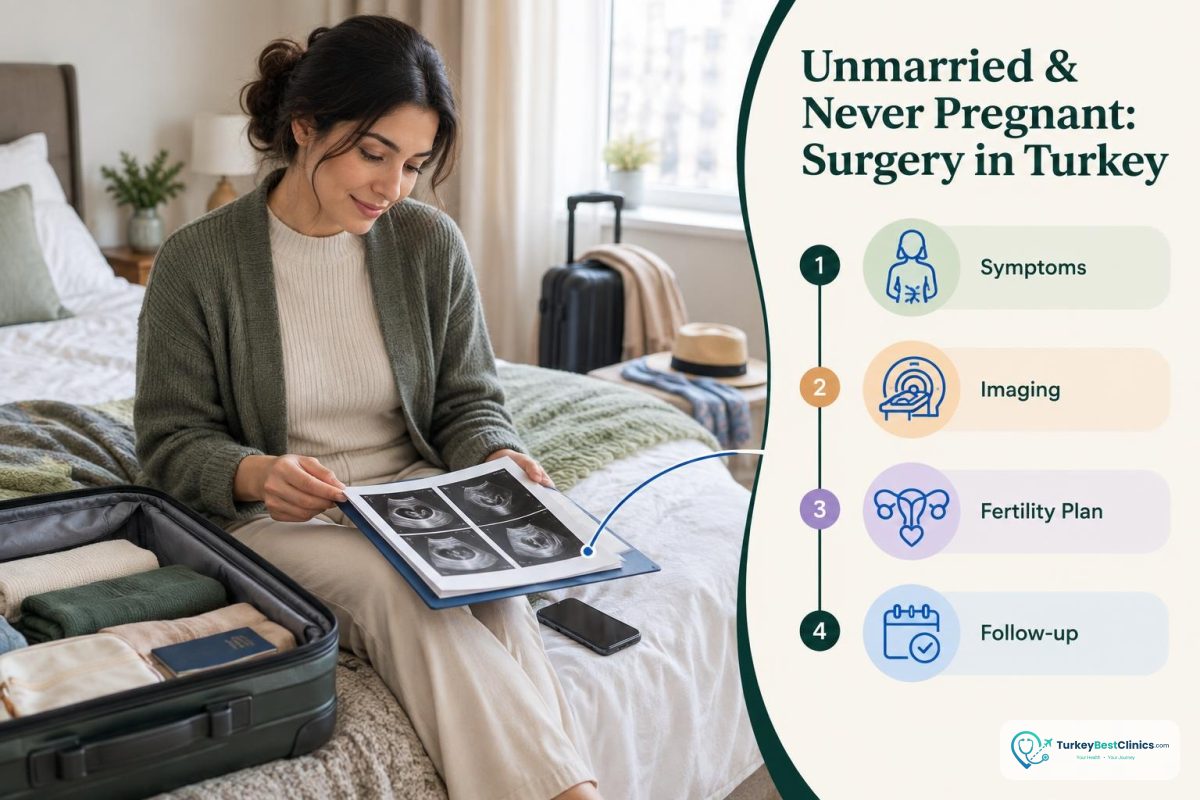
Initial Assessment for Genital Aesthetic and Fibroid Surgery
Being single or having never given birth does not automatically mean that you are unsuitable for gynecological surgery in Turkey. The main factors are your current symptoms, the condition of your uterine and genital anatomy, your future pregnancy plans, any previous procedures, and the risk profile of the selected method.
The purpose of a genital aesthetic assessment is not solely to change appearance. Specific concerns such as pain, friction, recurrent irritation, asymmetry, or congenital anatomical differences are considered alongside whether expectations are realistic and whether the procedure is medically necessary. In fibroid surgery, the size and number of fibroids, their location in the uterine wall, and their impact on bleeding, pain, or pressure symptoms are particularly important.
Marital status is not a criterion for clinical decision-making. Not having given birth may require consideration of uterine-sparing techniques, a separate assessment of whether a vaginal approach is necessary, and the explicit incorporation of your fertility goals into the surgical plan.
Safety Framework for Fibroid and Genital Surgery in Turkey
An online preliminary assessment can be carried out before you travel to Turkey; however, it does not replace an in-person gynecological examination. The final decision should be confirmed after an examination, imaging, and anesthesia assessment at a fully equipped hospital holding a Health Tourism Authorization Certificate issued by the Turkish Ministry of Health.
Turkish obstetricians and gynecologists can assess different anatomical scenarios, including uterine-sparing myomectomy, laparoscopic surgery, hysteroscopic fibroid removal, and vulvar surgery. For the term “experienced team” to have practical meaning, you should ask which method is used, approximately how many similar procedures are performed each year, what hospital support is available in the event of complications, and how fertility preservation is planned.
- The surgery should be planned at a hospital with a fully equipped operating room, anesthesia services, intensive care, and emergency intervention facilities.
- Sterilization procedures, protocols for single-use or reprocessable surgical equipment, and postoperative infection monitoring should be explained clearly.
- Blood type, complete blood count, coagulation tests, the possibility of pregnancy, and anesthesia risks are assessed before the procedure.
- After you return home, a plan should be made for online follow-up, sharing pathology results, and coordination with a local obstetrician and gynecologist when necessary.
Fibroid and Genital Aesthetic Surgery Plan Before Your Trip to Turkey
An organizational package may include airport-hospital-hotel transfers, accommodation near the hospital, interpreter support, and the logistical coordination required during the initial care period. Whether your companion can stay with you in the hospital depends on the hospital’s policies; choosing a hotel close to the hospital can reduce the transportation burden after surgery.
Before fibroid surgery, a pelvic ultrasound, contrast-enhanced pelvic MRI when necessary, a complete blood count, and an assessment for anemia are generally requested. If you have bleeding symptoms, iron deficiency, the medications you take, and your pregnancy plans are also reviewed; hysteroscopy may be considered for fibroids located inside the uterine cavity. For genital aesthetic procedures, a medical history shared safely and voluntarily, previous procedures, pain or irritation symptoms, and your expectations may be sufficient; sharing intimate photographs is not mandatory.
The length of your stay in Turkey varies according to the nature of the surgery. After laparoscopic myomectomy, several days of hospital and local follow-up are generally required, while open surgery may involve a longer rest period; for genital aesthetic procedures, the duration is determined by the scope of the treatment. Your companion may wait near the hospital on the day of surgery. In the following days, resting at the hotel, choosing a calm wellness program, or taking short, controlled walks in a park is preferable to long walks, intense sun exposure, swimming, or tiring city tours.
| Methods Compared for You | Most Important Advantage for You | Your Recovery and Hospital Stay |
|---|---|---|
| Laparoscopic myomectomy | Smaller incisions, generally less abdominal wall trauma, and the possibility of preserving the uterus | Usually a short hospital stay; physical recovery may be faster than with open surgery |
| Open myomectomy | Wider surgical access for large or numerous fibroids, or fibroids in locations unsuitable for laparoscopy | Longer hospital stay and recovery period; a greater safety margin is needed before traveling home |
| Genital Aesthetic Approaches Compared | Key Advantage That Makes a Difference | Effect on Recovery Time |
|---|---|---|
| Surgical correction targeting a specific anatomical area | Can directly address significant excess tissue, asymmetry, or functional symptoms | Sexual intercourse, strenuous exercise, and long journeys may be restricted because of swelling and sensitivity |
| Non-surgical monitoring or a conservative approach | May prevent unnecessary surgical risks when medical necessity is not clear | Does not involve recovery from surgical incisions or anesthesia; expectations regarding the outcome are different |
Understanding the Costs of Fibroid and Genital Aesthetic Surgery in Turkey
The price may include not only the surgery fee but also the surgeon, hospital, anesthesia, tests, pathology, accommodation, and follow-up. The ranges below are approximate healthcare tourism market prices; they do not replace a personalized quotation and vary according to the number and size of the fibroids and the surgical access route.
| Procedure or Country | Approximate Cost | Notes for Evaluation |
|---|---|---|
| Turkey – genital aesthetic surgery | €2,000–€5,000 | Whether the procedure involves one area or combined treatments, as well as anesthesia and follow-up coverage, is important |
| Turkey – myomectomy | €3,500–€8,000 | The laparoscopic, open, or hysteroscopic method, the number of fibroids, and the hospital stay are determining factors |
| United Kingdom | Genital aesthetic surgery: GBP 4,000–8,000; myomectomy: GBP 8,000–15,000 | Prices vary by private hospital, surgeon, and city |
| Germany | Genital aesthetic surgery: €4,000–€7,000; myomectomy: €7,000–€14,000 | The hospital and technical scope of the surgery affect the total cost |
| United States | Genital aesthetic surgery: USD 6,000–12,000; myomectomy: USD 15,000–30,000 | Anesthesia, operating room, and follow-up fees may be billed separately |
Factors That Affect Suitability and the Overall Process
- The surgeon’s specialization and experience: Actual case experience with specific techniques such as laparoscopic myomectomy, hysteroscopic treatment for intracavitary fibroids, or vulvar surgery affects the safety and scope of the surgical plan.
- Technology and technique: Pelvic MRI, high-resolution ultrasound, laparoscopic camera systems, hysteroscopic resectoscopes, and tissue removal methods when necessary play a role in determining the correct indication and surgical access route. Robotic surgery is not essential for every fibroid or every anatomy.
- Clinic location: Hospital capacity, transportation within the city after surgery, and international flight connections may differ between centers in Istanbul, Antalya, and Izmir. Accommodation close to the hospital is especially important when the process involves a long flight, open surgery, or a significant risk of bleeding.
For remote suitability assessment, it is helpful to share your imaging results from the last six to twelve months, any MRI images, your history of bleeding and pain, previous surgeries, known medical conditions, and the medications you take. Nevertheless, final suitability is determined after an in-person examination, an anesthesia consultation, and the necessary tests. Significant anemia, an active infection, the possibility of pregnancy, an uncontrolled chronic condition, or insufficient access to postoperative follow-up may lead to postponement of the travel plan.
Your Questions Before Travel and Next Steps
- How does not having given birth affect the myomectomy method or future pregnancy plans? The location of the fibroid in the uterine wall, the amount of tissue removed, and the healing process of the uterine wall should be evaluated together.
- Is the recommendation for genital aesthetic surgery genuinely based on medical necessity, or might expectation management and conservative monitoring be sufficient? Functional symptoms, anatomical findings, possible scarring, and sensory changes should be discussed clearly.
- How long should I wait before returning to my country after surgery, and how should online follow-up be conducted? The timing of your flight should be personalized according to the procedure, bleeding risk, wound check, pathology results, and coordination with a local doctor.
For a safe plan, the process begins with a review of your medical records and a video consultation with a doctor. The estimated method, required in-person tests, hospital stay, companion arrangements, and online follow-up steps are then clarified in writing. Being single or having never given birth is not a reason to exclude you from this process; rather, it is a detail that requires more careful planning of the surgical goals and fertility expectations.