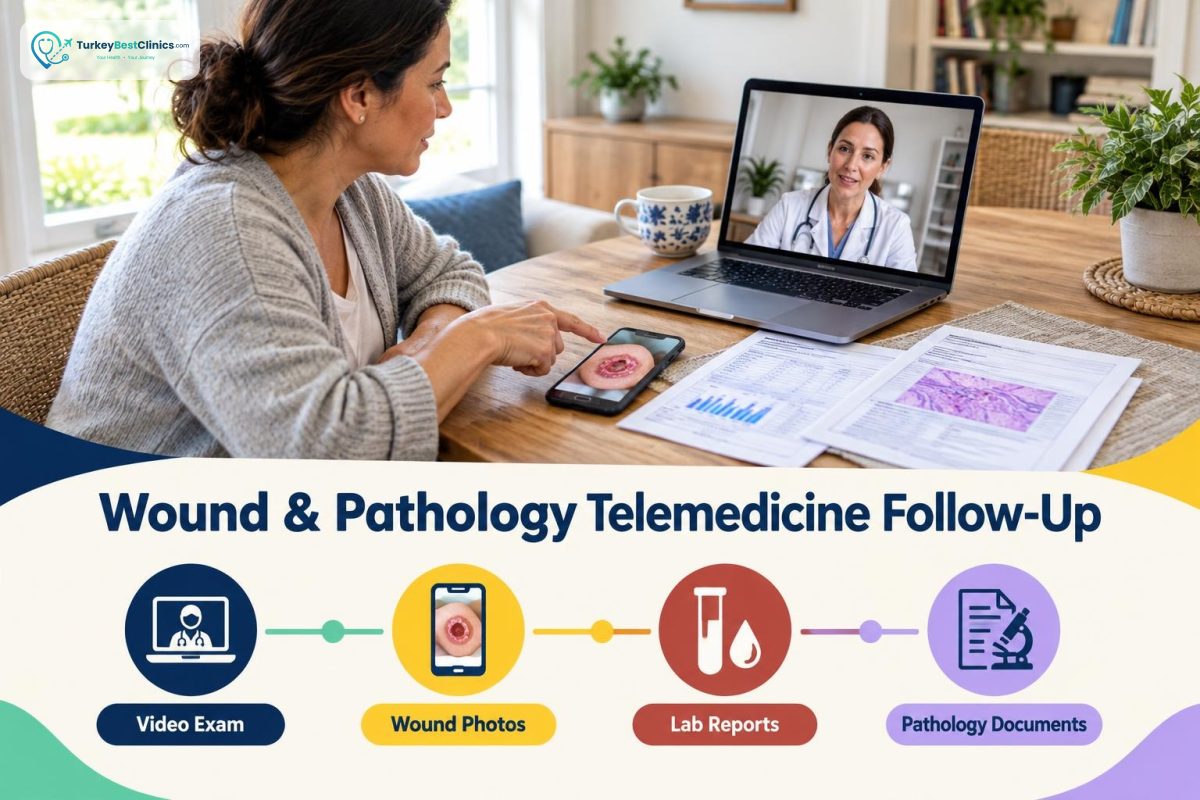
Scope of Wound and Pathology Follow-Up After Returning Home
After returning to your country following surgery in Turkey, the appearance of your wound and your pathology report can be assessed remotely by your surgeon in Turkey. Telemedicine follow-up combines video consultations, secure document sharing, comparison of wound photographs and coordination with your local healthcare team.
This method is used to assess the condition of the wound edges, redness, swelling, discharge, changes around the suture line and important terms in the pathology report. However, if you experience emergency symptoms such as severe bleeding, shortness of breath, altered consciousness, rapidly increasing pain or a high fever, you should contact emergency medical services in your country without waiting for an online consultation.
Telemedicine does not replace a physical examination, ultrasound, blood tests or repeat surgical assessment when required. However, during planned follow-up, it can help your surgeon in Turkey monitor the postoperative process continuously and assess new findings at the appropriate time.
What information is reviewed during a telemedicine consultation?
- Well-lit photographs of the wound from different angles, including the date
- Changes around the wound and any restriction of movement observed during the video consultation
- Symptoms you report, such as fever, pain, discharge or swelling
- The complete pathology report, additional staining results and any multidisciplinary board assessments
- Blood tests, cultures, imaging or notes from local doctors performed in your country
Surgical Safety and Pathology Reporting Standards in Turkey
Having your follow-up managed through a healthcare institution holding a Health Tourism Authorization Certificate issued by the Ministry of Health of the Republic of Türkiye helps ensure that communication, records, patient rights and international healthcare services are governed by defined procedures. It is also important for the institution to clearly share the operating room, sterilization, laboratory and archiving infrastructure required for the relevant specialty.
Your surgeon should be able to review the operative note and how the pathology specimen was processed through your medical file. Histopathological evaluation is explained by considering the site from which the tissue sample was taken, the number of samples, whether the report is definitive or preliminary, and whether additional examination is needed.
The experience of Turkish surgeons in wound closure, suture-line checks, drain or dressing follow-up, and interpreting postoperative pathology results together with clinical findings can improve the effectiveness of a video consultation. Nevertheless, a definitive diagnosis cannot be made based solely on an online assessment. If a finding is suspicious, a local examination, additional testing or a second pathology opinion may be recommended.
Essential practices for secure data sharing
- Share your pathology report through the institution’s secure portal or encrypted file system instead of by email.
- Make sure that identification details, your address or other personal data are not visible in the photographs.
- Ask in advance which platform will be used for the consultation, whether it will be recorded and how long the data will be stored.
- Send all pages of the report and its supplementary results, not just the summary.
How Is a Wound and Pathology Follow-Up Package Planned?
As part of the organization, VIP transportation, travel between the hospital and hotel, interpreter support, basic initial care supplies and essential post-discharge communication coordination may be planned. These logistical services do not replace medical decisions, and their scope should be confirmed in writing for each procedure.
Whether your companion can stay with you in the hospital should be clarified in advance according to the hospital’s policy and room type. Choosing a hotel close to the hospital can make transportation easier on follow-up days. Depending on the wound area and your surgical restrictions, your companion may take a walk in a quiet nearby park or use a low-intensity wellness service.
Before leaving Turkey, ask your surgeon in writing for the operative note, discharge summary, current version of the pathology report, wound-care instructions and the communication plan to follow in an emergency. If the pathology result is not yet ready, your file should state when the final report is expected and through which channel it will be shared once available.
Step-by-step online follow-up protocol
- The date of the first telemedicine consultation, communication channel and participating surgeon are determined.
- Before the consultation, wound photographs, fever and pain trends, discharge documents and the pathology report are sent securely.
- Your surgeon assesses the wound’s appearance, changes in your symptoms over time and your ability to move during daily activities.
- Medical terms in the pathology report are explained in plain language, including whether additional staining, a second pathologist’s opinion or a local examination is needed.
- The date of the next consultation, tests to be performed at a local healthcare facility and emergency communication conditions are documented in a written plan.
Video and document-based assessment options
| Follow-up method compared for you | Main benefit | Follow-up process and need to contact a healthcare facility |
|---|---|---|
| Video consultation with the surgeon | The wound’s general appearance, movement, pain and changes in symptoms are assessed during the same consultation. | The initial assessment usually lasts 20–40 minutes. If the appearance is concerning, an in-person examination can be arranged in your country. |
| Secure review of photographs and the pathology report | Wound images from different dates and report details can be compared to create a more organized record. | For asynchronous review, a response time of 24–72 hours is usually specified. This channel should not be used for emergency symptoms. |
Average Cost Comparison for Telemedicine Follow-Up in Turkey
The figures below do not represent surgical fees. They show approximate ranges that may apply to a single international telemedicine consultation or pathology report review after surgery. The final fee may vary depending on the consultation duration, the surgeon’s specialty, additional report review, interpreter requirements and the institution’s service scope.
| Country | Approximate range for one follow-up consultation | Currency |
|---|---|---|
| Turkey | 100–300 | € |
| United Kingdom | 150–450 | £ |
| Germany | 150–400 | € |
| United States | 200–600 | $ |
Check in writing whether the fee in Turkey covers only an explanation of the pathology report or a comprehensive surgical assessment that also includes the operative note, wound photographs and local test results. The total cost may increase if multiple consultations, an interpreter, new imaging or a joint consultation with a local doctor is required.
Factors That Change the Price and Process of Telemedicine Follow-Up
- The surgeon’s specialty and experience: A general wound check and assessment of a complication involving a specific organ or surgical field do not have the same scope. Allowing the surgeon who performed the operation to access the operative note, photographs and pathology report together supports a more complete assessment.
- Technology and assessment method used: High-resolution video consultations, comparison of date-stamped photographs and the use of secure electronic health records are important for wound follow-up. In pathology, in addition to the routine histopathology report, immunohistochemistry, special staining or digital pathology images may need to be sent for a second opinion.
- Clinic location: Surgeon fees, hospital infrastructure and international patient coordination services may differ between institutions in Istanbul, Ankara, İzmir and other cities. Location also affects transportation, accommodation and follow-up planning if you need to return to Turkey after surgery.
These three factors affect not only the fee but also the scope of the follow-up plan. When comparing prices, use the same criteria to check whether consultation time, the number of reports, photograph review, interpreter support, a written follow-up summary and emergency communication support are included.
Next Steps: Frequently Asked Questions About Wound and Pathology Follow-Up
What should I do if my pathology report is not in my country’s language?
You can request a qualified medical translation together with the original report. The translation should not replace the original report. During the assessment, your surgeon should check the specimen site, description, results and notes on additional examinations against the original document.
How should wound photographs be taken for telemedicine?
Take one overview, one medium-distance and one close-up photograph in a shadow-free setting with lighting similar to daylight. Share photographs taken from approximately the same angle each day, together with the dates, and wait for your surgeon’s written instructions before applying anything to the wound.
When should I contact local healthcare services instead of the surgeon in Turkey?
If you have uncontrolled bleeding, rapidly increasing swelling, foul-smelling discharge, significant wound opening, fainting, shortness of breath or a deterioration in your general condition, contact emergency medical services in your country. Then, when possible, inform the surgical team in Turkey and share your reports and details of the treatment provided.
Put your online follow-up plan in writing before discharge: clearly specify the date of the first consultation, the document-upload channel, how the pathology result will be shared, where to seek local care and the limits of emergency communication. This way, after returning home, wound healing and pathology assessment can follow a regular, documented process rather than relying on a single video consultation.