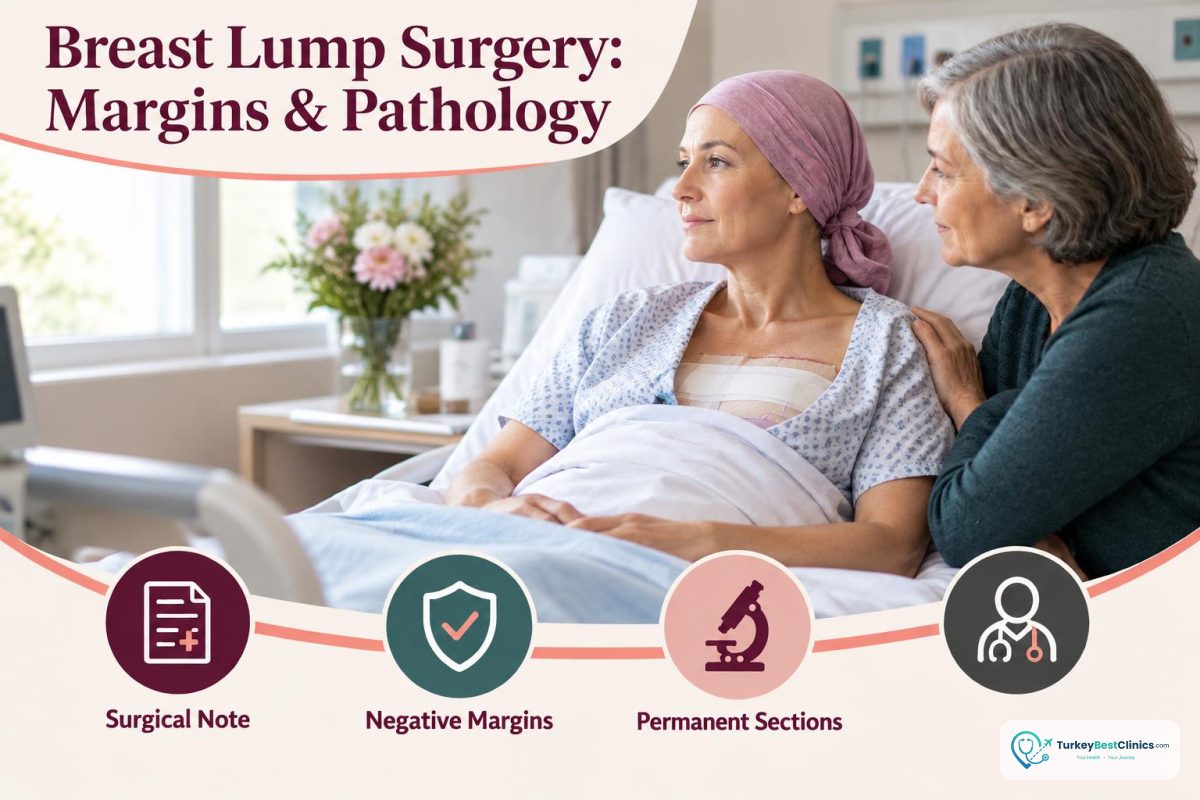
What Does a Negative Surgical Margin Mean After Breast Mass Surgery?
During breast mass surgery, the surgeon removes the mass together with a margin of surrounding tissue based on imaging and examination findings. The pathologist examines the removed specimen and assesses whether tumor tissue reaches the specimen’s inked outer surface.
A negative surgical margin, or clear margin, means that no tumor is seen at the edge of the examined specimen. This is an important safety indicator; however, it does not by itself guarantee that treatment is complete, that no additional treatment will be required, or that recurrence will not occur in the future. The final decision is made together with the tumor type, size, biological characteristics, lymph node findings, and imaging results.
After surgery in Turkey, you may request the operative note, pathology report, imaging results, and, if possible, copies of the pathology slides or paraffin blocks to verify your report. After returning to your country, these documents can also be submitted to your own breast surgery or oncology team for evaluation.
Key Information the Report Should Include
- The area from which the removed tissue was taken and the specimen orientation markings
- Mass size and histological diagnosis
- The distinction between invasive tumor, an in situ lesion, and a benign formation
- The closest distance to the surgical margins and the status of the margins
- The number of lymph nodes examined and, if applicable, information about involvement
- When necessary, receptor, HER2, proliferation, or other immunohistochemical results
- The pathologist’s interpretation and conclusion
Pathology Safety and Breast Surgery Standards in Turkey
Planning surgery at a healthcare facility holding a Health Tourism Authorization Certificate issued under the regulations of the Ministry of Health of the Republic of Türkiye can help ensure that the surgery, laboratory, translation, and discharge processes are managed within an established administrative framework. It is advisable to confirm the facility’s authorization certificate and the laboratory providing the pathology service in writing beforehand.
Reliable assessment in breast surgery depends on more than the surgical technique alone. Specimen orientation, matching radiological imaging with the pathological specimen, proper tissue fixation, and examination of permanent paraffin sections by a specialist breast pathologist are fundamental components of interpreting negative margins.
Teams working in breast surgery in Turkey may perform procedures such as breast-conserving surgery, mastectomy, sentinel lymph node sampling, wire- or marker-guided excision, and oncoplastic approaches for different clinical presentations. When assessing relevant experience, look beyond the physician’s total years in practice. Consider the multidisciplinary working structure of the breast surgery and pathology teams, the detail in the operative notes, and the reporting protocol.
How Can You Verify a Clear Margin Result?
- Obtain a complete, signed, and dated copy of the pathology report.
- Check the operative note for how the removed tissue was oriented and whether additional specimens were taken.
- If necessary, ask the pathology laboratory to prepare glass slides and paraffin blocks for a second opinion.
- Confirm in writing that the second opinion will be conducted at a center specializing in breast pathology.
- Share the results with your physician in your home country and jointly assess the need for additional imaging or treatment.
Pathology and Companion Support in a Breast Mass Surgery Package
The planned package may include airport-to-hospital transfers, accommodation, a medical interpreter, and initial care or prescription arrangements; check the scope, dates, and additional fees in writing before travel. Before breast mass surgery, breast ultrasound, mammography or MRI images, blood tests, an anesthesia assessment, and review of available biopsy material are generally planned; the final timeframe varies according to the scope of the procedure.
Plan in advance whether your companion can stay with you in the hospital, how long it will take to travel from the accommodation to the hospital, and what support you may need after discharge because of limited arm movement or pain. While you rest in the hospital, your companion may consider nearby options such as relaxing at the hotel, quiet walks in parks, or the hotel’s wellness areas that do not require strenuous physical activity after breast surgery; however, the surgeon’s approval is required before using a spa, sauna, or pool.
Plan for Your Stay in Turkey and Online Follow-Up
After a simple breast mass excision, same-day discharge or one night of observation may be sufficient; more extensive surgery, drain use, or an additional lymph node procedure may lengthen the stay. The pathology report is usually prepared within a few business days, but the timeframe may be extended if additional stains, immunohistochemistry, a second expert opinion, or complex tissue examination is required.
Before returning to your country, you should receive the pathology report, surgical summary, medication and wound-care instructions, follow-up plan, and emergency contact number digitally. During online follow-up, the appearance of the wound, fever, discharge, swelling, arm movement, and sharing the report with your physician in your home country may be assessed; an online consultation does not replace an in-person examination.
Breast Mass Surgery Costs in Turkey and Country Comparison
The approximate total cost of breast mass surgery in Turkey may generally range from €2,500–€6,500, depending on the scope of the procedure. This range is only a general reference because costs differ between single mass excision and breast-conserving surgery, sentinel lymph node procedures, oncoplastic correction, or advanced pathology testing.
| Country | Approximate surgical cost | Important pricing note |
|---|---|---|
| Turkey | €2,500–€6,500 | Surgery, hospital use, and basic pathology coverage may vary by package |
| United Kingdom | £6,000–£12,000 | In private healthcare, the surgical scope and pathology may be priced separately |
| Germany | €7,000–€14,000 | Hospital, anesthesia, imaging, and pathology items may be calculated separately |
| United States | $15,000–$30,000 | Insurance coverage and the combined hospital and surgeon fees may vary significantly |
When requesting a quote, ask to see not only the surgical fee but also the pathology report, additional immunohistochemical tests, second pathology opinion, lymph node procedure, anesthesia, hospital stay, and any potential revision consultation listed separately. Since the tests required to confirm a negative margin are not the same for every case, ask in advance how additional laboratory charges are calculated.
Factors That Affect the Surgical Method, Pathology Process, and Cost
The method selected for breast mass surgery is determined by the size and location of the mass, imaging findings, previous biopsy, the structure of the breast tissue, and oncological requirements. The comparison below shows the general difference between two basic surgical approaches; the option suitable for you is determined after examination and imaging.
| Methods Compared for You | Most Important Potential Advantage for You | Your Recovery and Hospital Stay |
|---|---|---|
| Breast-conserving surgery and mass excision | Allows removal of the mass with a safe margin of surrounding tissue while preserving most of the breast tissue | Short hospital stay in many suitable cases; return to daily activities may generally be faster, although pathology and the additional treatment plan are decisive |
| Mastectomy or wider surgical excision | More extensive tissue removal for large, multifocal, or otherwise unsuitable cases for a breast-conserving approach | May require a longer recovery, drain monitoring, and, in some cases, reconstruction planning |
Three Main Variables That Determine Cost and Process
- The physician’s expertise and experience: In addition to breast surgery, experience in margin assessment, sentinel lymph node planning, and oncoplastic closure may affect the scope of the surgical plan.
- Technology, technique, and materials: Wire localization, radar or magnetic localization, intraoperative specimen radiography, frozen-section assessment, and permanent paraffin sections may be used in different situations. Frozen section may not be sufficient for definitive margin assessment in every breast lesion; particularly in some in situ lesions, the final decision is based on permanent sections.
- Clinic location: Hospital operating costs, laboratory infrastructure, accommodation, transportation, and international patient services may differ between Istanbul, Ankara, Izmir, and other cities.
Ask in writing which pathology method will be used, in which language the report will be provided, whether slides or paraffin blocks can be sent for a second opinion, and what procedure will be followed if revision is required. These details can help you make a more accurate safety assessment than a price comparison alone.
Practical Steps to Take After the Pathology Result
It is possible to verify a clear surgical margin and pathology result in Turkey with confidence; this confidence should be based not only on a single concluding sentence but also on a traceable chain of documentation. Before surgery, clarify which laboratory will examine the specimen, when the report will be delivered, and the procedure for obtaining a second opinion if needed.
- Why is the orientation diagram of the removed specimen important, and how does the surgeon document it in the operative note?
- Does the negative-margin report state the tumor’s distance from the closest edge, and how does this result affect the plan after breast-conserving surgery?
- How is the process of sending glass slides and paraffin blocks to a breast pathologist in your country for a second opinion carried out?
Obtaining written answers to these questions makes it easier to provide your healthcare team in your home country with a complete record. If you experience fever, rapidly increasing redness, heavy discharge, shortness of breath, or uncontrolled pain, contact the surgical team or emergency medical services where you are located without waiting for an online consultation.