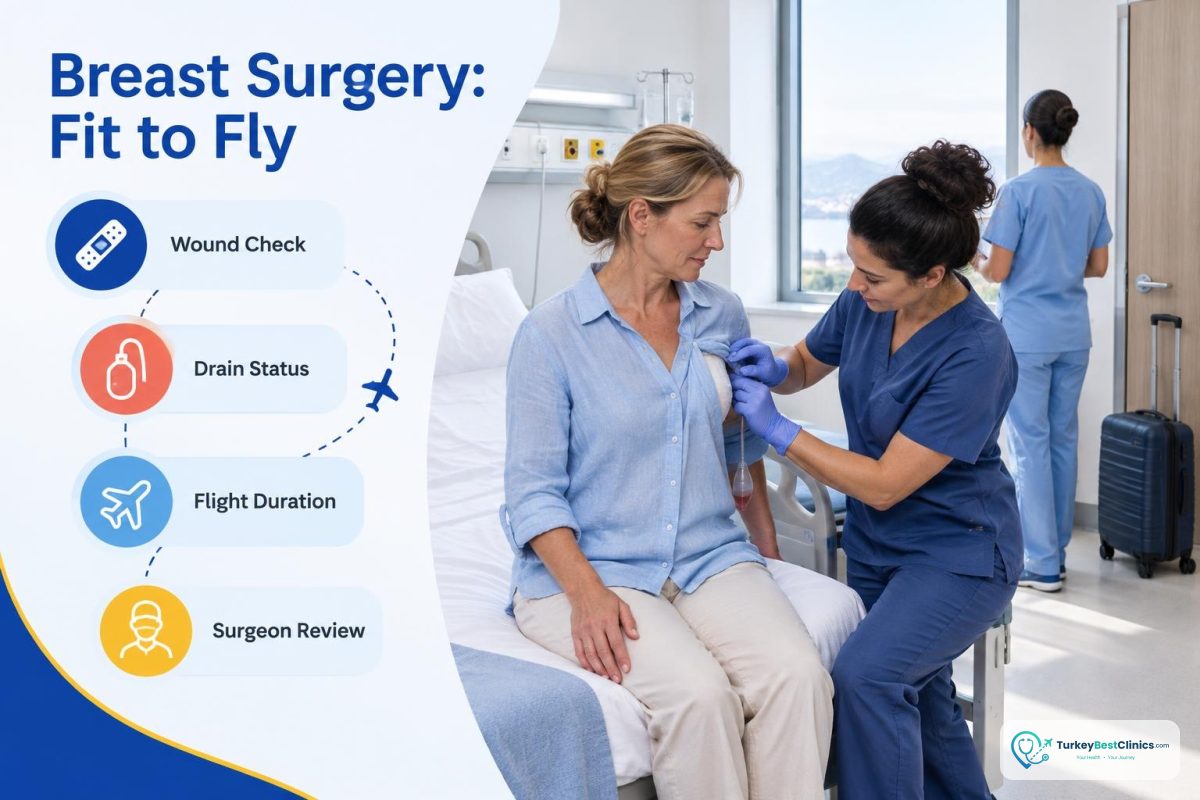
How Is the Decision to Fly Made After Breast Surgery?
If you are planning air travel after breast augmentation, reduction, lift, or implant replacement, a Fit to Fly report depends on more than the number of days since surgery. Cabin pressure alone does not cause a wound to open; however, risks such as swelling, bleeding, hematoma, fluid accumulation, pain, and prolonged immobility during the early recovery period may affect the decision to fly.
When recovery is uncomplicated, assessment for a short-haul flight is often carried out approximately 7–10 days after surgery, while longer or connecting flights are frequently assessed 10–14 days afterward. These time frames are not medical rules. If a drain is still in place, the wound edges have separated, or there is fever, increasing redness, significant one-sided swelling, or uncontrolled pain, the report may be postponed.
The purpose of the report is not merely to state that you “may fly.” Your surgeon should also explain whether special support is needed during the flight, how to use the compression garment, when your follow-up will take place, and which communication channel to use in an emergency.
Implant and Incision Checks Under Turkish Standards
In Turkey, the facility where your surgery is performed should hold a Health Tourism Authorization Certificate issued by the Ministry of Health. This certificate indicates that international applications, communication, and service processes within the scope of health tourism are subject to certain administrative standards; it does not, by itself, guarantee any specific surgical outcome or fitness to fly.
Surgery in a fully equipped hospital is important for access to sterilization procedures, operating-room safety, anesthesia assessment, and imaging or laboratory support when necessary. Your surgeon should make the decision about flying based on specific factors such as breast implant placement, the incision line, tissue tension, and postoperative drain monitoring.
Clinical Check Before the Fit to Fly Assessment
- The closure of the wound edges and the need for dressing changes are assessed.
- Swelling, bruising, hematoma, or possible seroma is evaluated.
- If a drain is present, the daily fluid volume, color, and anticipated removal date are reviewed.
- Body temperature, pulse, pain level, and mobility are checked.
- Flight duration, number of connections, accompanying support during travel, and the follow-up plan in the destination country are recorded.
Preparing to Fly as Part of a Breast Surgery Package
Planning may include airport transfers, accommodation, interpreter support, and basic guidance during the initial care period. Pre-flight dressing checks, an explanation of prescribed care instructions, and preparation of the report in the format required by the airline may also be added to the travel plan.
Whether your companion can stay with you at the hospital, how close your hotel is to the hospital, and which calm activities are suitable for your movement restrictions should be assessed in advance. Wellness facilities or short, non-strenuous park walks should only be considered with your surgeon’s approval. Particularly during the first few days, having your companion assist with luggage, transfers, and airport procedures can help you rest without placing strain on the chest area.
Step-by-Step Travel Protocol
- Before surgery, a general health assessment, anesthesia consultation, and blood tests when necessary are performed.
- During the first postoperative checks, the wound, area around the implant, and drain status are monitored.
- When the Fit to Fly decision is made, the flight duration and access to medical care in the destination country are taken into account.
- The use of a supportive surgical bra, arm movements, and safe intervals for walking in the cabin are explained for the flight.
- After you return to your country, online follow-up appointments are scheduled. Photos or videos should only be shared through a secure communication channel that is clinically appropriate.
Flight Assessment According to the Surgical Approach
| Methods Compared for You | Most Important Advantage for You | Your Recovery and Hospital Stay |
|---|---|---|
| Breast augmentation with implants | A more limited incision and generally a shorter early follow-up period | Usually same-day discharge or one night; the decision to fly is often made after the first wound check |
| Breast reduction or lift | More detailed shape and wound monitoring because excess skin and tissue are removed | Usually 1–2 nights; a longer recovery period may be needed before a long-haul flight |
This table is intended for general planning. The time frames above may not apply if the drain remains in place, there is tension along the incision, or an additional procedure has been performed.
Fit to Fly Assessment and Cost Comparison in Turkey
A Fit to Fly report is often prepared as part of the postoperative check-up. At some facilities, the surgeon’s examination, report, translation, and additional imaging may be charged separately. The figures below are approximate ranges for 2026 and relate only to the report and fitness-to-fly assessment; they do not represent the total cost of breast surgery.
| Country | Approximate assessment and report cost | Factors That May Affect the Price |
|---|---|---|
| Turkey | €50–150 | Surgeon’s check-up, ultrasound, translation, and additional dressing care |
| United Kingdom | GBP 100–250 | Private clinic fee, airline form, and imaging |
| Germany | €100–250 | Scope of the examination and language in which the report is prepared |
| United States | USD 150–400 | Plastic surgery examination, document format, and extent of follow-up |
If your airline has its own MEDIF or medical form, check in advance whether the report must be prepared in that format. A surgeon’s report does not necessarily replace the airline’s operational acceptance decision.
Surgical Criteria That May Change the Fit to Fly Date
The main factors determining the date on which you may be considered fit to fly are listed below. These are the key variables in the decision:
- The surgeon’s expertise and the scope of surgery: Implant placement, procedures involving the capsule, breast reduction, breast lift, or simultaneous revision surgery may create different wound-healing demands. The surgeon’s experience in breast surgery contributes to assessing incision-line tension and possible early complications.
- Technique and materials: Implant placement above or below the muscle, the volume of the silicone implant, the suture material used, drain placement, and incision length may affect early comfort. None of these factors alone constitutes permission to fly; they must be interpreted together with the examination findings.
- Clinic location: In centers with extensive international flight options, such as Istanbul, travel with shorter connections may be possible. In contrast, if there is a long transfer, multiple connections, or limited access to healthcare in the destination country, your surgeon may recommend a wider safety margin.
- Flight characteristics: Flights lasting more than four hours, overnight travel, prolonged sitting in a confined seat, and the need to lift luggage may increase pain, swelling, and circulation-related risks. Safe intervals for walking in the aisle and support from a companion should be planned.
If you have increasing pain, rapidly enlarging swelling in one breast, active bleeding, shortness of breath, fever, or wound opening, do not continue with your flight plans on your own and contact your surgical team urgently.
Steps After the Report and Frequently Asked Questions
On exactly which day is a Fit to Fly report issued?
There is no single mandatory day. After uncomplicated breast implant surgery, most assessments take place around day 7–10. Following more extensive procedures such as breast reduction or lift, assessment is generally performed on or after days 10–14. The final decision is based on the wound check and the flight details.
Can I fly while I have a drain?
The presence of a drain does not automatically prohibit flying. However, the amount of fluid, safe transport of the drainage system, signs of infection, and flight duration must be assessed together. Planning a long international flight before drain removal requires your surgeon’s explicit approval.
How can pressure on the wound area be reduced during a flight?
Use the surgical bra recommended by your surgical team, avoid carrying items that apply tight or direct pressure to the chest, and do not lift heavy luggage. Your plan for getting up and moving around should be based on your current surgical restrictions; do not use any compression product on your own initiative.
Before returning to your country, keep your written discharge summary, operative report, implant details, Fit to Fly document, and online follow-up dates with you. This page is for general information only; the decision to fly should be made jointly by the plastic surgeon who examined you and the relevant airline.