How Privacy Affects Clinical Decisions in Women’s Healthcare
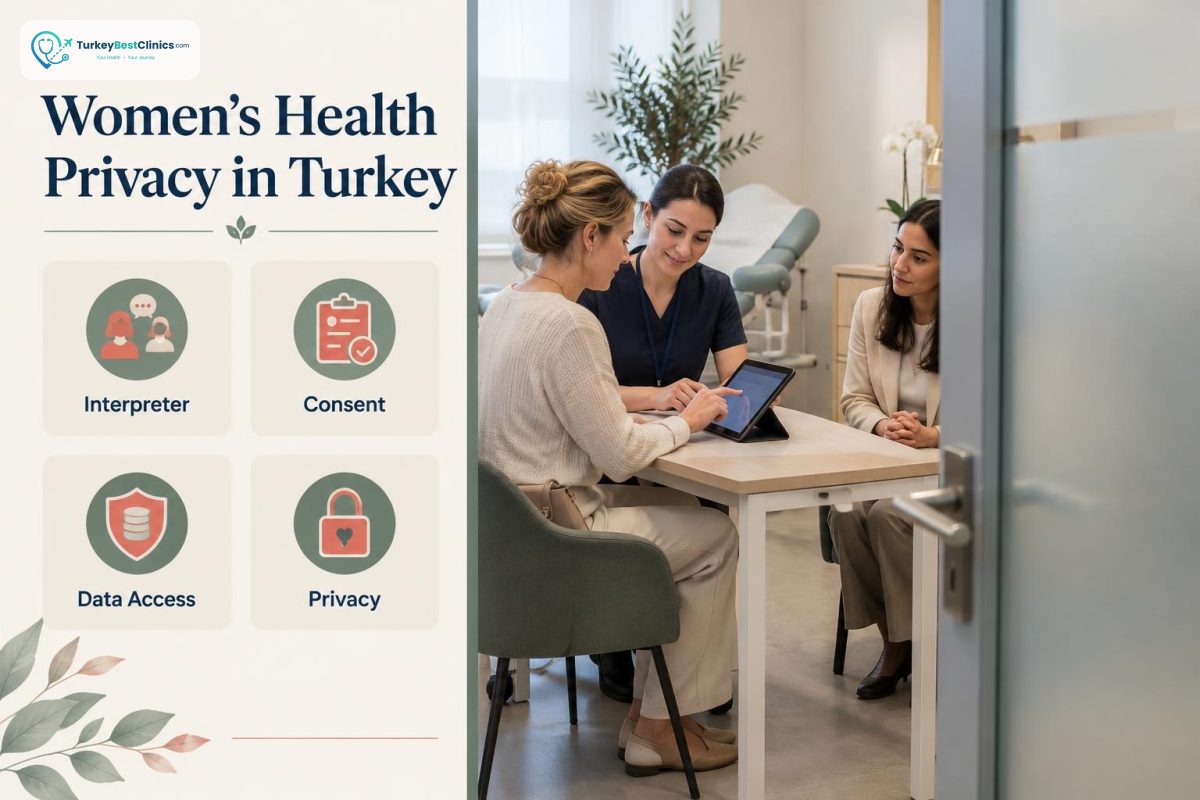
Privacy in women’s health assessments does not simply mean being examined behind closed doors. Knowing who will have access to the health information, images, laboratory results, and treatment decisions shared during your consultation is also an important part of the process.
Feeling comfortable during services such as gynecological examinations, fertility assessments, IVF, vaginal aesthetics, pelvic floor treatments, menopause counseling, or pregnancy follow-up directly affects clinical communication. When planning your care in Turkey, you can submit your preferences in writing before the procedure, including a request for a female physician, your choice of interpreter, whether you want a chaperone present, and your preferred communication channel.
Clearly stating your privacy expectations during the initial consultation can help prevent unnecessary communication or the involvement of people you do not want included in the process. Unless medically necessary, your consent should be obtained regarding who enters the examination room.
Which Information Can You Control?
- The healthcare professionals and interpreter who will be present in the examination room.
- Whether photography, video recording, or clinical imaging will be permitted.
- Whether results will be shared by email, telephone, secure portal, or in person.
- Which part of the consultation the chaperone may attend.
- Whether information will be shared with family members, an insurance company, or a travel organizer.
KVKK, Ministry of Health Authorization, and Safety During Women’s Examinations
Healthcare organizations operating in Turkey must meet the relevant licensing and authorization requirements. As a reasonable safety measure, before applying, you can check whether the organization involved in your medical tourism care holds a Health Tourism Authorization Certificate issued by the Ministry of Health of the Republic of Türkiye and verify the scope of its authorization.
Personal health data is considered special-category data in Turkey under Personal Data Protection Law No. 6698, known as the KVKK. Therefore, you may request information about the purpose of processing, retention period, and access permissions for your identification details, ultrasound images, hormone results, pregnancy information, operation notes, and communication records.
At authorized clinics, privacy practices should not rely solely on a general confidentiality statement. You can ask about specific procedures, such as the use of curtains or an enclosed examination area during gynecological examinations, restricting records to authorized users, keeping consent forms separately, and storing digital files with controlled access.
Specific Experience to Look for in Turkish Women’s Healthcare Teams
Your selected physician or team should be able to explain procedures directly related to your reason for seeking care, such as ultrasonography, colposcopy, hysteroscopy, laparoscopy, fertility assessment, or pelvic floor rehabilitation. The phrase “experienced team” alone is not sufficient; ask about the physician’s specialty, procedure volume, imaging method used, and the approach that would be followed in the event of a complication.
Regarding privacy, you may also request a written response about the availability of a female physician, the presence of female healthcare staff during the examination, the interpreter’s professional confidentiality obligations, and the sharing of sensitive information only with staff who need it. A medical tourism facilitator is not the person who makes medical decisions; explanations about diagnosis and treatment should be obtained directly from the authorized physician.
Women’s Healthcare Packages and a Controlled Process in Turkey
As part of the organization of your care, logistical assistance can be arranged for airport-to-clinic transfers, suitable hotel recommendations, interpreter support, and initial post-procedure care or prescription processes. You can decide in advance who will receive which information. During a women’s health assessment, identity verification, medical history, existing reports, required blood tests, and the need for ultrasonography are usually clarified during the initial consultation.
Depending on the reason for seeking care, your stay in Turkey may be 1–2 days for an examination alone, or longer for a surgical procedure or advanced reproductive health planning. The exact duration is determined by the type of procedure, menstrual cycle, laboratory results, anesthesia requirements, and the physician’s follow-up plan.
In Istanbul, resting at a quiet hotel after a procedure, taking short cultural trips indoors, or enjoying light gastronomic experiences may be more suitable. In Antalya, short programs in shaded areas may be preferable to intense sun exposure, long walks, and sea activities. In Izmir, low-intensity seaside or museum plans with easy access to post-procedure follow-up may be preferred.
Two Consultation Models for Privacy
| Methods Compared | Key Advantage | Effect on Recovery Time |
|---|---|---|
| In-person women’s health examination | Ultrasonography, physical assessment, and any necessary samples can be planned within the same clinical process | The examination itself generally requires no additional recovery; the duration may change if a biopsy or surgery is added |
| Secure online preliminary consultation | Allows you to share a sensitive medical history through a controlled digital channel before traveling and to discuss your preference for a female physician in advance | There is no physical recovery period; however, an in-person examination may be required for a definitive diagnosis |
An online consultation does not replace a physical examination or emergency assessment. If a video consultation is planned, you should clarify the security of the platform, whether the consultation will be recorded, and which medical file will contain the consultation notes.
Cost of Women’s Healthcare Privacy in Turkey and Country Comparison
Privacy is not usually priced as a separate “confidentiality fee” at most clinics; the cost is based on the scope of the examination, ultrasonography, laboratory services, consultation, or surgical procedure. The figures below are approximate international ranges for privacy-focused women’s health assessments and standard gynecological examinations. Biopsies, IVF, cosmetic surgery, and hospital stays may fall outside these ranges.
| Country | Approximate Price | What May Commonly Be Included |
|---|---|---|
| Turkey | €100–€300 | Specialist consultation, basic examination, and ultrasonography in some packages |
| United Kingdom | £250–£600 | Private gynecology consultation; tests are usually charged separately |
| Germany | €200–€500 | Private examination and clinical assessment; advanced imaging may incur an additional charge |
| United States | $300–$800 | Private physician consultation; insurance coverage and test fees vary |
When comparing quotations, do not look only at the total price. Ask in writing whether the choice of a female physician, interpreter, secure transfer, ultrasonography, laboratory services, follow-up consultation, preparation of medical reports in English, and a contact line to use in case of complications are included.
Criteria That Affect Privacy and the Treatment Process
- Physician’s specialty and experience: The physician’s training and practical experience relevant to your needs, such as gynecological ultrasonography, colposcopy, hysteroscopy, reproductive endocrinology, or pelvic floor surgery, should be assessed. If you have a strong need for private communication, clarify from the outset whether a female physician and female healthcare staff are available.
- Methods and medical technology used: Methods such as transvaginal ultrasonography, 3D ultrasound, colposcopy, hysteroscopy, or laparoscopy may involve different preparation, data-recording, and recovery requirements. The clinic should explain why a particular method is recommended, how long images will be retained, and who will interpret the results.
- Clinic location: Clinics in Istanbul, Antalya, and Izmir may differ in terms of transportation, hospital infrastructure, interpreter availability, and access to post-procedure follow-up. If sedation, a biopsy, or surgery is planned, access to emergency support and follow-up should take priority over proximity to the airport.
- Data and communication protocol: Ask whether results will be sent through WhatsApp, a personal email account, or shared phones. A secure portal, two-factor authentication, limited user access, and written consent procedures are factors that may offer stronger privacy safeguards.
- Consent and interpretation: Do not sign a medical consent form in a language you do not understand. The interpreter is expected to provide more than word-for-word translation: they should not pressure your decision and should protect the confidentiality of your health information.
Questions Before Applying and Next Steps
Before making initial contact, share your reports, current treatments, previous operation details, and any imaging results through a secure channel. Before sending identification or medical records, review the organization’s authorization certificate, data-processing notice, and information about who will have access to your files.
Three Questions to Have Answered During the Initial Consultation
- How will my request for a female physician or female healthcare professional during the examination be recorded? Along with this question, you can ask about the interpreter’s position in the room, the chaperone policy, and whether you will be informed in advance about who will be present during the examination.
- Which system will store my ultrasound, colposcopy, or biopsy images, and when will they be deleted? Ask clearly whether separate consent is required for photography and video recording and whether the images will be used for educational or promotional purposes.
- How can I receive my post-procedure results only through the channel I choose? Request written information about the secure portal, verification code, English-language report, follow-up consultation, and contact details for the medical team to reach in the event of an unexpected result.
If your privacy expectations are not being met, you have the right to pause the procedure, request another physician, or end the consultation before treatment begins. If you experience an emergency symptom, heavy bleeding, severe pain, fever, or serious pregnancy-related complaints, urgent medical assessment is required regardless of your travel plans.