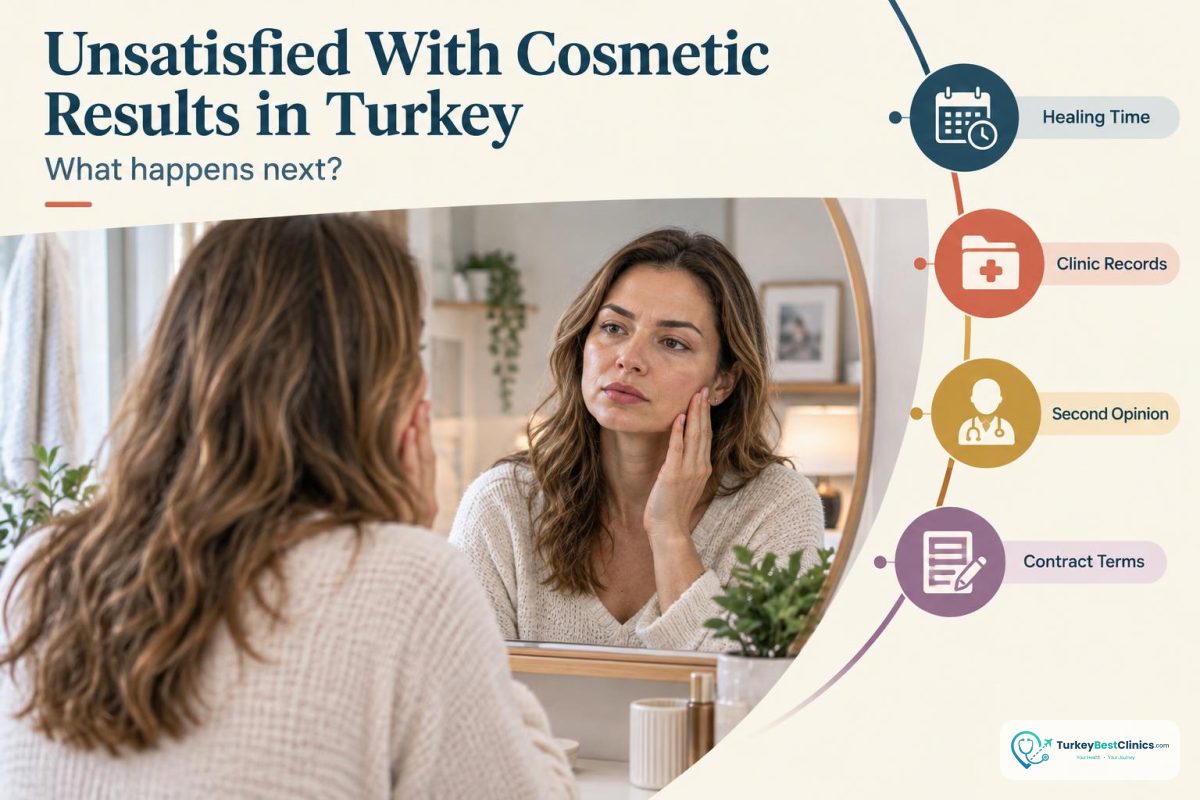
The Difference Between Cosmetic Expectations and Actual Healing
After a cosmetic procedure in Turkey, seeing a result in the mirror that differs from what you expected does not always mean the procedure was unsuccessful or that a permanent problem exists. Swelling, asymmetry, firmness, changes in skin color, and tissues not yet reaching their final shape may persist for varying periods after procedures such as rhinoplasty, facelift surgery, breast surgery, liposuction, and dermal filler treatment.
The aim of the initial assessment is to determine whether cosmetic dissatisfaction is caused by temporary signs of healing, a mismatch between expectations and the actual result, or a medical complication. Planning a corrective procedure before making this distinction may cause additional trauma to tissues that are still healing.
Key Timeline for Assessing the Result
- During the first days and weeks, swelling, bruising, and tenderness may alter the appearance.
- After nose surgery, the final contour may become clearer over several months, depending on skin thickness and the technique used.
- Swelling and tissue firmness may last longer after liposuction or body contouring.
- With injections such as dermal fillers and botulinum toxin, early asymmetry may be related to swelling at the treatment site or the time needed for the product to settle.
- Severe pain, fever, rapidly increasing redness, discharge, shortness of breath, or changes in vision require urgent medical assessment regardless of cosmetic expectations.
Turkey’s Safety and Authorization Framework for Cosmetic Revision
Before your first appointment, check whether the facility performing the procedure holds a Health Tourism Authorization Certificate issued by the Ministry of Health of the Republic of Türkiye. This certificate concerns authorization to provide services within the scope of health tourism; by itself, it does not guarantee a specific cosmetic result. The clinic should also clearly provide information about the relevant specialist, operating-room conditions, emergency plan, and written procedures for revision requests.
When assessing a revision specialist, examine their experience in relation to the specific procedure rather than relying on general claims. For example, in revision rhinoplasty, septal support, the nasal valve, and cartilage graft options are important; in breast surgery, capsular contracture, implant position, and asymmetry matter; after facelift surgery, scarring, nerve function, and tissue tension should be considered.
When evaluating the experience of Turkish plastic, reconstructive, and aesthetic surgery specialists in these areas, ask to see before-and-after photographs of similar revision cases at different stages of healing, treatment records, and information about possible limitations. Remember that photographs alone do not guarantee a result, but they may help you understand the clinic’s clinical approach.
Documentation and Communication Safety
- Keep the pre-procedure consent form, quotation, invoice, operative report, and discharge documents.
- Take dated photographs in the same lighting at different stages of recovery.
- Report concerns in writing through the clinic’s email address or official communication channel rather than relying only on social media messages.
- Request a written plan for the follow-up examination before your flight and for follow-up care after returning home.
Post-Procedure Support and What the Cosmetic Revision Package Covers
A health tourism package may include VIP transfers, accommodation, interpreter support, and the organization of initial care or essential products. Check the scope, number of days, and additional fees in the signed quotation. If you are dissatisfied with the cosmetic result, the package should specifically state in writing whether it covers a revision consultation, video consultations, additional tests, the cost of repeat surgery, and complication management.
Before deciding on revision, photo analysis, a physical examination, and a review of previous operative reports may be planned depending on the procedure. Ultrasound, CT scans, or blood tests may also be required. In many cases, the tissues are allowed time to settle; however, assessment should not be delayed if there are signs of infection, impaired circulation, or another urgent medical finding.
On lighter days outside follow-up appointments in Istanbul, covered museums, quiet cafés, or short car transfers may be suitable. After procedures involving the nose, face, or eye area, it is generally more appropriate to avoid crowded and dusty places. In Antalya, resting at the hotel and taking short, shaded walks may be suitable; in Izmir, calm dining stops may be more appropriate for accompanying guests while limiting intense sun exposure, swimming, and physical exertion.
Comparison of Two Main Correction Approaches
| Methods Compared | Key Advantage | Effect on Recovery Time |
|---|---|---|
| Observation, follow-up, and limited medical treatment | Helps avoid unnecessary surgery before healing is complete and allows minor contour differences to be addressed with less invasive intervention. | Does not require recovery from additional surgery; however, depending on the procedure, it may be necessary to wait weeks or months to see the final result. |
| Surgical revision | Provides a direct correction option for significant asymmetry, structural problems, implant position issues, scarring, or loss of function. | It may be more complex than the initial operation; tissue condition, the need for grafts, and the effects of previous surgery may extend the recovery period. |
Cost Comparison for a Revision Consultation and Second Procedure
There is no single price in Turkey for dissatisfaction with a cosmetic result, because the situation may range from a simple check-up and minor correction to extensive revision surgery. The ranges below are approximate planning figures that may be seen in the international healthcare tourism market in 2026. They vary depending on the procedure, hospital, anesthesia, tests, and whether accommodation is included.
| Country | Approximate range for revision or corrective treatment | Currency |
|---|---|---|
| Turkey | 1,500–8,000 | € |
| United Kingdom | 4,000–15,000 | £ |
| Germany | 5,000–16,000 | € |
| United States | 7,000–25,000 | $ |
For average revision planning in Turkey, a range of approximately €1,500–8,000 may be used as a reference. This range does not represent a minor correction and multi-area surgery in the same way. When requesting a quotation, ask for the surgeon’s fee, operating-room and anesthesia charges, implant or graft costs, pathology and imaging fees, follow-up visits, and any additional nights of accommodation to be listed separately.
Factors Determining the Cosmetic Result and Revision Cost
Consider the following factors together when assessing the scope and cost of the revision process:
- The specialist’s expertise and revision experience: It is important to choose a specialist with verifiable experience in identifying complications from previous procedures, such as cartilage support in revision rhinoplasty or capsular contracture management in breast surgery.
- Technology, techniques, and materials: Options such as ear or rib cartilage grafts in revision rhinoplasty, fat injection for facial contouring, implant replacement in breast surgery, or ultrasound-assisted assessment may change the cost and treatment process.
- The clinic’s location: In Istanbul, Antalya, and Izmir, hospital standards, operating-room use, accommodation duration, transportation, and international coordination costs may vary.
- The previous procedure and tissue condition: Multiple surgeries, thin skin, scar tissue, an implant capsule, or wound-healing problems may make the surgical plan more complex.
During the first clinical consultation, discuss measurable goals instead of “guarantees”: breathing function, a specific degree of asymmetry, scar location, implant position, or the conditions under which the contour will be assessed can be documented in writing. If cosmetic expectations cannot be fully met, the specialist should state this clearly and explain the alternatives.
Next Steps to Know Before Applying
Before traveling to Turkey again, organize your medical file and obtain at least one independent specialist opinion. The following questions may help clarify your roadmap when researching relevant revision and procedure options through the portal:
- How long should I wait before revision rhinoplasty, and how can it be determined whether septal or nasal valve support is needed?
- If I have asymmetry or capsular contracture after breast surgery, how should implant replacement, capsule surgery, and observation be compared?
- If contour irregularity occurs after filler treatment or facial contouring, what are the risks of surgical revision compared with limited injectable correction?
Before deciding on a new procedure, request a written medical explanation, follow-up schedule, and details of the fee coverage from the current clinic. Also clarify restrictions concerning flying, sun exposure, exercise, swimming, saunas, and skincare products with the specialist who will perform the procedure. The final plan should be based on an appropriate medical examination, not solely on an online photo assessment.