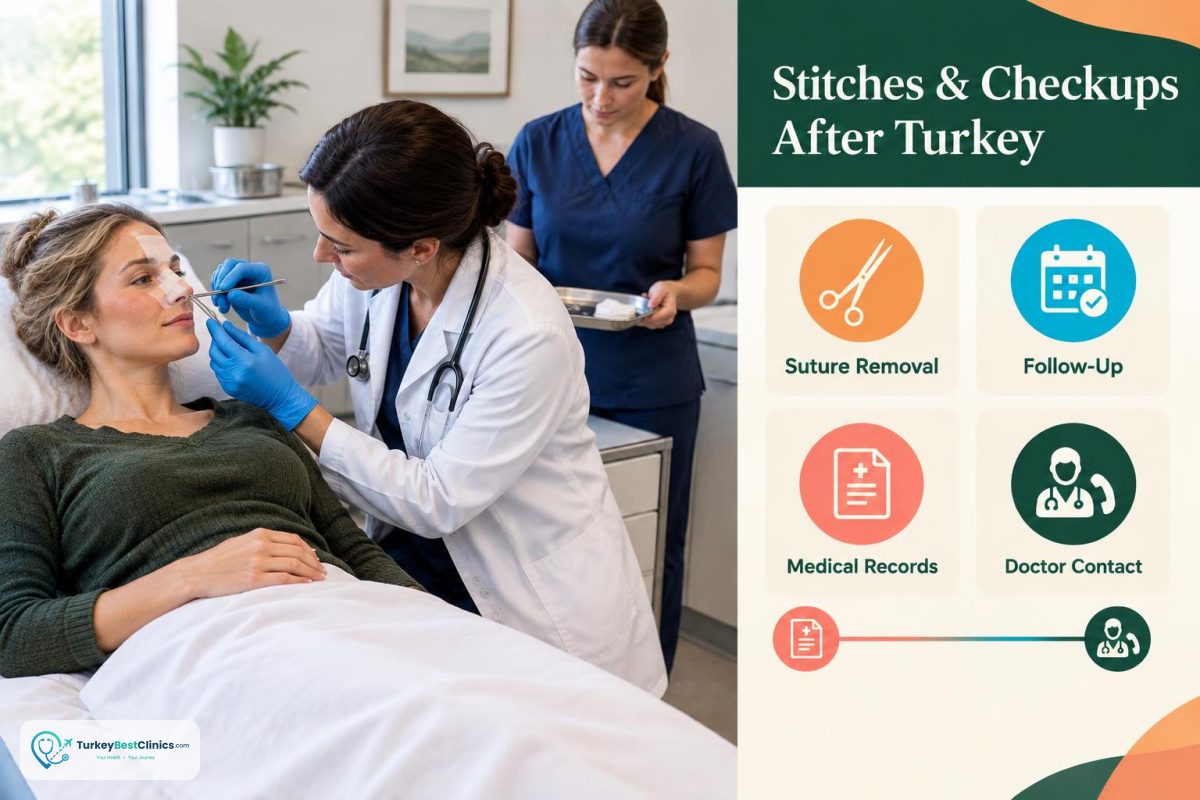
Stitch Removal and Follow-Up After a Procedure in Turkey
Returning to your home country after surgery or a cosmetic procedure in Turkey does not necessarily mean that your follow-up must continue in Turkey. Stitch removal, wound checks, and routine healing assessments can often be carried out locally, based on the operating surgeon’s recommendations and the agreement of a doctor in your home country.
However, not all stitches are removed at the same time, and not every wound is monitored in the same way. The suture material used, surgical site, skin tension, risk of infection, use of drains, and planned follow-up intervals should be clarified in advance.
The safest approach is to create a written follow-up plan between the team in Turkey and your doctor at home. This plan should clearly state the date range for stitch removal, dressing method, showering and physical activity restrictions, the types of wound-care products to use, and which symptoms require urgent medical assessment.
Absorbable and Non-Absorbable Stitches
Absorbable stitches are broken down by the body over time and usually do not need to be removed separately. By contrast, some stitches used on the skin surface and metal staples are removed by a healthcare professional within a specific time frame, depending on the progress of wound healing.
The timing of stitch removal should not be determined by the calendar alone. Wound-edge closure, the degree of redness, discharge, swelling, and tension around the surgical site should be assessed together.
Ministry of Health Authorization and Clinic Communication for Stitch Follow-Up
When planning a procedure in Turkey, choosing healthcare providers with a Ministry of Health-approved Health Tourism Authorization Certificate is important for access to surgical records, discharge documents, and international follow-up coordination. This certificate does not, by itself, guarantee a particular outcome; it indicates that the provider has the official framework required to offer services within the scope of health tourism.
Your follow-up plan should be prepared in line with the specialty of the team that performed the procedure. For example, after plastic surgery, monitoring facial and body incisions involves assessing wound-edge tension, scar direction, and the possibility of a seroma. After an orthopedic procedure, movement restrictions, cast or splint checks, and the effect of joint movement on the suture line must also be considered.
When assessing the Turkish surgeon’s case experience, do not rely only on a general statement about experience. More concrete indicators include the type of procedure performed, the incision or closure technique used, the postoperative follow-up protocol, and accessibility in the event of a complication.
Providing Complete Documentation
- Operation or procedure report
- Discharge summary and current medical recommendations
- Type of suture material used and the planned date range for removal
- Pathology, imaging, or laboratory results, if available
- Dated photographs of the wound area
- Telephone and email contact details for the clinic in Turkey
Preparing these documents in English or in a language your doctor can understand helps reduce information loss. In medical translation, it is particularly important to accurately convey terms such as the procedure name, anatomical site, and suture material.
Follow-Up Package Prepared in Turkey for Stitch Monitoring
Depending on the provider, arrangements may include VIP airport-clinic-hotel transfers, accommodation support, interpreter coordination, and guidance required during the initial aftercare period. Since the scope of these services may vary by provider, they should be confirmed in writing before booking.
Before leaving Turkey, a final wound check is generally performed and a follow-up note is prepared for your doctor at home. If your return date is very close to the stitch-removal period, completing the pre-travel check or arranging an appointment with a doctor in your home country in advance may be considered.
For companions in Istanbul, options may include indoor shopping areas, short museum visits, and quiet evening meals suitable for rest; in Antalya, short shaded walks near the hotel; and in Izmir, relaxing seaside breaks and light culinary experiences. If there is swelling, sun sensitivity, or restricted movement around the surgical site, long walks, sea activities, intense sun exposure, and crowded places should be postponed.
Checklist Before Leaving Turkey
- Confirm in writing whether the stitches are absorbable.
- Obtain the earliest and latest follow-up dates for stitches that need to be removed.
- Ask how wound care should be performed and which activities should be avoided.
- Save the contact details of the clinic representative to contact if unexpected symptoms occur.
- Provide consent for your doctor at home to communicate with the clinic’s medical team.
Costs of Stitch Removal and Follow-Up in Turkey and Other Countries
Stitch removal or a basic postoperative wound check may be a limited-scope procedure. However, the cost may change if the assessment includes a surgical evaluation, dressing change, ultrasound, drain check, or additional tests. The figures below are general market ranges only, and a procedure-specific quotation should be requested.
| Country | Approximate range for a basic check or stitch removal | Notes |
|---|---|---|
| Turkey | €50–€250 | Varies by private clinic, hospital, specialty, and additional procedures |
| United Kingdom | £80–£300 | Private consultation, nursing services, and surgeon assessment may be priced differently |
| Germany | €80–€300 | Private payment and insurance coverage may be determining factors |
| United States | $150–$600 | The total cost may vary depending on the consultation, facility, and insurance copay |
The clinic in Turkey may have included a certain number of early follow-up appointments in the procedure fee. Nevertheless, consultations in your home country, travel insurance, or additional imaging may be charged separately.
Comparing Two Follow-Up Approaches
| Follow-Up Approach | Key Advantage | Effect on Recovery Time |
|---|---|---|
| Follow-up with the surgeon in Turkey | Direct access to all technical details of the surgery and the materials used | Unexpected findings may be interpreted more quickly by the same team |
| Follow-up with a doctor in your home country | Convenient access and the opportunity for regular local examinations | If the plan is communicated accurately, it may reduce the burden of travel; missing documentation may delay assessment |
Factors That Affect the Cost and Follow-Up Plan
- Doctor’s specialty and experience: Simple stitch removal and a postoperative surgical wound assessment may not require the same level of expertise. The operating surgeon’s specialty, the complexity of the surgery, and the experience of your doctor at home in the relevant field can affect the follow-up plan.
- Suture and closure method: Absorbable sutures, removable monofilament stitches, intradermal closure, metal skin staples, and adhesive closure create different follow-up requirements. A definitive appointment date should not be set without knowing the type of suture used.
- Clinic location: In health tourism centers such as Istanbul, Antalya, and Izmir, private hospital and consultation fees may vary according to the centrality of the location, hospital infrastructure, and scope of services. The regional pricing policy of the clinic in your home country should also be considered.
These factors determine not only the cost of stitch removal but also the scope of the check and the level of coordination required. Ask for the written quotation to specify consultation, dressing changes, additional imaging, and emergency communication services separately.
Safe Steps to Take After Returning Home
When should the follow-up appointment be scheduled?
The appointment date should be determined by the surgeon in Turkey according to the surgical site and suture material. If you develop a symptom that requires attention after returning home, seek local medical care without waiting for the planned appointment date.
Which symptoms require prompt assessment?
Increasing redness or swelling, foul-smelling discharge, separation of the wound edges, uncontrolled bleeding, high fever, newly developing severe pain, or a marked deterioration in your general condition should be taken seriously. Since the meaning of these findings can vary from person to person, contact a healthcare professional rather than attempting to diagnose yourself.
How can your doctor at home communicate with the team in Turkey?
With your written consent, the operation report, photographs, and follow-up notes can be shared by email or through a secure healthcare communication channel. Direct communication between the two teams can make decision-making easier, particularly in cases of wound opening, drain problems, or unexpected swelling.
- Are my stitches absorbable, or do they need to be removed in my home country?
- At what intervals and under what lighting conditions should the surgical site be monitored with photographs?
- How can I find out whether an ultrasound, dressing change, or surgical assessment is needed during the wound check?
Obtaining written answers to these questions before leaving Turkey can help ensure that follow-up in your home country is carried out more systematically and safely. If your local doctor’s assessment differs from the recommendations of the surgeon in Turkey, arrange for both teams to discuss the situation again rather than making changes on your own.