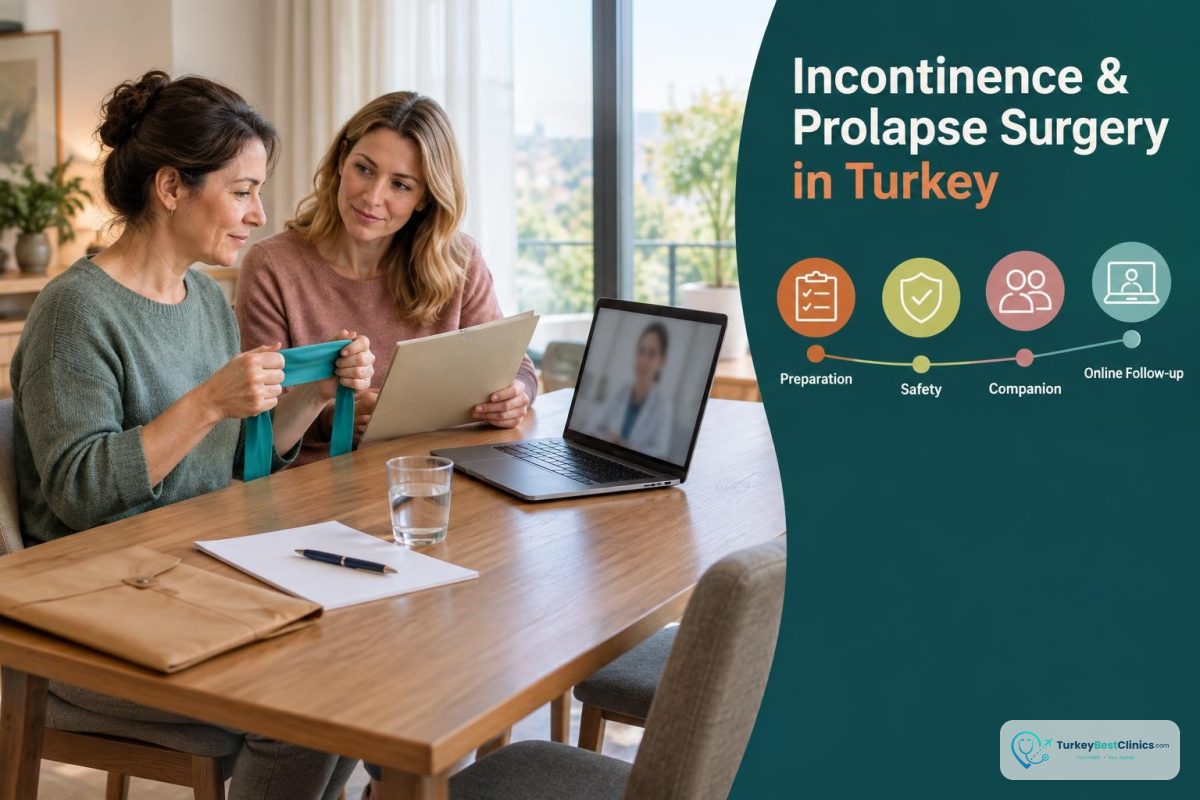
How Can Pelvic Floor Exercises Support Your Surgical Journey?
Urinary incontinence and pelvic organ prolapse can cause control and comfort issues during daily movement, coughing, exercise, or prolonged standing. Pelvic floor exercises do not replace surgery; however, they may help you identify the correct muscles, learn to control breathing and pressure, and begin postoperative rehabilitation more consciously.
A program prepared before travelling to Turkey should be tailored to the type of symptoms, the degree of prolapse, previous surgeries, childbirth history, and the planned surgical technique. General exercise advice provided remotely cannot replace a gynecology or urogynecology assessment.
Identifying the Correct Muscles
To identify the pelvic floor muscles, consider stopping the urine flow only as a one-time awareness tool to help locate the muscles; do not practise the exercise regularly while urinating. With a correct contraction, you should feel a gentle upward tightening around the vagina and anus without unnecessarily tensing the buttocks, thighs, or abdominal muscles.
At the beginning, short and controlled contractions without holding your breath are preferred under the guidance of a physiotherapist. If you experience pain, a noticeable increase in pressure, worsening vaginal heaviness, or difficulty urinating, inform your healthcare team rather than continuing the exercises.
Pelvic Surgery Safety and Urogynecology Standards in Turkey
It is important to plan surgery at a facility holding a Health Tourism Authorization Certificate issued by the Ministry of Health of the Republic of Türkiye and able to document the relevant surgical infrastructure. You can verify in writing beforehand that the certificate is current, that the hospital where the surgery will take place is fully equipped, and that intensive care and emergency intervention facilities are available.
Assessment for urinary incontinence and pelvic organ prolapse surgery may require coordination between obstetrics and gynecology, urogynecology, urology, anesthesiology, and, when necessary, pelvic floor physiotherapy teams. Turkish physicians work with different approaches, including vaginal repair, midurethral sling procedures, laparoscopic sacrocolpopexy, and selected robotic pelvic surgeries; however, the appropriate method is determined according to your examination, test results, and risk profile.
Preoperative Safety Checklist
- Urinalysis and, when considered necessary, urine culture may be used to assess for an active infection.
- A pelvic examination helps identify the location and degree of prolapse.
- If the type of urinary incontinence is unclear, urodynamic testing may be requested; this test is not mandatory for every patient.
- Post-void residual urine, ultrasound, or other examinations may be planned according to clinical need.
- The anesthesia assessment reviews existing medical conditions, previous surgeries, allergies, and your flight plan.
Requesting written information about the hospital’s sterilization processes, operating room standards, anesthesia team, and postoperative observation plan can help you make an informed decision rather than relying only on the clinic’s marketing statements.
What Is Included in Your Urinary Incontinence and Prolapse Surgery Package?
A health tourism package may include airport-hospital-hotel VIP transfers, accommodation near the hospital, a medical interpreter, and essential support during the initial care period; you should check the scope and exclusions in the written contract. Topic-specific assessments such as urinalysis, pelvic examination, anesthesia consultation, and, when considered necessary, urodynamic testing are scheduled during the initial evaluation days in Turkey before surgery.
The conditions under which your companion may stay with you in the hospital should be clarified in advance according to the hospital’s visitor and companion policies; staying at a hotel near the hospital can reduce the transportation burden after surgery. While you rest, your companion may take a short walk in a quiet park near the hospital or use the hotel’s wellness facilities in a way that complies with the movement restrictions resulting from your surgery.
Stages of the Pre-Travel Exercise Plan
- Initial online consultation: The relationship between incontinence and coughing, sudden urgency, or continuous leakage is assessed, along with sensations of prolapse, constipation, childbirth history, and previous surgery.
- Muscle awareness: You are taught how to identify and relax the pelvic floor muscles and activate them together with your breathing.
- Controlled strengthening: Long and short contractions are generally addressed alternately; the number of repetitions is determined according to your individual tolerance.
- Applying the exercises to daily life: Breathing and muscle control are practised before coughing, standing up, or lifting, with an emphasis on avoiding excessive straining.
- Reassessment in Turkey: The surgeon and physiotherapist determine, based on examination findings, whether the exercises should continue before surgery.
Do not decide on your own when to resume pelvic floor exercises during the early postoperative period. A gradual program is prepared by considering the stitches, signs of healing, urination, and the movement restrictions recommended by the surgeon.
Comparing Surgical Costs and Planning Your Travel Budget in Turkey
The average surgical cost of urinary incontinence or pelvic organ prolapse surgery in Turkey may generally range from approximately €3,000–€7,500, depending on the scope of the procedure. This range is only a general market indicator and may vary according to the examination, tests, hospital stay, implant or sling material, need for additional repair, and accommodation arrangements.
- Turkey: Approximately €3,000–€7,500
- United Kingdom: Approximately £7,000–£14,000
- Germany: Approximately €6,000–€12,000
- United States: Approximately $12,000–$25,000
When requesting a quotation, ask for the surgeon’s fee, anesthesia, operating room, hospital room, pathology, follow-up examinations, interpreter, transfers, accommodation, and any possible additional-night charges to be listed separately. Country comparisons should not be interpreted as exact quotations because health insurance, taxes, hospital category, and the scope of surgery may differ.
Factors Determining the Surgical Method, Preparation, and Recovery Time
Comparison of Two Main Surgical Approaches
- Vaginal repair or midurethral sling approach: In appropriately selected cases, this may reduce the need for an abdominal incision. Recovery time varies according to the scope of the procedure; many plans include a short period of hospital observation and follow-up in Turkey for approximately 7–14 days.
- Laparoscopic or robotic pelvic surgery: Particularly for certain types of prolapse, this may be performed through small incisions in the abdominal wall, and techniques such as sacrocolpopexy may be considered. The hospital stay and timing of your return home are determined according to bowel function, urination, pain control, and the surgeon’s approval for flying.
The choice between these two approaches is not based solely on recovery speed. The anatomical location of the prolapse, associated urinary incontinence, previous surgeries, general health, and long-term goals are assessed together.
Specific Factors Affecting the Price
- The physician’s expertise and experience: Urogynecology training, experience in pelvic reconstruction, and the surgeon’s annual volume of the planned procedure are considered.
- Technology, technique, and materials: The approach, such as vaginal repair, midurethral sling, laparoscopic sacrocolpopexy, or robotic surgery, as well as the sling system, suture material, and, when necessary, mesh selection, may affect the cost.
- Clinic location: In major centres such as Istanbul, Ankara, and Izmir, the hospital category, operating room capacity, distance to the hotel, and international coordination services may influence the total price.
The planned hospital stay varies according to the type of surgery; although discharge is often possible after a short observation period, additional repair or difficulty emptying the bladder may extend follow-up. Before returning to your country, the surgeon should approve wound assessment, evaluation of urination, and fitness to fly.
Follow-up After Returning Home with Online Follow-up
After leaving Turkey, online follow-up may be used to assess wound healing, urinary control, fever, increasing pain, bleeding, or newly developing symptoms. The consultation schedule is set at discharge, and you may be advised to contact a local healthcare provider when necessary.
Next Steps: Three Key Questions About Pelvic Floor Guidance
- Is urodynamic testing needed before travel? If the type of urinary incontinence is unclear, ask what findings would lead to this test and how the results could affect the choice of surgery.
- When can pelvic floor exercises begin after prolapse surgery? Ask the surgeon and physiotherapist how recovery restrictions differ for vaginal repair, sling procedures, and laparoscopic sacrocolpopexy.
- Which checks must be completed before flying home? Clarify whether urination, signs of infection, pain control, and the first postoperative examination will be completed before your flight date.
This guide is intended for general informational purposes. Exercise intensity, choice of surgery, hospital stay, and return date should be determined according to an individual examination and a written plan provided by the relevant specialists in Turkey.