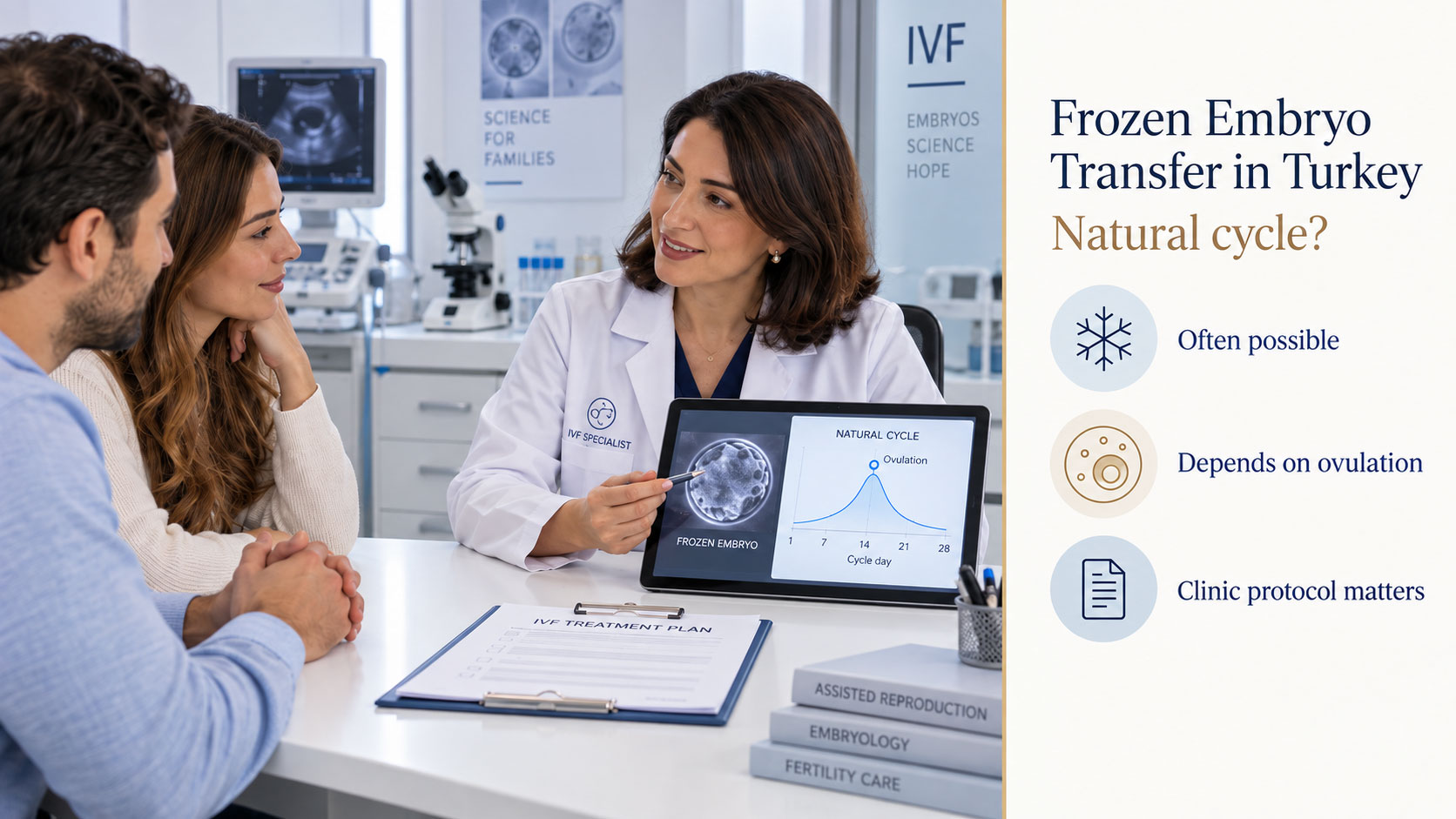
What does FET and the natural-cycle option mean?
Frozen embryo transfer involves thawing an embryo previously preserved using vitrification and placing it inside the uterus. Also known as FET, the aim of this process is to match the embryo’s developmental stage with the appropriate timing of the uterine lining.
In a natural-cycle transfer, the procedure is planned by monitoring your own ovulation. If ovulation is regular, follicular development, the uterine lining and the timing of ovulation are assessed through ultrasound and hormone monitoring. The transfer date is then determined according to the embryo’s developmental day.
Not every FET protocol is performed in a natural cycle. If ovulation is irregular, the appropriate timing cannot be identified, or previous evaluations indicate that a specific plan is needed for the uterine lining, a hormone-supported programmed cycle may be considered.
Natural, modified natural and programmed cycles
- Natural cycle: Ovulation is monitored through serial ultrasounds and, when necessary, blood hormone tests. The transfer date is calculated based on spontaneous ovulation.
- Modified natural cycle: Follicular development is monitored naturally. If the physician considers it appropriate, a trigger injection may be used to make the timing of ovulation more predictable.
- Programmed or hormone-prepared cycle: The uterine lining is prepared with hormone support, and the transfer date is planned in advance. Ovulation monitoring is not as central as it is in a natural cycle.
The choice of approach is not based solely on scheduling convenience. Ovulation patterns, previous FET outcomes, ultrasound findings, development of the uterine lining and the clinic’s monitoring protocol are evaluated together.
Safety and embryology standards for FET in Turkey
When choosing a center for medical tourism in Turkey, it is important to verify that the provider holds a Health Tourism Authorization Certificate issued by the Ministry of Health. This certificate indicates that the organization is authorized to provide healthcare services to people living abroad; however, you should also ask separately about the quality procedures used by the embryology laboratory.
Safety during FET is not limited to the transfer procedure itself. Embryo identification, record-keeping for cryopreservation tanks, vitrification and thawing protocols, laboratory temperature monitoring and final checks before transfer should all be evaluated together.
How clinical experience is reflected in natural-cycle monitoring
Obstetrics and gynecology specialists and reproductive endocrinology teams working in this field in Turkey monitor natural ovulation using serial transvaginal ultrasounds, measurements of the uterine lining and, when necessary, blood hormone tests. The embryology team assesses the post-thaw condition of the blastocyst or embryo at an earlier developmental stage, cell integrity and the records required before transfer.
When speaking with a center, you may request written information about its annual number of FET procedures, the distribution between natural and programmed cycles, how post-thaw embryo survival rates are reported and the laboratory’s internal quality-control system. A single success rate should not be interpreted without knowing the patient’s age, the embryo’s developmental stage, whether genetic testing was performed and the condition of the uterus.
What may be included in a FET package in Turkey?
A medical tourism package may include airport or in-city VIP transfers, hotel accommodation at the selected standard, medical interpreter support and initial post-procedure care guidance. Confirm the inclusions and additional charges in writing before travelling. The length of stay in Turkey for FET may vary depending on the number of ultrasounds required during a natural cycle. While many plans require monitoring over several days, the trip may be shorter if the initial ultrasound and some blood tests can be completed in your home country.
For a natural-cycle protocol, the date of the start of menstruation, previous ultrasound reports, embryo-freezing records and any documents relating to uterine assessment are shared before travelling to Turkey. The center should explain on which days follicular development will be monitored, whether progesterone or similar hormone tests will be needed and how the plan would change in the event of unexpected early ovulation.
Preparation and timing before transfer
- It is clarified how the first day of the menstrual cycle should be reported.
- The baseline ultrasound examines the uterine structure, ovaries and any possible signs of cysts.
- During serial monitoring, the growth of the dominant follicle and endometrial thickness are assessed.
- The timing of ovulation is identified naturally or, in a modified natural protocol, triggered at the physician’s discretion.
- The transfer date is calculated according to the embryo’s developmental day.
- The thawing date, embryo identification checks in the laboratory and the post-transfer monitoring plan are documented in writing.
FET costs in Turkey and international comparisons
In Turkey, the approximate total cost of a single frozen embryo transfer using a natural or modified natural cycle may range from €1,500–€3,500, depending on what is included. This range varies according to whether ultrasound monitoring, hormone tests, embryo thawing, the transfer procedure, physician evaluation and, at some centers, short-term coordination services are included.
The figures below are approximate international market ranges for 2026 and should not be considered definitive quotes. Donor eggs, genetic embryo testing, embryo biopsy, long-term storage, additional uterine procedures and travel expenses are generally priced separately.
- Turkey: Approximately €1,500–€3,500
- United Kingdom: Approximately GBP 2,000–4,500
- Germany: Approximately €2,000–€4,000
- United States: Approximately USD 3,000–6,500
Review the inclusions when comparing quotes
Ask whether the price in Turkey covers only the embryo transfer fee or also includes the ultrasounds and blood tests involved in natural-cycle monitoring. The contract should explain the conditions under which the embryo was previously stored, the laboratory procedure that will be used for thawing and the fee policy if the transfer is cancelled.
Factors that affect FET costs and the natural-cycle process
- Physician expertise and experience: A physician’s experience with natural-cycle, modified natural-cycle and programmed FET protocols in reproductive endocrinology and infertility may affect the monitoring frequency, timing plan and assessment of complex cases.
- Methods used and laboratory infrastructure: Vitrification-based embryo storage, the thawing protocol, blastocyst transfer, the embryo identification system and cryobank record-keeping may influence pricing. Genetic testing, biopsy or additional laboratory procedures requested for the embryo may be charged separately from the FET fee.
- Clinic location: Clinical services, laboratory capacity, accommodation costs and transfer distances may differ in Istanbul, Ankara, Izmir and other cities. When comparing prices in city centers with those in surrounding districts, make sure the same service items are included.
A natural cycle does not always mean a shorter or less expensive option. Serial ultrasound checks, unexpected ovulation timing, moving the transfer to another day or extending travel plans may affect the total budget.
Next steps and key questions when planning FET
When researching natural-cycle FET in Turkey, first organize your embryo-storage records, previous transfer reports and current ultrasound results. Then ask the center to provide written information about the rationale for selecting the protocol, the monitoring schedule, the fee inclusions and the alternative plan if the transfer is postponed.
- How many ultrasounds and which hormone tests are required to monitor ovulation for natural-cycle FET? This can help clarify your length of stay in Turkey, possible travel changes and monitoring fees.
- How are a vitrified blastocyst’s thawing and the laboratory checks performed on the day of transfer? You can request details about embryo identification, post-thaw assessment and transfer timing.
- If a natural cycle is not suitable, when would a modified natural or programmed FET option be considered? Ask about the alternative plan in cases of irregular ovulation, early ovulation or uterine-lining development that differs from expectations.
This information provides a general overview and does not replace an individual medical assessment. The protocol should be selected based on the records of the available embryos, ovulation patterns, uterine assessment and the clinical opinion of the specialist team caring for you.