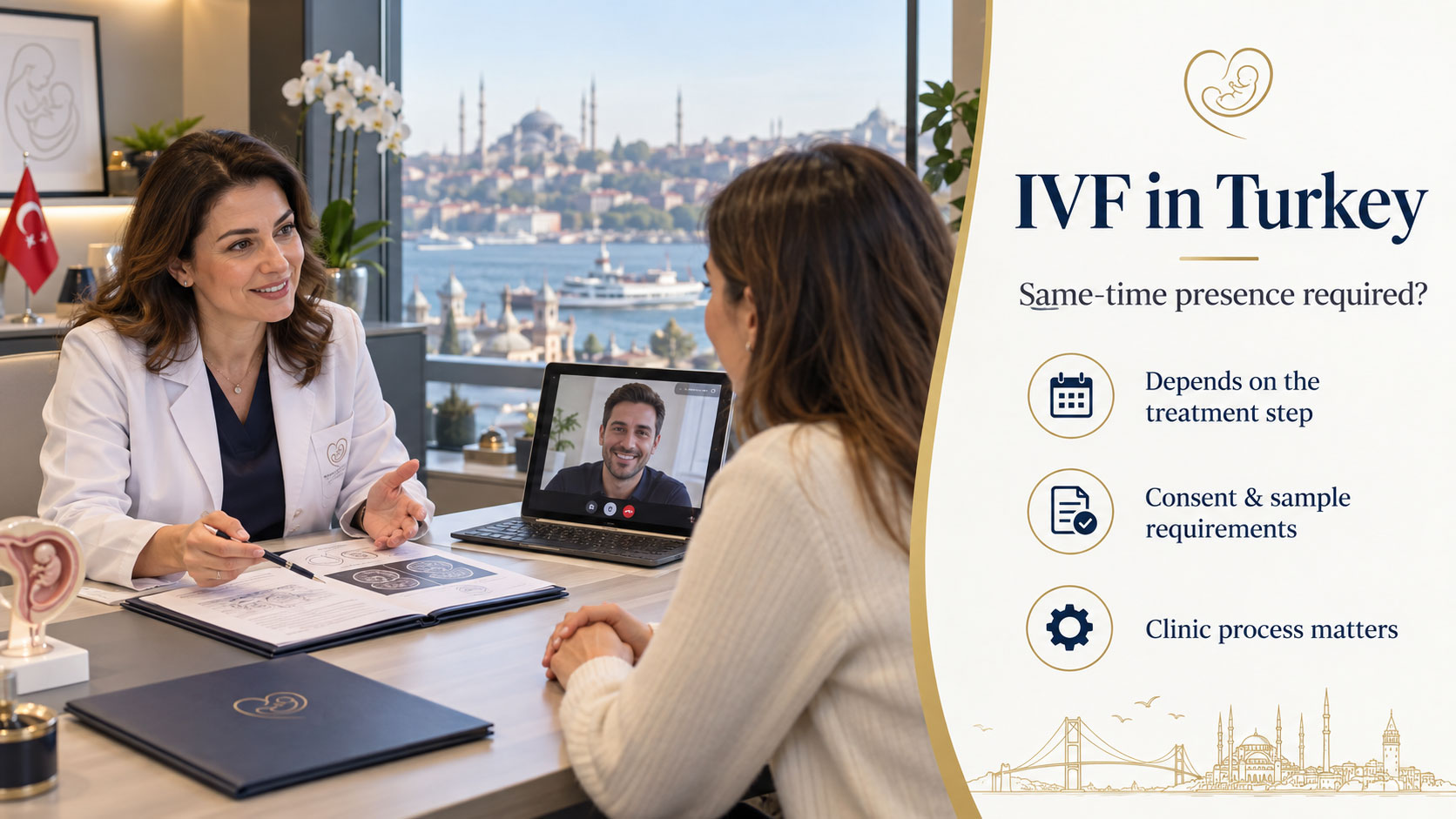
Clinic Visits at the Same Time During IVF Treatment in Turkey
If you live abroad, one of the most important logistical questions when planning IVF treatment in Turkey is whether both partners need to be at the clinic at the same time for every appointment. In general, it is not necessary to attend all check-ups, blood tests and consultations together; appointments can be planned separately according to each partner’s role in the fertility treatment and the nature of the procedure involved.
However, some stages of IVF treatment are directly related to sperm collection, egg retrieval, written consent or embryo transfer. Therefore, before setting your travel dates, you should obtain written confirmation from the clinic about the stages that require physical attendance.
Stages When Being Present Together Is Particularly Important
- Checking marriage and identity documents during the initial assessment
- Signing the treatment plan and legal consent forms
- Providing a sperm sample on the day of egg retrieval
- Delivering the sample to the laboratory if previously frozen sperm will not be used
- Completing the required consent and identity verification procedures before embryo transfer
These requirements may not be applied in the same way at every clinic. In particular, if sperm is frozen in advance or the sample is prepared earlier at a reliable centre, the male partner may not need to be present on the day of egg retrieval. The final decision depends on the clinic’s medical and administrative procedures.
Legal Consent and Clinic Safety for IVF in Turkey
IVF procedures in Turkey are carried out within the framework of the rules for assisted reproductive treatment centres established by the Ministry of Health. When choosing a centre for medical tourism, check whether it holds a Ministry of Health of the Republic of Türkiye-approved International Health Tourism Authorisation Certificate and the relevant licence for an assisted reproductive treatment centre.
Turkish obstetrics and gynaecology specialists and reproductive endocrinology teams may be involved in assessing ovarian reserve, controlled ovarian stimulation, follicle monitoring, ultrasound-guided oocyte retrieval, sperm preparation and embryo culture. When assessing a clinic’s experience, do not rely only on general promotional statements. Also review the embryology laboratory’s working methods, vitrified embryo storage infrastructure, sperm-freezing procedures and emergency plan.
Physical Attendance and Signature Procedures
For IVF treatment in Turkey, documents showing marital status and the identity details of both partners may be required. Written consent from both partners may be necessary at certain stages of treatment; whether a power of attorney, remote signatures or documents signed in advance are accepted varies from one centre to another.
For this reason, send your passports, marriage certificate, any divorce or name-change documents and reports from previous treatments to the clinic before travelling. Also confirm in writing in advance whether the documents require Turkish translation, an apostille or notarisation.
IVF Travel and Package Inclusions
A medical tourism package may typically include VIP airport-to-clinic transfers, accommodation at a contracted hotel, interpreter support in a foreign language and guidance on initial post-procedure care or necessary basic products. The inclusions should be clearly stated in the clinic’s quotation.
Before treatment begins, AMH, FSH, LH, oestradiol and thyroid assessments may be arranged, along with an ultrasound antral follicle count, semen analysis and, where considered necessary, infection screening. The female partner’s active medication protocol may usually require approximately 8–14 days of monitoring, during which several ultrasound scans and hormone tests are performed.
How long the male partner needs to stay in Turkey depends on when the sperm sample will be provided. If a fresh sample is to be used, he may need to be at the clinic on the day of egg retrieval. If sperm is frozen in advance, the centre should explain when and under what quality conditions the sample must be delivered.
Suggested Travel Schedule
- Initial online consultation and review of medical records: before travelling
- Starting medication and follicle monitoring: approximately 8–14 days
- Egg retrieval and sperm collection: on the same day or within the time frame specified by the clinic
- Embryo transfer: within a few days according to the fresh-transfer plan, or during a later trip in a frozen embryo transfer protocol
- First pregnancy test: on the date recommended by the clinic after transfer, usually in approximately 9–14 days
This schedule is not fixed. Embryo development, hormone response, endometrial thickness or the decision to freeze embryos may change the length of your stay in Turkey.
IVF Costs in Turkey and International Comparisons
The average clinic cost of standard IVF treatment in Turkey may be approximately €2,500–€5,000, depending on what is included. This amount often covers the initial assessment, ultrasound monitoring, egg retrieval, laboratory procedures and a specified number of embryo transfers; medication, genetic testing, frozen embryo transfer and additional accommodation may be charged separately.
- Turkey: Approximately €2,500–€5,000
- United Kingdom: Approximately £5,000–£8,000
- Germany: Approximately €4,000–€7,000
- United States: Approximately $12,000–$20,000
These ranges are approximate figures provided for market comparison and do not replace a direct quotation. Medication dosage, embryo freezing, sperm freezing, blastocyst culture, embryo storage duration, genetic analysis and additional transfers may change the total budget.
Items to Check When Requesting a Quotation
- Whether medication is included in the total price
- How many ultrasound scans and hormone tests are included
- Embryology laboratory and blastocyst culture fees
- The cost of sperm freezing and storage duration
- Whether the quotation includes one embryo transfer or more than one
- The fee policy if the transfer is cancelled or the embryos are frozen
Factors Affecting Couples’ Clinic Stay and Treatment Cost
The physical attendance plan and total cost may vary according to the following specific factors:
- Doctor’s expertise and experience: In cases such as advanced age, diminished ovarian reserve, repeated unsuccessful treatment or male-factor infertility, the assessment approach of a doctor specialising in reproductive endocrinology may affect the travel and monitoring plan.
- Methods used and laboratory technology: Working with fresh sperm, sperm freezing, intracytoplasmic sperm injection (ICSI), blastocyst culture, vitrified embryo freezing and assisted embryo procedures require different planning and pricing. ICSI is not automatically necessary in every IVF cycle; suitability is determined through clinical assessment.
- City where the clinic is located: In centres such as Istanbul, Ankara, Izmir or Antalya, hotel, transfer and local transportation costs may vary in addition to clinic fees. Distance from the airport is also important when planning for one partner to travel to Turkey only for a specific procedure.
The quotation should clearly state the days on which each partner needs to be present, whether fresh or frozen sperm will be used, which documents require signatures and what plan will be followed in the event of unexpected follicle development.
Three Specific Questions to Ask Before Travelling to Turkey
- Does the male partner definitely need to be at the clinic on the day of egg retrieval? Ask about sperm freezing, the sample acceptance period and alternative sample delivery procedures.
- Which documents must both partners sign in person? Clarify the requirements for the marriage certificate, passports, translation, notarisation or apostille before travelling.
- How would the length of stay in Turkey change if a vitrified embryo transfer were planned instead of a fresh embryo transfer? Ask the clinic coordinator in writing about the new travel dates required for embryo freezing, storage and a subsequent transfer.
The safest approach is to send both partners’ medical records and existing test results to the clinic before the initial consultation, then mark the procedures requiring physical attendance separately on a calendar. This will clarify the days when you need to be at the clinic together; however, medical decisions and legal consent requirements should only be finalised with the authorised centre.