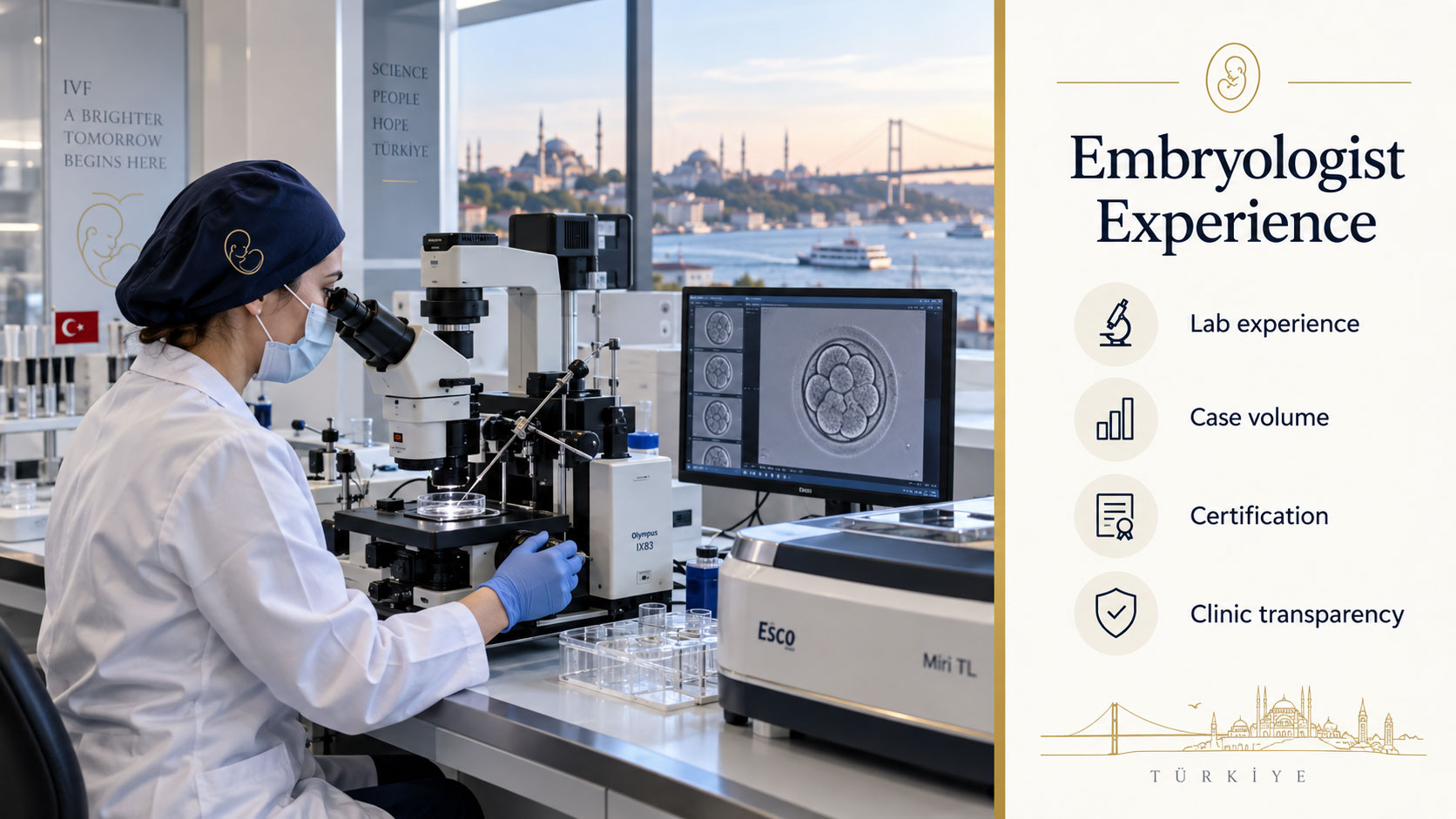
Why Is Embryologist Experience Important for Understanding IVF Outcomes?
During IVF treatment, the embryologist manages many critical stages, from evaluating egg and sperm samples in the laboratory and carrying out fertilization to embryo culture and vitrification. Therefore, when choosing a clinic, you should consider not only the doctor’s expertise but also the embryology laboratory’s team structure and daily working standards.
Embryologist experience alone does not guarantee a pregnancy outcome. Many variables can affect the result, including age, ovarian reserve, sperm characteristics, previous treatment history, embryo development, and uterine conditions. For this reason, assess experience together with measurable laboratory information.
During your initial consultation, ask for the name, educational background, professional role, and stage of involvement of the person responsible for the embryology laboratory. Transparency is better demonstrated when the clinic can explain which procedures the team routinely performs rather than using only general statements.
Key documents to check
- The embryologist’s undergraduate and postgraduate education in biology, genetics, biochemistry, veterinary medicine, or a related health sciences field
- Total experience working in embryology laboratories and the period spent working at the current clinic
- The scope of their role in embryo culture, microinjection, blastocyst culture, vitrification, and warming procedures
- Where applicable, training and certification records from ESHRE, ALPHA, or similar international professional organizations
- The division of responsibilities among the laboratory director, quality manager, and clinical doctor
Safety and Authorization Checks for Embryology Laboratories in Turkey
When applying for treatment under health tourism arrangements in Turkey, verify whether the clinic or relevant healthcare facility operates within the scope of the International Health Tourism Authorization Certificate issued by the Ministry of Health. It is important to confirm in writing the certificate’s validity, the facility’s official legal name, and the unit in which the service is provided.
Do not consider the term “accredited” sufficient on its own. A Ministry of Health authorization certificate, licensing information, the laboratory’s quality system, and laboratory standard certificates such as ISO 15189, where applicable, represent different aspects. Ask separately about the scope and validity date of each document.
When assessing the experience of Turkish embryology teams, ask about their recent procedure volume and the methods used rather than relying on broad claims such as total case numbers. For example, the annual number of ICSI procedures, the proportion of cycles undergoing blastocyst culture, the number of vitrified embryos, and post-warming viability records can provide a more concrete picture of the laboratory’s workflow.
Specific elements to look for in the laboratory quality system
- Continuous or regular recording of incubator temperature, gas levels, and humidity
- A written backup plan for power outages, equipment failures, and incubator replacement
- At least two-step verification or an electronic tracking system for embryo and sample identification
- Sample placement, record-keeping, and access controls for vitrification tanks
- Documented procedures for air quality, particle control, and cleaning in the laboratory environment
- The ability to explain internal quality control results and participation in external quality assessment programs
Due to personal data and clinical confidentiality requirements, these records may not be provided to you as detailed patient files. However, you can request general information about the methods used, audit frequency, how quality indicators are monitored, and the period covered by the results.
What Is Included in a Turkey IVF Package Covering Embryologist Services?
A health tourism package may include airport or local VIP transfers, accommodation, interpreter support, and guidance regarding the initial care process. Check the scope, number of days, and additional fees in writing. From an embryology perspective, ask whether the package includes evaluation of egg and sperm samples, selection of the fertilization method, laboratory monitoring of embryo development, and sharing of procedure reports.
The length of your stay in Turkey may vary depending on the scheduling of egg collection and whether embryo transfer is performed during the same cycle or at a later date through a frozen embryo transfer. If you are traveling from abroad, ask the clinic how long previously performed hormone tests, semen analyses, ultrasound reports, and infection screenings remain acceptable.
Communicating directly with the embryology laboratory
Requesting a brief consultation with an embryologist during your initial online meeting may be useful when choosing a clinic. You can ask how embryo assessment criteria are reported, whether blastocyst culture is routinely performed in every cycle or only in selected cases, and under what conditions embryos are vitrified.
It is a more reliable sign of communication when the embryologist explains limitations, possible scenarios, and the group to which the data applies instead of making definite promises about success. Photos, videos, or anonymized results tables from another clinic should not, on their own, be considered proof of laboratory quality.
Comparing Costs for IVF and Embryologist Experience in Turkey
The approximate total cost of IVF treatment in Turkey may range from €2,500–€4,500 for many standard cycles. This range varies depending on whether medications, genetic testing, donor procedures, additional freezing procedures, and travel expenses are included.
| Country | Approximate standard IVF/ICSI cost | What to check regarding embryology services |
|---|---|---|
| Turkey | €2,500–€4,500 | Confirm in writing whether ICSI, embryo culture, and vitrification are included |
| United Kingdom | GBP 5,000–8,000 | Check whether medication, laboratory, and freezing fees are charged separately |
| Germany | €4,000–€7,000 | Ask about legal coverage, insurance contributions, and additional laboratory procedures |
| United States | USD 15,000–25,000 | Check whether ICSI, biopsy, genetic analysis, and transfer are priced separately |
These prices are approximate ranges for international market comparison and do not replace an individual quote, as exchange-rate movements, clinic scope, and personal treatment planning may affect the cost. Request a written quote with separate line items for the embryologist consultation, ICSI, blastocyst culture, first embryo transfer, embryo freezing, storage period, warming, and follow-up.
How Do Embryologist Experience, Treatment Methods, and Clinic Location Affect the Price?
When assessing the factors that affect the price, look not only at the total amount but also at the scope of laboratory services. The following points provide a basic framework for comparing quotes:
- Expertise of the doctor and embryology team: The laboratory director’s length of service, annual procedure volume, and active role in microinjection and blastocyst culture may affect the price. Ask whether the team includes a single embryologist or several specialists working in shifts, and how laboratory responsibility is handled at weekends.
- Methods and laboratory technology: Procedures such as ICSI, time-lapse embryo monitoring, controlled vitrification, laser-assisted procedures, or embryo biopsy may change the package scope. Not every method is necessary for every cycle; medical necessity and additional fees should be explained separately.
- Clinic location: Rent, laboratory operating costs, transportation, and accommodation expenses may differ between Istanbul, Ankara, Izmir, and other cities. In addition to the city, it is important to know whether the clinic has its own laboratory, whether samples are transported to another center, and how transfer time is managed.
When you receive multiple quotes, compare the same scope of services. For example, one quote may include only egg collection and transfer, while another may include ICSI, embryo freezing, and one year of storage. These two prices are not directly equivalent.
How should you interpret outcome tables?
Try to request success rates from the clinic broken down by age group, type of embryo transfer, and fresh versus frozen transfer. Instead of relying on one overall percentage, ask how many cycles the data is based on, how pregnancy is defined, and whether the live birth rate is reported separately.
You can also ask which assessment system underlies the embryo quality classification. Morphological classification describes the embryo’s appearance and stage of development; it does not, by itself, show that the embryo is genetically normal.
Three Embryology Questions to Ask Before Choosing a Clinic in Turkey
After your initial consultation, the following questions can help you compare quotes and laboratory practices more rationally:
- Who is responsible for the embryology laboratory, and what has been their role in ICSI, blastocyst culture, and vitrification procedures during the past 12 months?
- Which written quality procedures are used for embryo identification, incubator monitoring, and vitrification tank records?
- Which services are included in the quoted price: embryo culture, the first transfer, freezing, storage, warming, and, where applicable, embryo biopsy?
Clear and consistent answers that align with the scope of the supporting documents can help you evaluate the clinic’s communication. Before making a decision, review your video consultation notes, written price quote, authorization certificate information, and the scope of the planned procedures together.