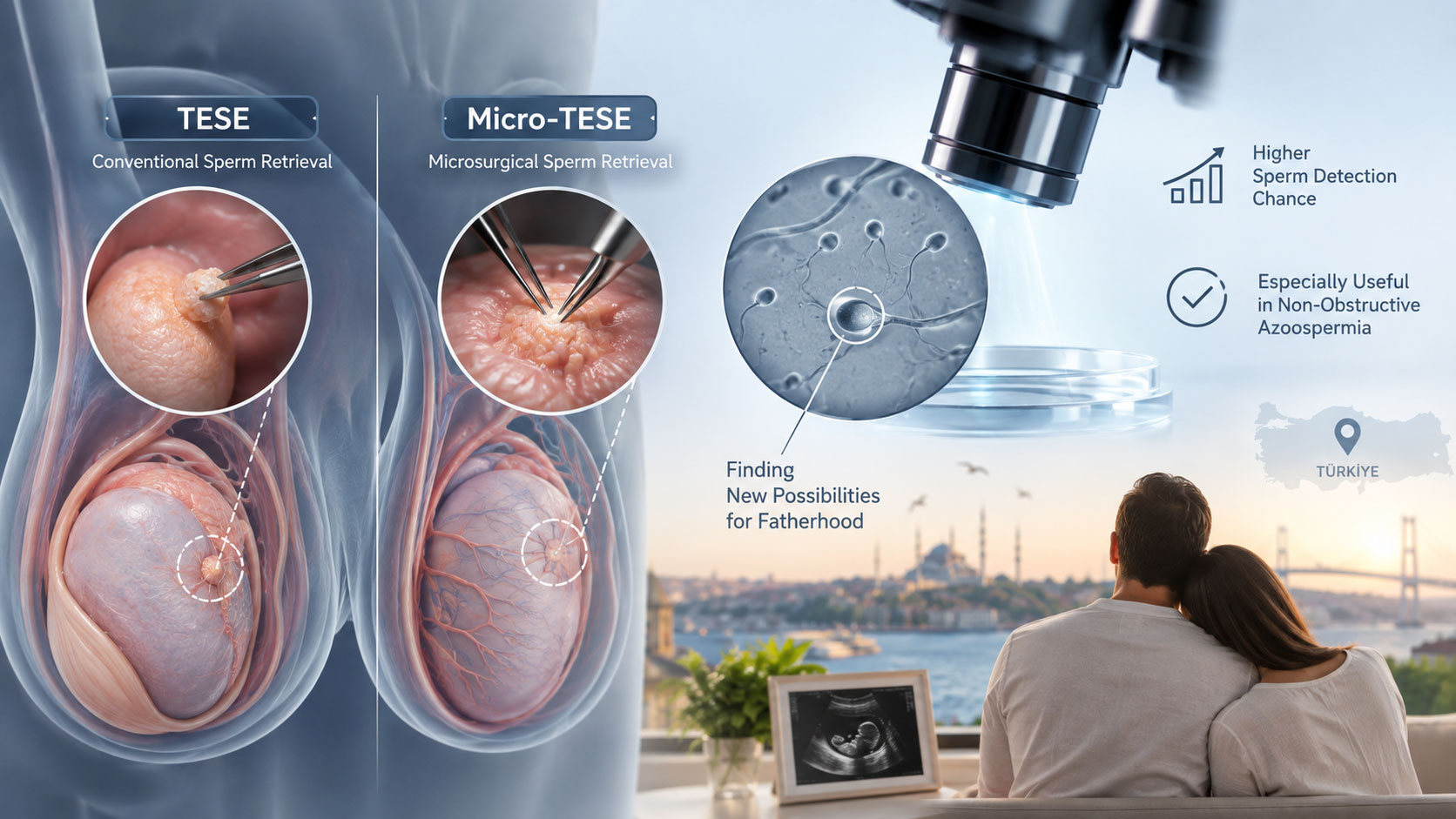
What Does the Sperm Retrieval Process with TESE and Micro-TESE Involve?
When no sperm are found in the semen, this is called azoospermia. TESE involves taking small samples from the testicular tissue to search for sperm, while Micro-TESE involves examining the testicular tissue under an operating microscope and selecting tubules that are more likely to contain sperm.
For these procedures, success is assessed solely by whether sperm are found during surgery. Finding sperm does not mean that the IVF and ICSI process planned for the same day or earlier will definitely be successful; embryo development, egg-related factors and laboratory conditions also affect the outcome.
Distinguishing obstructive and non-obstructive azoospermia
The first step is to distinguish obstructive azoospermia, in which sperm are produced but cannot reach the semen because of a blockage in the ducts, from non-obstructive azoospermia, in which sperm production in the testes is significantly reduced or continues only in isolated areas. This distinction is assessed through a physical examination, at least two semen analyses, hormone testing, ultrasound and, when necessary, genetic investigations.
- Obstructive azoospermia: If sperm production in the testes is preserved, sperm retrieval rates with TESE may exceed 80–95% in many series.
- Non-obstructive azoospermia: Sperm retrieval rates with Micro-TESE are generally reported at approximately 35–60%; higher or lower results may be seen in selected groups.
- Conventional TESE: In non-obstructive azoospermia, the success rate is usually more variable than with Micro-TESE and may be reported at approximately 20–45%.
These rates should not be directly compared between centres. Age, genetic findings, previous sperm retrieval attempts and the characteristics of the patient group included in the study can significantly alter the statistics.
Safety and Andrology Standards for Micro-TESE in Turkey
When applying for treatment within the scope of health tourism in Turkey, you can check whether the clinic or hospital operates under a Health Tourism Authorization Certificate issued by the Ministry of Health of the Republic of Türkiye. This certificate is an important administrative indicator that health tourism services are being provided in accordance with regulations; it does not, by itself, guarantee sperm retrieval.
When planning Micro-TESE, it is important for specialists in urology, andrology, embryology and, when necessary, genetics to assess the case together. The experience of Turkish urology teams with different clinical conditions, such as obstructive azoospermia, a history of varicocele, hormonal disorders and Y-chromosome microdeletions, can only be meaningfully evaluated by asking clearly about the methods used, the annual number of procedures and the patient group from which the results were calculated.
Key documents reviewed during the assessment
- Dates and results of at least two separate semen analyses
- FSH, LH, total testosterone and any other hormone results considered necessary by the physician
- Reports from previous TESE, Micro-TESE or duct surgery procedures
- Genetic assessments such as karyotyping and Y-chromosome microdeletion testing
- Testicular ultrasound and, if available, physical examination findings
- The plan for examining the tissue collected during the procedure in the embryology laboratory and freezing it if sperm are found
In particular subtypes of Y-chromosome microdeletion, the likelihood of finding sperm may be very low. For this reason, sharing genetic reports during an online assessment before travelling may help prevent an unnecessary procedure from being planned.
What Is Included in a TESE and Micro-TESE Package in Turkey?
A health tourism package may include VIP airport-to-hospital transfer, selected accommodation, interpreter support and coordination of initial post-procedure care or essential products; you should check the scope in the written quotation.
For Micro-TESE, the length of stay in Turkey generally varies from approximately 5 to 10 days, depending on the plan. Before the procedure, semen analysis, hormone tests, anaesthesia assessment and, when considered necessary, genetic investigations are completed. If sperm are found, same-day use or cryopreservation is discussed with the embryology team.
Procedure-day and follow-up plan
TESE or Micro-TESE is generally performed under anaesthesia, and the tissue collected is sent to the laboratory. The time required to search for sperm may vary depending on the laboratory’s workflow and the nature of the sample; sufficient time should be allowed in the travel plan for a post-procedure check-up.
During recovery, you will receive individual instructions regarding strenuous physical activity, flying and sexual activity. If severe pain, increasing swelling, fever or a noticeable change at the wound site develops, you should contact the team that performed the procedure promptly.
TESE and Micro-TESE Costs in Turkey: Comparison by Country
The average surgical and laboratory cost of TESE or Micro-TESE in Turkey may range from approximately €2,500 to €5,500. This estimate does not always include IVF, ICSI, genetic testing, long-term sperm storage, medication, additional nights of accommodation or complication management.
| Country | Approximate TESE/Micro-TESE cost | Price note |
|---|---|---|
| Turkey | €2,500–€5,500 | Varies according to the centre and the anaesthesia and embryology services included |
| United Kingdom | £5,000–£10,000 | Private-centre prices; IVF/ICSI is generally calculated separately |
| Germany | €4,000–€8,000 | Surgical, laboratory and storage charges may be listed separately |
| United States | $8,000–$16,000 | Hospital, anaesthesia and pathology fees may increase the total |
When comparing international prices, do not compare only the surgical fee. Also compare whether tissue examination during surgery, sperm freezing if sperm are found, storage duration, follow-up examinations and interpreter coordination are included in the same quotation. Because exchange rates and the scope of clinical services may change, treat these figures as a written preliminary quotation range rather than fixed prices.
Factors That Affect the Success Rate and Cost of TESE
The success rate and total cost may not be affected by the same factors. When evaluating the procedure plan, review the following areas separately:
- Experience of the urology andrology specialist: Particularly in non-obstructive azoospermia, the surgical approach used for microscopic dissection, a history of previous unsuccessful TESE and preservation of testicular tissue are important. Ask which azoospermia group the centre used to calculate its results and how many procedures the figures are based on.
- Method and laboratory infrastructure: Conventional TESE and Micro-TESE are not the same procedure. An operating microscope, intraoperative sperm searching, an experienced embryology team and cryopreservation capacity may be decisive factors in the process.
- Genetic and hormonal status: The type of Y-chromosome microdeletion, karyotype result, FSH level, testicular volume and findings related to the pituitary–testicular axis may alter the likelihood of finding sperm. Providing an individual percentage without these data is not reliable.
- Clinic location: Centres in Istanbul, Ankara, Izmir and other cities may have different hospital, anaesthesia, accommodation, interpreter and laboratory charges. Evaluate location not only by price, but also by whether the hospital where the procedure is performed and the andrology laboratory work in coordinated cooperation.
When requesting a quotation, obtain written clarification about the fee policy if no sperm are found, the scope of an additional search for samples during the same session, tissue storage charges and whether IVF/ICSI procedures are billed separately. These questions support both budget planning and transparency in medical decision-making.
Three Questions to Answer Before Travelling to Turkey
- For my type of azoospermia, is TESE or Micro-TESE more appropriate? How do semen analyses, hormone results, testicular volume and genetic reports influence this choice?
- Which patient group does the centre’s reported sperm retrieval rate refer to? Are obstructive and non-obstructive azoospermia reported separately, and are cases with previous TESE identified separately?
- If sperm are found, what same-day ICSI and freezing plan will be followed? Are the embryology laboratory, cryopreservation period and IVF/ICSI fees included in the surgical package?
A plan that answers these three questions with supporting documents and a written scope can make research into TESE or Micro-TESE in Turkey more realistic. Final suitability and the individual likelihood of success are determined by the relevant urology and andrology team after the examination and available test results have been assessed together.