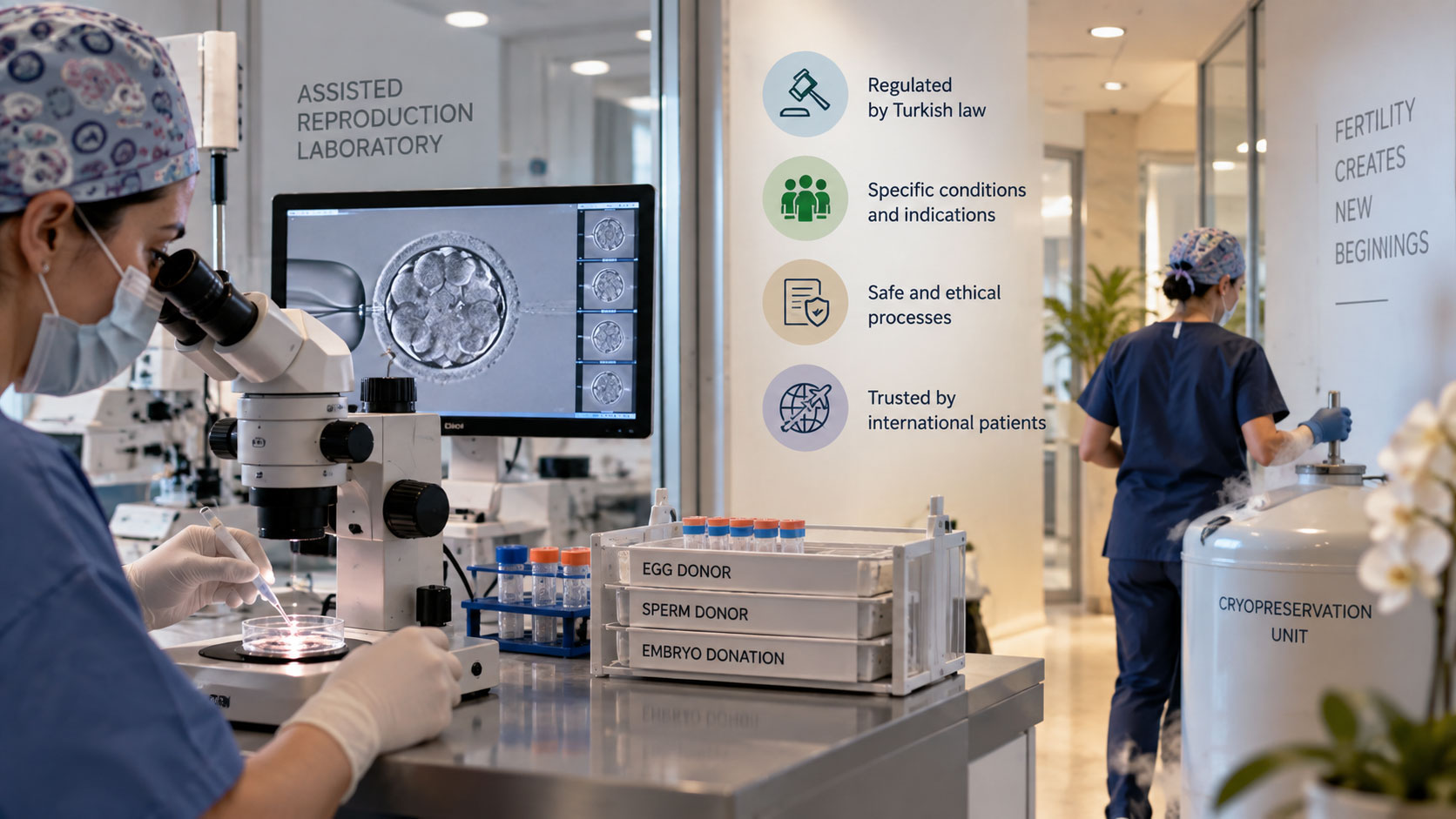
Basic Legal Status of Egg and Sperm Donation in Turkey
IVF treatment using egg donation, sperm donation, or embryo donation is not permitted in Turkey. This prohibition covers obtaining reproductive cells from a donor in Turkey, using them in a laboratory, or bringing them from abroad and incorporating them into a treatment protocol.
Living abroad, holding foreign citizenship, or applying through medical tourism does not change this rule. Even if a clinic operating in Turkey is authorized by the Ministry of Health, it cannot offer donation-based treatment. A Medical Tourism Authorization Certificate only allows services that comply with the legislation to be made available to international applicants; it does not permit a prohibited method.
When planning assisted reproductive treatment in Turkey, the basic principle is that the genetic material must belong to the married couple themselves. Therefore, before applying, the clinic should clearly distinguish between the options that can be performed using your own eggs and sperm and donation alternatives that cannot legally be carried out in Turkey.
Assisted Reproductive Technology Regulations, Ministry of Health Oversight, and the Limits on Donation
What does a Medical Tourism Authorization Certificate provide?
In Turkey, IVF and other assisted reproductive techniques are carried out under regulations known as assisted reproductive technology regulations, together with the relevant healthcare legislation. A clinic holding a Medical Tourism Authorization Certificate approved by the Ministry of Health may provide foreign-language support, coordinate international applications, and offer logistical services related to the treatment process. However, this certificate does not authorize the use of an egg or sperm bank.
It is also important that the clinic is authorized to perform the relevant assisted reproductive treatments, that its embryology laboratory operates in compliance with the legislation, and that procedures are properly recorded. Turkish obstetricians and gynecologists and fertility specialists have experience in procedures using the couple’s own gametes, such as ovulation monitoring, egg retrieval, sperm preparation, intracytoplasmic sperm injection, and embryo transfer. This technical expertise does not mean that donation treatment is legal in Turkey.
Can donor material be brought from abroad?
Bringing material from a sperm or egg bank in another country to continue a donation protocol that is not legally available in Turkey does not provide a secure legal route. It may also create additional issues involving customs, the transportation of biological material, laboratory acceptance, genetic records, and reproductive health legislation.
Therefore, if a clinic offers treatment with donor material, anonymous egg donation, a sperm bank, or embryo donation, you should request written information explaining under which licenses and legal provisions the service is being offered in Turkey. In practices that do not comply with the legislation, serious uncertainty may arise regarding fees, contracts, embryo storage, and treatment outcomes.
Your IVF Process in Turkey Without Donation
For a treatment plan using your own eggs and sperm, logistical services such as international travel coordination, accommodation, interpreter support, and initial care coordination may be included in the package. The suitability of a protocol that does not involve donation is determined after reviewing your medical records and carrying out an assessment in Turkey.
Before travelling from abroad, it is useful to share previous IVF reports, hormone results, semen analysis, ultrasound images, surgical history, and any genetic test results. In Turkey, ovarian reserve, the structure of the uterine cavity, sperm parameters, and previous embryo development will be reassessed; if considered appropriate, a treatment plan will be created using your own gametes.
Whether the medication protocol, egg retrieval, and embryo transfer can be completed during the same trip depends on ovarian response, the duration of embryo development, and the transfer strategy. For this reason, before finalizing your flights or hotel stay, you should obtain an approximate schedule and the cancellation or modification terms from the clinic in writing.
Costs of Donation Treatments in Turkey and Other Countries
Since egg or sperm donation cannot be offered as a legal treatment package in Turkey, there is no legitimate and comparable Turkey price for this procedure. The figures below are approximate ranges that may be seen at private clinics in the listed countries; they may not include the scope of treatment, donor selection, medications, laboratory procedures, genetic testing, or travel expenses.
| Country | Approximate range related to donation | Legal status and scope |
|---|---|---|
| Turkey | No legal donation package | Egg, sperm, and embryo donation are not performed |
| United Kingdom | Approximately GBP 8,000–15,000 | Donor-egg treatment; medications and additional tests may be charged separately |
| Germany | Sperm donation approximately EUR 4,000–8,000 | Sperm donation is possible under certain conditions; egg donation is prohibited |
| United States | Egg donation approximately USD 20,000–40,000 | Donor compensation, agency, medication, and laboratory fees may increase the total |
For IVF in Turkey using your own gametes without donation, starting prices of approximately EUR 2,500–5,000 may be seen at private clinics; this figure cannot be compared with donation treatment. Before accepting a quotation, check whether medications, embryo freezing, storage, genetic testing, additional ultrasounds, and the cost of a second transfer are included.
Factors That Affect Legal Treatment Options in Turkey
Whether donation is legal is not a matter that changes according to price. However, the scope and total cost of assisted reproductive treatment planned with your own gametes in Turkey may vary according to the following factors:
- The specialist’s expertise and clinical experience: In cases such as low ovarian reserve, previous unsuccessful attempts, reduced sperm count, or problems with embryo development, experience in reproductive endocrinology and embryology becomes important. The specialist’s approach to ICSI, embryo culture, and the assessment of repeated treatment failure may affect the scope of the quotation.
- The methods and laboratory procedures used: Conventional IVF and ICSI, fresh transfer and frozen embryo transfer, blastocyst culture, and preimplantation genetic testing when indicated do not have the same cost structure. The suitability of these methods should be determined only through medical assessment; no technique guarantees success.
- The clinic’s location: Transportation, accommodation, and coordination costs may vary in centers such as Istanbul, Ankara, Izmir, and Antalya, where international healthcare services are concentrated. Ask the clinic to specify separately whether airport transfers, an interpreter, accommodation, medication, anesthesia, and embryo storage fees are included in the quoted price.
Three Donation Questions to Answer Before Applying
- Which IVF options can be used in Turkey without donor eggs or donor sperm? Ask which legal protocol may be considered based on your ovarian reserve, semen analysis, and previous treatment records.
- Instead of Turkey, which countries offer a legal and regulated process for donation treatment? Also examine the country’s requirements regarding donor eligibility, identity disclosure rules, genetic screening, access to information during childhood, and parenthood documentation.
- How can the Turkish clinic’s Medical Tourism Authorization Certificate and assisted reproductive treatment license be verified? Check the certificate number, the scope of the clinic’s authorization, the status of its embryology laboratory, and written confirmation that the contract does not include donation.
Because legislation may change over time, before making travel and payment decisions, request an up-to-date written explanation from the Turkish clinic, a detailed price breakdown, and documentation specifying the legal framework under which the procedure will be performed. Even if you have been directed to Turkey for donation treatment, do not transport biological material or make a payment before legal compliance has been confirmed.