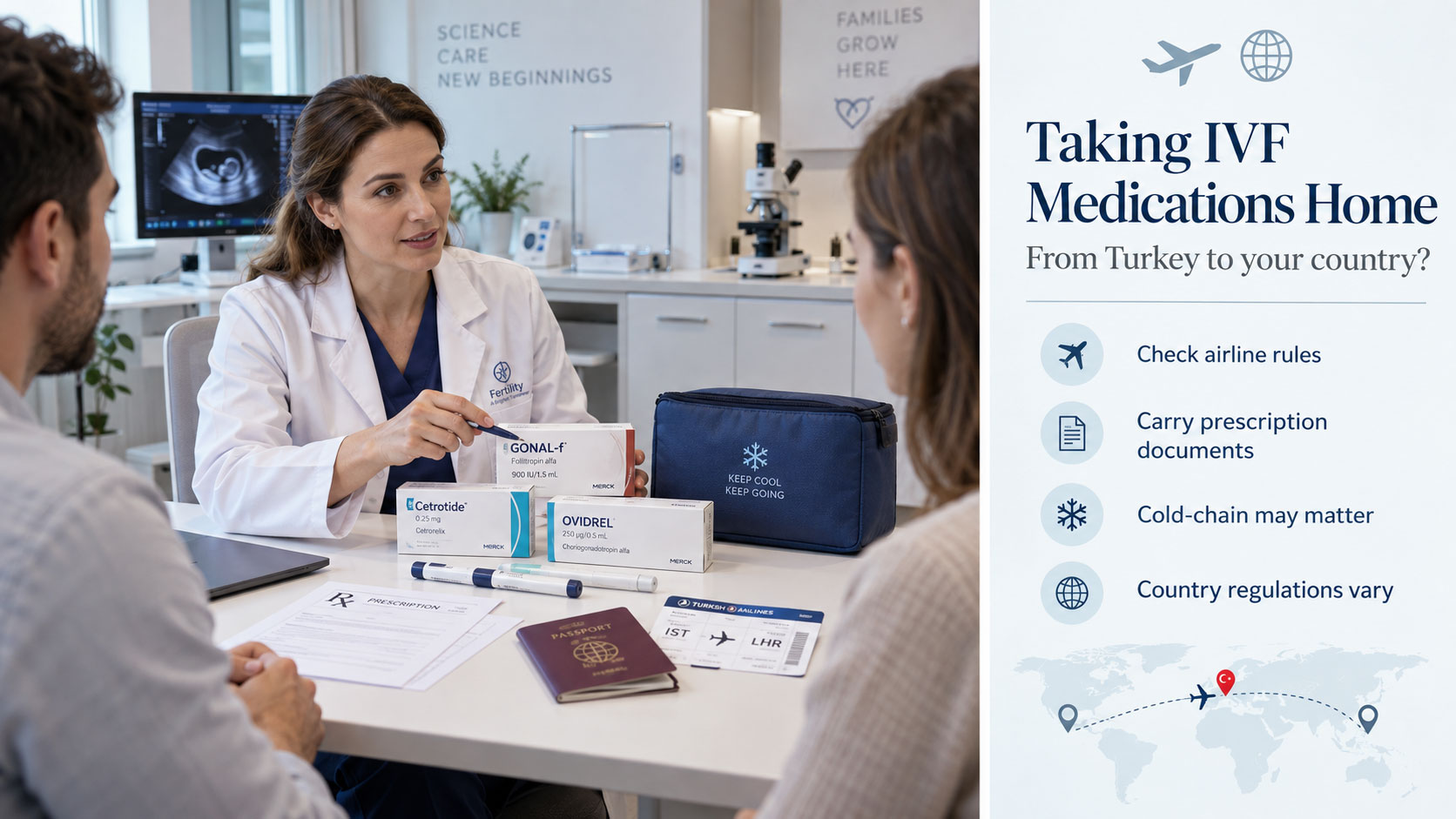
What Does Taking IVF Medications from Turkey to Your Country Involve?
In some cases, you may be able to take medications prescribed during IVF treatment in Turkey to your home country for personal treatment purposes; however, this is not automatically accepted without complications. The medication’s active-ingredient group, total quantity, injectable form, storage temperature, prescription status and the import regulations of your destination country must all be considered together.
For hormone-containing injections and products requiring a cold chain in particular, approval from the Turkish clinic alone may not be sufficient. Departure rules from Turkey, airline security procedures and customs regulations in the destination country are enforced by different authorities. It is therefore important to verify every stage in writing before travelling.
Assessing Medications as Personal-Use Items
Medications prescribed for use during a short-term IVF protocol and carried in reasonable quantities may be assessed as personal-use items in many countries. However, the definition of a reasonable quantity varies from country to country, and some customs authorities may request a doctor’s letter showing the duration of treatment.
Giving the medications to another person, carrying them for commercial purposes or possessing them without a prescription may lead to different legal consequences. Removing the medications from their boxes and distributing them among different bags, carrying unlabelled syringes or sending the medications by courier may make the explanation process more difficult.
Safety and Documentation for IVF Medications in Turkey
Check whether the organisation where you are planning treatment in Turkey holds a Health Tourism Authorisation Certificate issued by the Turkish Ministry of Health. This certificate indicates that the organisation is authorised to provide international healthcare services; it does not mean that you are permitted to import medications into your country.
A physician working in obstetrics and gynaecology or reproductive endocrinology may incorporate ultrasound measurements and hormone results into the treatment plan to assess ovarian response. Concrete clinical experience in this field helps determine the medication dose and administration schedule according to the individual’s medical condition; the prescription must be issued only by an authorised physician.
Documents to Include in Your Travel File
- A prescription signed by the physician or a printed copy of the electronic prescription
- A doctor’s letter in English or the official language of the destination country, explaining the active ingredient, dosage and frequency of use whenever possible, rather than only the brand name
- A patient information document matching the name on your international passport
- A pharmacy receipt showing that the medications were purchased
- If a cold chain is required, a letter from the clinic or pharmacy explaining the storage temperature
- Confirmation of any advance notification to the airline regarding injections, needles or cooling equipment
The documents may include the diagnosis, treatment duration, daily medication plan and total quantity being carried. To protect medical privacy, prepare a clear file that allows customs officials to understand that the medication belongs to you and is intended for personal treatment, without sharing unnecessary details.
What Is Included in a Turkey Health Tourism Package with IVF Medications?
Coordination may include VIP transfers between the airport or hotel and the clinic, suitable hotel accommodation, interpreter support when needed, and basic guidance on initial care or medication use. Check the package contents in writing, including the cost of prescription medications, pharmacy provision, cold-chain equipment and official permits required to enter your country.
If you plan to take IVF medications from Turkey, request a medication list, administration schedule and storage instructions from the clinic before travelling. The start and end dates of injections used for ovarian stimulation, the timing of monitoring ultrasounds and any necessary protocol changes may affect how long you need to stay in the country.
Cold Chain and Airport Security Procedures
Products that must be kept refrigerated may generally be safer to carry in your hand luggage rather than in checked baggage; nevertheless, confirm the airline’s cabin baggage and liquid rules in advance. Cooling gel, thermal bags and needle equipment may require explanation during security screening.
Do not allow the medications to come into direct contact with ice, and obtain written information from the clinic about the product’s permitted temperature range. Airlines may have additional rules for electric mini coolers, dry ice or injection equipment. For connecting flights, you must also check the customs procedures of the transit country; reviewing only the rules of the final destination is not sufficient.
Practical Steps When Entering the Country
- Keep the medications in their original, pharmacy-labelled packaging.
- Keep the prescription and doctor’s letter together with the medications in easily accessible hand luggage.
- Find out in advance whether you need to declare that you are carrying prescription medications on the customs form.
- If an official asks questions, explain that the medication is for your personal IVF treatment and that the quantity is limited to the period stated on the prescription.
- If you are uncertain, obtain a written response from the customs or medicines regulatory authority of the destination country.
Average Cost of IVF Medications in Turkey and Country Comparison
Medication costs may be calculated separately from the clinical fee for IVF treatment. The ranges below are approximate market indications that vary according to the prescription protocol, number of injections, pharmacy prices, reimbursement status and currency fluctuations; they do not constitute a personalised quote.
| Country | Approximate IVF medication cost | Main factor affecting the price |
|---|---|---|
| Turkey | €400–€1,200 | Medication protocol and total number of injections |
| United Kingdom | GBP 800–2,000 | Private prescription, pharmacy and reimbursement conditions |
| Germany | €700–€1,800 | Insurance coverage and prescription co-payment |
| United States | USD 2,000–6,000 | Insurance coverage, pharmacy network and protocol length |
A medication cost that appears lower in Turkey may require additional transport equipment, translation, a doctor’s report or assessment by a local physician when you return home. Therefore, compare not only the price of the medication but also all official and logistical expenses that may arise during travel.
Factors Determining the Price and Transport Process for IVF Medications
- Physician’s expertise and experience: Training in reproductive endocrinology, experience managing similar ovarian responses and experience developing protocols based on ultrasound and hormone monitoring may affect the assessment fee and follow-up plan.
- Medication method and administration type: Daily subcutaneous injections, different dosage options, hormone groups used for ovarian stimulation, ovulation-triggering injections and luteal support products may change the total cost. Not all products have the same storage temperature requirements; cold-chain needs also affect the transport plan.
- Clinic location: Clinic, pharmacy and transfer costs may vary between Istanbul, Ankara, Izmir and other cities. The distance from the airport, the number of monitoring visits and whether treatment continues in the same city may affect the overall budget.
- Prescription and documentation services: An English doctor’s letter, certified translation, a detailed medication list or documentation requested by the airline may incur additional charges. Ask in advance whether these items are included in the package.
- Protocol length: The duration of injections may vary according to ovarian reserve, response to previous treatment, ultrasound findings and hormone results. A longer protocol may require more medication and more monitoring.
These factors do not replace medical advice. Do not change the medication dose, administration day or storage conditions yourself; ask for written communication to be established between the physician in Turkey and the healthcare professional who will provide follow-up in your country.
Three Questions to Answer Before Returning to Your Country
- Does my country accept prescription injections used in IVF treatment for personal use? Request up-to-date written information from the destination country’s customs and medicines regulatory authorities, specifying the active-ingredient group and total quantity you will carry.
- How can I protect IVF medications requiring a cold chain during a connecting flight? Ask the clinic about the permitted temperature range for the medications, and check the airline’s written rules regarding thermal bags, cooling gel, hand luggage and needle equipment.
- How will the protocol started in Turkey continue in my country? Clarify before travelling when ultrasound and hormone monitoring will be performed, how the results will be shared and who will make decisions if a protocol change is required.
Because customs legislation and airline rules may change, carry out a final check close to your travel date. Carrying the clinic document, pharmacy receipt and prescription may reduce the risk; however, no document guarantees acceptance by the destination country.