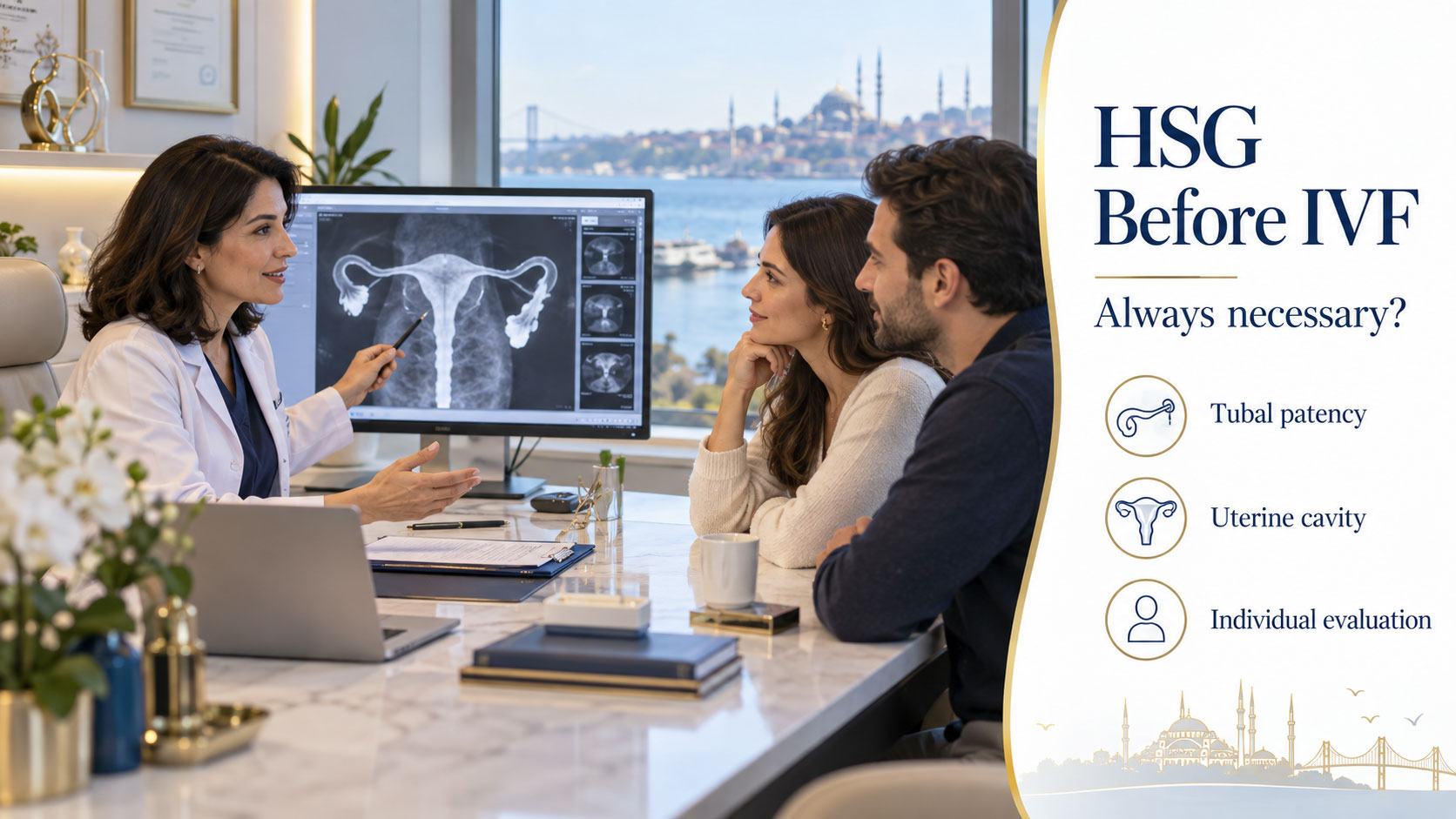
What Does HSG Show Before IVF?
A hysterosalpingogram (HSG), commonly known as a uterine X-ray, is an X-ray-guided examination used to assess the shape of the uterine cavity and whether the fallopian tubes are open. Contrast material introduced through the cervix travels through the uterus toward the tubes, allowing possible blockages or structural differences within the uterus to be evaluated during imaging.
Because the embryo is transferred directly into the uterus during IVF, open fallopian tubes are not as fundamental a requirement as they are for intrauterine insemination or natural conception. Therefore, HSG is not automatically considered a mandatory and unchanging prerequisite in every case. However, when specific findings are present, it can provide important information that may affect the treatment plan.
HSG and IVF Safety: Which Standards Apply in Turkey?
When arranging treatment as part of medical tourism in Turkey, it is important to choose healthcare institutions with a Health Tourism Authorization Certificate issued by the Ministry of Health, as well as units authorized to perform the procedure. Planning HSG in a radiology department in coordination with an obstetrics and gynecology team ensures a documented process regarding contrast material, radiation safety and possible pain management.
Turkish physicians do not evaluate HSG solely by determining whether the tubes are open or blocked. X-ray images are assessed for the uterine contour, the proximal part of the tube, the distal section, passage of contrast into the abdominal cavity and possible hydrosalpinx. Teams working in reproductive endocrinology and infertility combine HSG findings with ultrasound, semen analysis, ovarian reserve tests and previous treatment information to determine their impact on the IVF protocol.
Pre-procedure safety check
- Possible pregnancy is ruled out before the procedure.
- If there is an active pelvic infection, fever, abnormal discharge or unexplained bleeding, the procedure may be postponed.
- Previous reactions to iodinated contrast material and known allergies should be shared with the medical team.
- A history of ectopic pregnancy, tubal surgery, pelvic infection or endometriosis should be reported.
- Previous ultrasound, MRI, HSG or laparoscopy reports should be provided for review when necessary.
What Is Included in IVF and HSG Packages in Turkey?
Depending on the package, VIP airport-to-clinic transfers, accommodation, interpreter support and initial post-procedure care guidance may be arranged. The scope, duration and conditions for accompanying persons should be clearly stated in the written quotation. For HSG, a short visit to Turkey may usually be sufficient. However, if IVF assessment, hormone tests or ultrasound are also performed during the same trip, the length of stay may be extended according to the individual schedule.
HSG is generally scheduled during the early follicular phase, after menstrual bleeding has ended, usually between days 6 and 10 of the cycle at many centers. The exact date is determined according to the menstrual cycle, possibility of pregnancy, the clinic protocol and the appointment schedule. If passage of contrast through the tubes cannot be assessed clearly or the result conflicts with clinical findings, the physician may recommend another method.
Methods that may be considered instead of or after HSG
- HyCoSy or foam sonohysterography: May help assess the uterus and tubal passage under ultrasound guidance and does not involve radiation.
- Transvaginal ultrasound: Provides information about the uterus, ovaries and certain structural findings such as hydrosalpinx, but it does not show every tubal blockage on its own.
- Laparoscopy: In selected cases, such as suspected endometriosis, adhesions or tubal damage, it allows direct assessment and may make certain surgical procedures possible during the same session.
HSG Cost: Comparison of Turkey, Europe and the United States
In Turkey, the cost of a hysterosalpingogram varies depending on whether the procedure is performed as HSG alone, the contrast material used, the radiology report, the need for anesthesia or sedation and the city where the facility is located. The figures below are approximate ranges for the HSG procedure only and do not include medical evaluation or IVF treatment.
| Country | Approximate HSG cost | Pricing note |
|---|---|---|
| Turkey | €150–350 | Contrast, imaging and reporting may vary by center. |
| United Kingdom | GBP 500–1,000 | Private clinic, radiology and hospital fees may be calculated separately. |
| Germany | €400–800 | The scope of the procedure and insurance conditions may affect the total cost. |
| United States | USD 800–2,000 | Physician, facility, radiology and insurance portions may be charged separately. |
The average range stated for Turkey is only a general market estimate and does not replace a definitive price quotation. When requesting a written quote, ask whether contrast material, the radiology report, an obstetrics and gynecology assessment, possible sedation, interpreter support and a follow-up consultation are included.
Factors Determining the HSG Decision and Procedure
The factors that may simultaneously affect whether HSG is needed and the total cost include:
- The physician’s expertise and experience: It is important that a physician working in reproductive endocrinology, infertility and IVF has experience linking HSG findings with the embryo transfer plan. Information sharing between the radiologist and gynecologist is particularly relevant when hydrosalpinx or a blockage in the proximal part of the tube is suspected.
- The method and materials used: Standard fluoroscopic HSG uses an X-ray machine and iodinated contrast material. Some centers may offer ultrasound-guided HyCoSy, foam contrast or sonohysterography. The selected method can affect the price and preparation requirements in terms of radiation exposure, the need for sedation and the detail of imaging.
- The clinic’s location: In medical tourism centers such as Istanbul, Ankara, Izmir and Antalya, hospital infrastructure, radiology capacity and international coordination services may affect the price. When choosing a city, consider not only the cost but also whether the procedure will be coordinated within the same healthcare network as the IVF center.
Open tubes on an HSG do not mean that IVF will definitely be successful. Likewise, a tube that appears blocked does not always mean that IVF is directly required; image quality, the location of the blockage and the clinical history must be interpreted together. Particularly when hydrosalpinx is suspected, whether additional surgery or a different approach is needed before embryo transfer should be discussed separately.
Three Logical Next Steps Regarding HSG Requirements
- Can IVF assessment be performed without an HSG result? If previous ultrasound, evaluation of the uterine cavity or a reliable test showing tubal patency is available, some centers may not request a new HSG. The decision depends on how current the existing reports are and on the treatment history.
- Is a tube that appears blocked during HSG actually blocked? Cervical spasm, catheter positioning or inadequate contrast progression can create the appearance of a false blockage. For this reason, the result is interpreted together with image quality and clinical findings and, when necessary, confirmed with options such as HyCoSy or laparoscopy.
- How might an IVF plan change if hydrosalpinx is present? If fluid accumulation is seen within a tube, its possible effect on fluid entering the uterus and on the embryo transfer plan is assessed. Whether surgery, tubal occlusion or a different preparation is needed is decided only after a detailed examination and imaging.
When applying from abroad, sharing your menstrual cycle dates, previous HSG or ultrasound reports, history of ectopic pregnancy and pelvic infection, regular medications and known contrast reactions in advance can facilitate the assessment. Whether HSG is genuinely necessary for you should be confirmed after an initial remote medical consultation and in light of examination findings in Turkey.