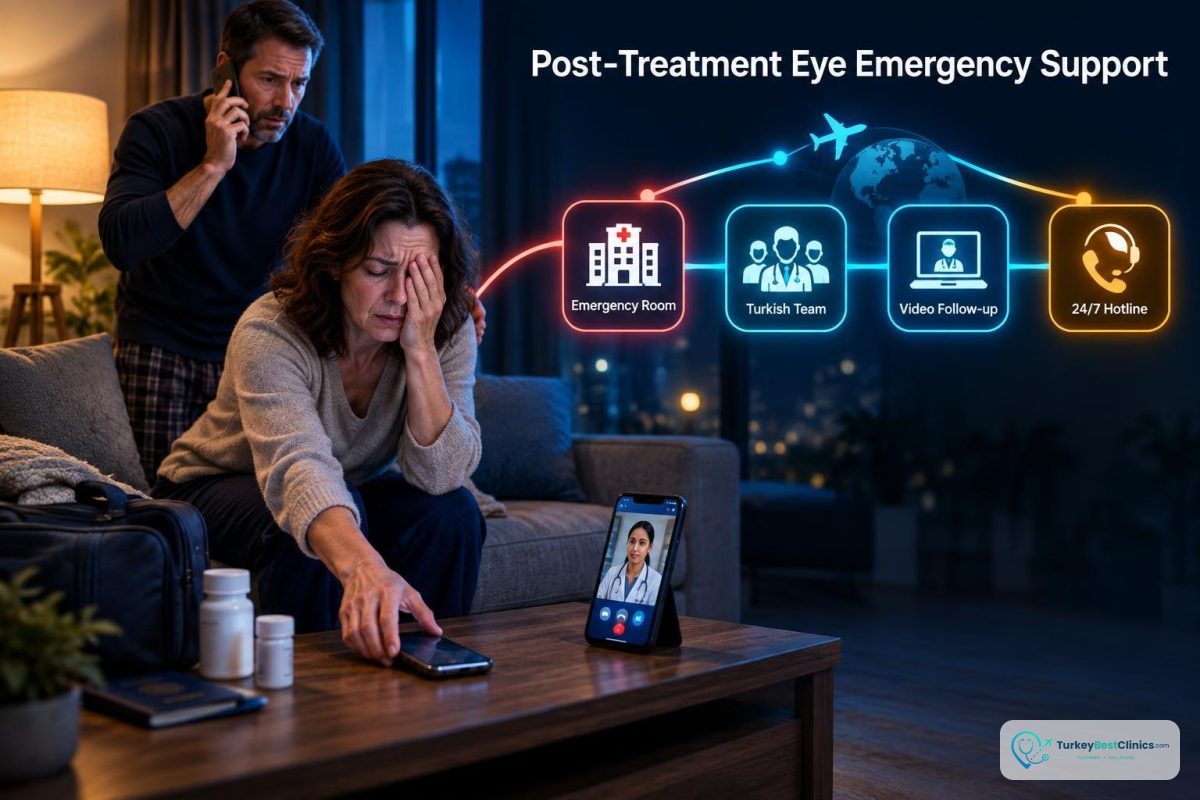
How Should You Assess Emergency Symptoms After Eye Treatment?
After returning home following eye surgery or an eye procedure, you may experience a sudden decrease in vision, marked redness, flashes of light, new floaters, swelling around the eye, discharge, or increasingly severe pain. As these symptoms may not be part of a routine recovery, remote assessment should be initiated without delay.
Sudden vision loss, a curtain or shadow in your field of vision, nausea accompanied by severe headache, eye trauma, intense light sensitivity, or a sensation that the surgical area has opened require urgent assessment. In these situations, call the emergency department or eye emergency unit in the country where you are staying without waiting for a response from the team in Turkey; use your local emergency number. In European Union countries, 112 can be used, while 112 is the emergency number in Turkey.
Information to Have Ready When Making Your Initial Report
- The name and date of the procedure performed in Turkey
- Your discharge report, prescription, and eye measurement results
- When the symptoms began and how quickly they progressed
- Any change in your level of vision, pain severity, or discharge
- Your country, city, telephone number, and the hours when you can be reached
Do not rub your eye or wear contact lenses, and follow only the care plan previously provided in writing by the team in Turkey. Before starting a new treatment product or changing your current treatment, prioritize local emergency assessment.
Eye Surgery Safety and Authorization Framework in Turkey
As part of medical tourism in Turkey, check whether the organization you contact holds a Health Tourism Authorization Certificate issued by the Ministry of Health. This certificate is an important starting point for ensuring that international healthcare coordination is conducted in accordance with regulations; it does not, by itself, guarantee a specific medical outcome.
For an emergency support plan to be reliable, the hospital where the surgery was performed should provide 24-hour emergency department access, access to an ophthalmologist, sterile operating room infrastructure, and the necessary imaging facilities. The center where tools such as slit-lamp examination, intraocular pressure measurement, dilated fundus examination, and, when necessary, optical coherence tomography can be performed should be explained in advance.
Responsibilities of the Medical Team in Turkey
- Safely storing your procedure file, surgical notes, and discharge documents
- Conducting an initial assessment of symptom urgency by telephone or secure video consultation
- Referring you to an appropriate eye clinic or emergency department in the city where you are staying
- Facilitating the transfer of medical information between the local doctor and the surgeon in Turkey
- Sending follow-up images and reports to the surgical team when necessary
Remote communication does not replace a physical eye examination. The surgeon in Turkey may recommend follow-up based on the results of the local examination; however, emergency diagnosis and treatment must be provided by an authorized healthcare facility in the country where you are staying.
Package and Companion Support Plan After Eye Treatment
An international treatment coordination package may include airport or in-city VIP transfers, hotel arrangements, interpreter support, and guidance for the initial care period; you should confirm the scope and any additional fees in writing. Depending on the type of eye procedure, visual acuity, intraocular pressure, corneal or retinal checks, and an assessment of fitness to fly may be scheduled before discharge.
Whether your companion can stay with you at the hospital, how close your hotel is to the healthcare facility, and how you will travel together in an emergency should be clarified in advance. During periods of limited vision or light sensitivity, your companion should choose a quiet walk in a park near the hotel or a low-intensity wellness area instead of long, tiring activities.
Emergency File to Prepare Before Returning Home
Before your return, you should receive a file containing the name of the procedure, surgery date, recommended follow-up time, expected recovery symptoms, and warning signs. The file should clearly state the name of the surgeon in Turkey, clinic telephone numbers, the 24/7 emergency contact line, the online follow-up link, and the response time outside working hours.
The names of medications or care products, how often to use them, and any special warnings should also be included in your discharge documents. Ask the team in writing at what point dryness, pressure changes, or light sensitivity after air travel should no longer be considered normal.
Cost Framework for 24/7 Communication and Local Support
There is no single standard fee set by public authorities for 24/7 emergency communication and local support in Turkey. This service may be included in the surgical package, or post-procedure coordination, interpretation, local appointment scheduling, and document transfer may be priced as separate items.
| Country or service scope | Typical pricing approach | What to check |
|---|---|---|
| Turkey | It may be included in the package in many plans; separate coordination offers may range from approximately €0–€300 or more | Whether 24/7 response, interpretation, local referral, and transportation are included |
| United Kingdom | Remote follow-up or coordination may be charged separately by private clinics | Consultation, emergency assessment, and private eye clinic fees in GBP |
| Germany | Local emergency examinations and private follow-up fees vary according to the provider’s insurance agreement | Whether insurance covers communication and translation costs involving a foreign center |
| United States | Emergency department, ophthalmologist, and imaging fees may be high and charged as separate items | Insurance network, preauthorization, and emergency transportation coverage |
The Turkey range above is not the price of medical treatment; it is only an approximate reference for coordination services that some organizations may offer. Local emergency department examinations, imaging, ambulance services, repeat surgery, or prescription care may not be included in this amount; review the exact scope in your contract.
Factors Determining How Eye Emergency Support Operates
The quality of an emergency communication plan depends on more than simply having a telephone number. The following factors determine how quickly and safely you can be directed when symptoms develop:
- Physician expertise and experience: The surgeon’s experience with the relevant procedure type, whether cataract, retinal, corneal, refractive, or glaucoma surgery, affects the scope of complication assessment.
- Technology and methods: Depending on the symptoms, slit-lamp examination, intraocular pressure measurement, OCT, corneal topography, ultrasound biometry, or fundus imaging may be required. It should be specified in advance where each test will be performed.
- Clinic location: The distance of the surgical center in Turkey from the airport, the network of affiliated eye clinics in your home country, and access to a 24-hour emergency department affect coordination time.
- Communication protocol: In addition to telephone, messaging, and video consultation channels, the identity of the on-call team outside working hours and the response time should be provided in writing.
- Document and data transfer: Securely sharing examination reports, surgical notes, and images is important for protecting personal health data.
Two-Stage Approach in an Emergency
| Approach | Most important benefit for you | Recovery and assessment process |
|---|---|---|
| Local emergency eye examination | Risks such as vision loss, infection, or high intraocular pressure are assessed physically | The examination and necessary imaging may be performed on the same day; timing varies according to the findings |
| Online coordination with the surgical team in Turkey | Your procedure file and surgical details are transferred to the local doctor | Online follow-up continues as local reports become available; it does not replace a physical examination |
Next Steps: Three Critical Questions About 24/7 Eye Support
- Should I contact the local emergency department or the surgeon in Turkey first if my vision suddenly becomes blurred? How should the correct order of action and the use of local emergency numbers such as 112 be planned according to the severity of the symptoms?
- If an infection is suspected after eye surgery, which examination and imaging results should be sent to the team in Turkey? When are slit-lamp examination, intraocular pressure, and OCT reports needed?
- How will the support plan change if I need to return to Turkey after going back to my home country? In what order should fitness to fly, companion support, hotel arrangements, local follow-up, and online monitoring be organized?
Have these three topics added to your written plan before returning home, and save the emergency contact number somewhere easily accessible on your phone. The most important safety step is to seek emergency medical assessment where you are without waiting for a remote response when serious symptoms occur.