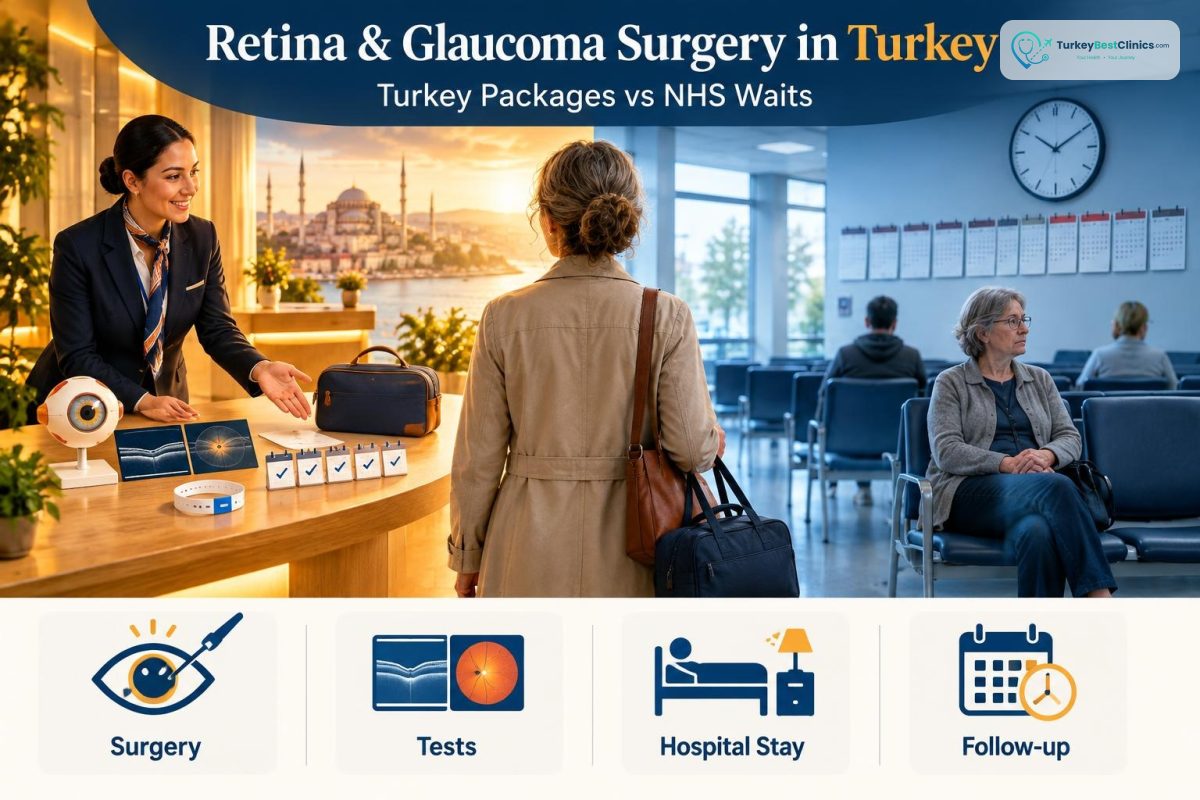
Treatment Planning in Turkey for Retinal Detachment and Glaucoma Surgery
Retinal detachment is a serious condition that requires prompt ophthalmic assessment and, in most cases, surgical planning to prevent vision loss. If you experience flashes of light, a sudden increase in floaters or a curtain-like shadow across your field of vision, you should seek an urgent eye examination rather than wait; these symptoms do not confirm a diagnosis, but they should be assessed without delay.
The aim of glaucoma surgery is to control intraocular pressure and slow the progression of optic nerve damage. The choice of surgery is determined after assessing intraocular pressure, optic nerve findings, visual field test results, current eye-drop treatments and accompanying conditions such as cataracts.
In Turkey, private hospital packages are generally arranged around a specific procedure and a short-term medical tourism programme. You should check in writing whether the quotation covers only the surgery or also includes tests, anaesthesia, hospitalisation, medication, transfers and online follow-up services.
Hospital Safety in Vitrectomy and Glaucoma Surgery
It is important for surgery to be planned at a facility holding a Medical Tourism Authorisation Certificate issued under the regulations of the Turkish Ministry of Health and operating with a fully equipped hospital infrastructure. Before treatment, verify that the certificate is current, as well as the name of the hospital where the surgery will take place and the surgeon’s authorisation details; a certificate held only by an intermediary company should not be considered sufficient.
For retinal surgery, factors to assess include operating microscopes, 23G or 25G pars plana vitrectomy systems, gas or silicone oil options for intraocular tamponade, and access to postoperative retinal imaging. In glaucoma surgery, tools such as Goldmann tonometry, optical coherence tomography, visual field analysis and, when necessary, gonioscopy form part of the decision-making process.
Ophthalmologists in Turkey perform vitrectomy, scleral buckling and combined approaches for retinal detachment, as well as trabeculectomy, tube implantation and MIGS techniques in selected glaucoma cases. The phrase “experienced team” is not sufficient on its own; you should ask about the surgeon’s expertise in the relevant procedure, the hospital’s intensive care and emergency eye support, the equipment used and the postoperative follow-up plan.
Preoperative Safety Checklist
- Fundus examination, intraocular pressure measurement and visual acuity assessment
- Dilated-pupil examination for the retina, with OCT or ocular ultrasonography and B-scan imaging when required
- For glaucoma: visual field testing, OCT nerve fibre analysis, corneal thickness measurement and angle assessment
- Blood tests, electrocardiography and a review of your medical history to assess anaesthetic suitability
- Informing the surgeon about all medications, bleeding risk and current eye drops
What Is Included in a Retina and Glaucoma Package?
A private hospital package may include VIP airport-hospital-hotel transfers, accommodation at a hotel near the hospital, a professional interpreter when needed, initial postoperative care recommendations and support with prescription arrangements. The quotation should clearly state the number of people covered, number of nights, vehicle waiting time and medication coverage.
After retinal detachment surgery, air travel may be restricted depending on the gas tamponade used; therefore, the surgeon determines the return date based on the type of intraocular gas and the time required for it to be absorbed. If silicone oil has been used, a later removal procedure may not be included in the package. After glaucoma surgery, initial pressure checks are generally scheduled in the days and first weeks following surgery; the length of stay in Turkey varies according to the technique used and the intraocular pressure trend.
You should clarify in advance whether your companion may stay with you in the hospital and whether the hotel is within walking distance or a short transfer from the hospital. If you have positioning restrictions or reduced vision after retinal surgery, your companion can remain available to you while you rest with low-intensity activities, such as a quiet walk in a park near the hospital or time in the hotel’s wellness area.
Example Process and Stay Plan
- Day 1: Examination, imaging, laboratory assessment and surgical decision
- Day 2: Retinal or glaucoma surgery, followed by postoperative observation
- Day 3: Initial check-up, assessment of the eye dressing and discharge recommendations
- Follow-up period: Online sharing of reports, images and intraocular pressure results after returning home
This is a standard example; the duration may change depending on the extent of the retinal detachment, whether the macula is affected, the use of intraocular gas, the type of glaucoma surgery and the need to coordinate with an ophthalmologist in your home country.
Comparing Turkey, the NHS and Private European Costs
The figures stated for Turkey are approximate euro ranges for private hospital medical tourism and vary according to the city, surgeon, surgical technique, length of hospital stay, type of tamponade and package contents. For people who meet the eligibility requirements, treatment through the NHS is generally not billed separately within the public system; the comparison here concerns waiting and organisational processes rather than a direct NHS price.
| Country or system | Retinal detachment surgery | Glaucoma surgery | Typical inclusions |
|---|---|---|---|
| Private hospital in Turkey | Approximately €3,500–€7,500 | Approximately €2,500–€5,500 | Surgery, surgeon and hospital fees; tests, hospitalisation, transfers and follow-up depending on the package |
| Private sector in the United Kingdom | Approximately £8,000–£15,000 | Approximately £5,000–£10,000 | Private hospital and surgical fees; accommodation and international transfers are usually excluded |
| Private sector in Germany | Approximately €6,000–€12,000 | Approximately €4,000–€8,000 | Hospital and physician fees; additional imaging and extended follow-up may be priced separately |
| Private sector in the United States | Approximately USD 12,000–25,000 | Approximately USD 8,000–18,000 | Surgery and facility fees; insurance, anaesthesia, tests and follow-up may be itemised separately |
These ranges are not official quotations. Particularly in retinal detachment cases, emergency admission, laser treatment to surround additional tears, adding scleral buckling to vitrectomy, later removal of silicone oil or a longer hospital stay may increase the total cost. In glaucoma care, the difference between MIGS, trabeculectomy and tube implantation is related to the implant used, whether cataract surgery is performed during the same session and the need for intensive follow-up.
How Are NHS Waiting Times Assessed?
Within the NHS, retinal detachment is generally not treated as a procedure placed on a routine waiting list; it is expected to be assessed on the same day or within a very short period by an emergency eye unit or retinal service. The exact timing depends on when symptoms began, the condition of the macula, the characteristics of the retinal tear and regional capacity.
For glaucoma surgery, the waiting time may be weeks or months depending on visual field progression, intraocular pressure, response to eye-drop treatment, surgical priority and the capacity of the relevant NHS region. The initial examination before referral, tests and postoperative checks may also add to the overall timeline; you should request the current waiting time in writing from the relevant NHS trust or eye clinic.
Factors That Affect the Cost and Recovery Timeline
- Surgeon’s expertise and experience: For a retinal surgeon, assess their focus on vitrectomy, retinal tears and combined retinal procedures; for a glaucoma surgeon, consider experience with trabeculectomy, tube surgery or MIGS. It is also important to ask whether the surgeon personally participates in postoperative checks.
- Technology, technique and materials: For retinal surgery, 23G or 25G vitrectomy, gas tamponade, silicone oil, scleral buckling and endolaser may affect the cost; for glaucoma, trabeculectomy, valved tube implants, iStent-like MIGS options or laser-assisted techniques may also influence pricing. The appropriate method should be determined by the clinical characteristics of the eye, not price alone.
- Clinic location: Hospital capacity, international patient coordination, accommodation costs and transport expenses may differ in Istanbul, Ankara, Izmir and other centres. A central location may offer shorter transfers but can increase the total package price.
Before requesting a quotation, ask in writing which eye is scheduled for surgery, the type of anaesthesia, the number of hospital nights, whether gas or silicone oil is included, the revision policy in case of complications and the scope of online follow-up after you return home.
Next Steps After Retina and Glaucoma Surgery
Before making a decision, sharing your existing eye reports, OCT and visual field images, list of eye drops and details of previous surgeries can speed up the assessment. If retinal detachment is suspected, an online consultation does not replace an urgent in-person examination.
- After retinal surgery with gas tamponade, when can I fly, and how will the return flight be planned within the package?
- What differences between trabeculectomy, tube implantation and MIGS should be considered based on my intraocular pressure?
- After returning to my country, how will OCT, visual field and intraocular pressure checks be coordinated through online follow-up?
For both types of surgery, the outcome is not determined by the day of surgery alone; appropriate preoperative assessment, selection of the suitable technique, early review and ongoing ophthalmic follow-up in your home country are all important.