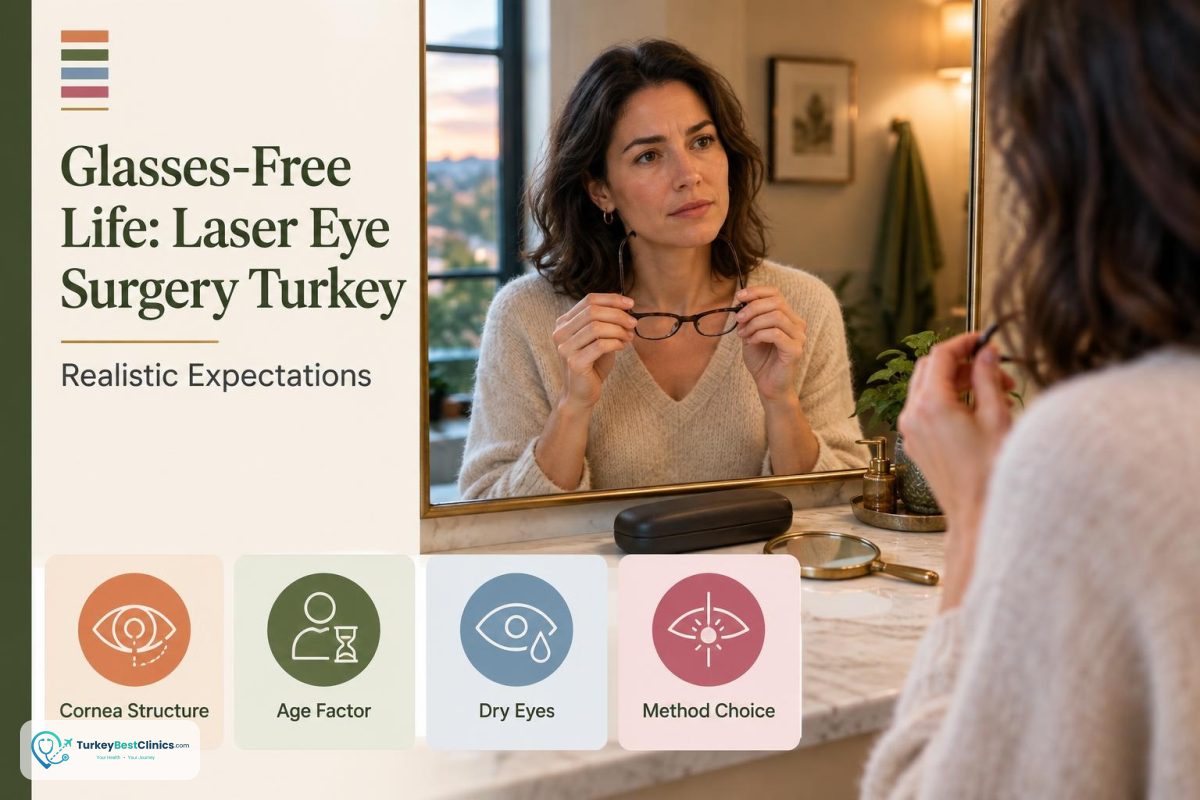
What the Goal of Living Without Glasses Really Means
The phrase life without glasses used by clinics in Turkey generally refers to reducing the need to wear glasses or contact lenses during the day because of myopia, hyperopia, or astigmatism. It does not mean that you will remain completely glasses-free under all circumstances and for the rest of your life.
Laser refractive surgery can provide significant independence from glasses for distance vision. However, mild visual effects when driving at night, dryness after prolonged screen use, or the need for reading glasses at an older age may still occur. The most realistic expectations can be determined after a detailed eye examination and corneal measurements have been completed.
Especially after the age of 40, age-related loss of near focusing ability, known as presbyopia, should be assessed. Even if your distance vision is corrected with laser surgery, you may need reading glasses when reading a book, using a phone, or viewing small text.
What You Should Know When Assessing a Promise of Life Without Glasses
- The outcome depends on the technique selected and whether your current prescription falls within the safe limits of your cornea.
- Blurred vision, light sensitivity, dryness, or fluctuating vision may occur during the first few days.
- Vision may stabilize within a few days for some procedures, while others may take several weeks or longer.
- Although uncommon, enhancement treatment, continued use of glasses, or a different treatment option may become necessary.
Corneal Measurements and Clinic Safety in Turkey
A reliable assessment involves more than simply measuring your prescription. Corneal topography and tomography, corneal thickness, the tear film, a fundus examination, eye pressure, and pupil characteristics should all be evaluated together. These findings provide the basis for determining whether laser surgery is safe for you and which technique may be more suitable.
When choosing a provider in Turkey for medical tourism, check whether it holds a Ministry of Health-approved Health Tourism Authorization Certificate. This certificate does not guarantee a specific visual outcome on its own, but it is an important administrative indicator confirming that the institution is authorized to provide international health tourism services.
The main options used by Turkish ophthalmology teams to correct myopia, hyperopia, and astigmatism include LASIK, femtosecond-assisted LASIK, SMILE, and surface-ablation procedures such as PRK. When assessing a surgeon's experience, ask not only about their overall number of surgeries, but also about their approach to the specific technique being considered, higher prescriptions, thin corneas, and the risk of dry eye.
Key Areas Assessed During the Examination
- Whether your prescription has remained stable over the past year
- Corneal thickness, shape, and signs of irregularity
- Tear production and the moisture balance of the ocular surface
- Assessment of the retina, optic nerve, and eye pressure
- Your expectations for night vision, occupation, and driving habits
- Whether reading glasses may be needed in the future because of presbyopia
What Is Included in a Laser Eye Treatment Package?
A medical tourism package may typically include airport or in-city VIP transfers, hotel accommodation, interpreter support, and initial post-procedure care, along with guidance regarding prescription products. Confirm the package contents, number of hotel nights, follow-up examinations, and any possible additional charges in writing.
The required stay in Turkey for laser eye treatment may range from approximately 3 to 7 days in many arrangements. The exact duration is determined by the measurements obtained during the initial examination and the technique selected. Corneal topography, pachymetry, tear-film assessment, and a detailed eye examination generally form the basis of pre-procedure planning.
On the day of the procedure and during the following days of light recovery, your companion may choose covered bazaars, a quiet museum visit, or a short afternoon Bosphorus cruise in Istanbul; a relaxing coastal walk near the hotel and a moderate gastronomic experience in Antalya; or a short seaside route or indoor cultural venue in Izmir. During the first few days, it is more suitable to avoid windy, dusty, and intensely sunny environments, refrain from rubbing your eyes, and keep plans light enough not to interfere with follow-up examinations.
Key Differences Between LASIK, SMILE, and PRK
| Techniques Compared | Main Distinguishing Advantage | Effect on Recovery Time |
|---|---|---|
| LASIK | A corneal flap is created to aim for rapid visual recovery; it is a common option for myopia, hyperopia, and astigmatism. | Vision generally becomes functional early on; dryness and light sensitivity may continue for some time. |
| SMILE | A lenticule is removed through a small incision in the cornea; the absence of a flap may offer a corneal-surface advantage for some suitable candidates. | Fluctuating vision may occur during the first few days; stabilization of clarity varies according to individual healing and prescription. |
| PRK | Laser treatment is applied after removing the surface layer; it may be considered in some cases involving thin corneas or situations unsuitable for flap creation. | The first few days may be less comfortable, and visual recovery may progress more slowly than with LASIK. |
This table does not constitute a recommendation of one technique. It is not safe to decide based solely on the procedure name without assessing your corneal structure, prescription, ocular surface, and daily needs together.
Approximate Costs in Turkey, the UK, Germany, and the USA
In Turkey, the average cost of laser refractive surgery for both eyes may range from approximately €1,500–€3,500, depending on the technique and clinic package. The figures below are general market ranges. Be sure to confirm whether examinations, follow-up visits, travel, and additional procedures are included.
| Country | Common Price Range | Notes on Pricing |
|---|---|---|
| Turkey | €1,500–€3,500 | The technique, package contents, city, and clinic services can affect the price. |
| United Kingdom | £3,000–£5,000 | The scope of surgery and follow-up for both eyes may vary by clinic. |
| Germany | €3,000–€6,000 | The technique and the surgeon's area of expertise may affect the total cost. |
| United States | $4,000–$7,000 | Initial examinations, technology selection, and follow-up visits may be priced separately. |
Rather than using the lowest price as your only criterion, compare the scope of the assessments, who will perform the surgery, the follow-up plan, and the communication process in the event of complications. International travel, accommodation, and post-procedure follow-up requirements may add to the overall budget.
Clinical Factors Affecting Price and Outcomes
- Surgeon's expertise and experience: A team that regularly focuses on refractive surgery and can explain the suitability limits of LASIK, SMILE, and PRK may provide a more comprehensive assessment. Evaluate experience not only through marketing claims, but also by reviewing the surgeon's history with the relevant technique and approach to managing complications.
- Technology and technique: Femtosecond lasers, wavefront- or topography-guided lasers, excimer laser platforms, and SMILE may have different cost and suitability profiles. More important than the brand name of the device is how it guides treatment based on your measurements and how it is adapted to your corneal data.
- Clinic location: Clinics in Istanbul, Antalya, and Izmir may have different costs for rent, staff, hospital infrastructure, and international coordination. The choice of city affects not only the procedure fee, but also airport access, follow-up visits, and access to a healthcare facility if needed.
No clinic can provide a personal guarantee before an examination regarding the likelihood of being glasses-free, night vision, the possibility of dryness, or the need for enhancement treatment. Read the expected outcomes, possible side effects, follow-up dates, and the communication channel available after you leave the country in the written consent form.
Three Specific Questions to Ask Before Making a Decision
- Based on my corneal topography and thickness, which of LASIK, SMILE, or PRK do they support, and why?
- If I develop presbyopia after the age of 40, how is the likelihood of needing reading glasses assessed even if my distance vision is corrected?
- If I experience dry eye, night glare, or undercorrection after the procedure, what will the follow-up plan be before and after I return from Turkey?
Receiving clear, written answers based on your measurement results can help you evaluate the promise of a life without glasses as a realistic treatment goal. The right decision should be based not on advertising language, but on a clear comparison of your individual examination findings, risks, and expectations.