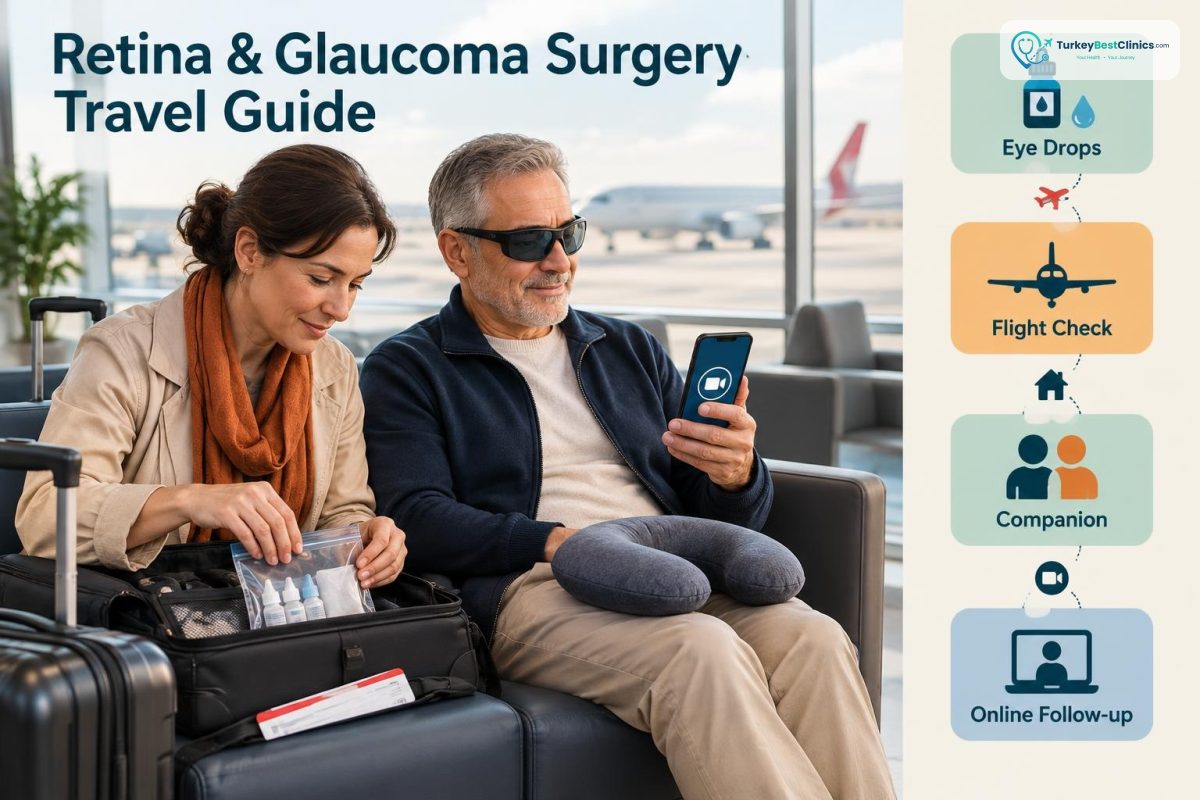
How Are Eye Drops Planned After Retinal and Glaucoma Surgery?
Eye drops used after retinal or glaucoma surgery may serve different purposes, including controlling intraocular pressure, inflammation, infection risk, and surface sensitivity. Which drops are used, how often they are applied, and for how many days depend on the surgical technique, examination findings, and your surgeon’s assessment.
When you travel to Turkey from abroad, the plan should cover not only the day of surgery but also preoperative measurements, the discharge examination, fitness to fly, and online follow-up consultations after you return home. Your travel plans should not be finalized until you have received a written eye-drop schedule, application instructions, and emergency contact details at discharge.
Features of the eye-drop plan in retinal surgery
After vitrectomy, retinal detachment repair, or the use of intraocular gas, the eye-drop schedule is arranged according to the presence of gas in the eye, intraocular pressure, the corneal surface, and the appearance of the retina. If gas has been used, your surgeon must give clear approval for flying and traveling to high altitudes; changes in aircraft cabin pressure may pose a serious risk with certain types of gas.
Intraocular pressure monitoring after glaucoma surgery
After glaucoma surgery, your eye-drop regimen may differ from the routine used before surgery. Because intraocular pressure can fluctuate, some drops may be temporarily reduced, changed, or adjusted; this decision should only be made after examination and pressure measurement. Returning to your previous eye-drop regimen on your own may affect the treatment target and the safety of recovery.
Safety Standards for Retinal and Glaucoma Surgery in Turkey
Planning surgery at a healthcare facility holding a Health Tourism Authorization Certificate regulated by the Ministry of Health of the Republic of Türkiye is an important starting point for international applications, medical records, interpreting, and care coordination. Surgery should be performed in a fully equipped hospital with sterile operating-room protocols, anesthesia assessment, and the ability to provide emergency observation when necessary.
In retinal care, procedures such as pars plana vitrectomy, endolaser, and the management of intraocular gas or silicone oil may be considered. In glaucoma care, options may include trabeculectomy, tube implantation, or, in selected cases, minimally invasive glaucoma surgery. A surgeon’s experience should be explained not only through a statement such as “a high number of cases,” but also by specifying the planned technique, postoperative pressure monitoring, gas or silicone oil checks, and complication management.
- Before surgery, visual acuity, intraocular pressure, biomicroscopic examination, and fundus assessment are performed.
- For retinal conditions, optical coherence tomography, ocular ultrasonography, or wide-field retinal imaging may be required.
- For glaucoma, corneal thickness, visual field testing, optic nerve imaging, and angle assessment may be planned.
- If gas or silicone oil is used, its travel restrictions should be provided in writing.
- Before discharge, eye-drop application and eye-protection methods should be demonstrated practically.
The purpose of these checks is not to make a diagnosis, but to clarify the surgical plan and the safe timing of your return according to your individual findings. You must provide the clinic with complete information about previous eye surgeries, regular treatments, allergies, and your flight date.
Travel and Companion Planning in a Retinal and Glaucoma Surgery Package in Turkey
As part of the arrangements, airport-to-hospital VIP transfers, hotel accommodation suitable for your hospital visits, medical interpreter support, and initial post-discharge care or necessary starter supplies may be planned. Package details should be confirmed in writing according to the scope of surgery and the hospital’s practices.
For retinal or glaucoma surgery, the stay in Turkey is generally planned for approximately 5–10 days to include the preoperative assessment, the procedure, and at least one early follow-up visit. Gas, silicone oil, intraocular pressure, or healing findings may extend this period. The decision to fly should not be made until the eye examination and any intraocular material used have been confirmed.
Having your companion stay with you at the same hospital or at a hotel within a short distance can help you keep track of eye-drop times and move around safely during the first few days. A calm wellness program that does not interfere with eye rest, short walks in a park, or rest areas at the hotel may be suitable; bright sunlight, dusty environments, and strenuous physical activity should be limited according to your restrictions.
Step-by-step travel protocol
- Your medical records, imaging, and current eye-drop list are reviewed online before surgery.
- Your initial examination and necessary measurements are performed in Turkey; the surgical method and estimated length of stay are clarified.
- At the first postoperative examination, intraocular pressure, retinal appearance, incision sites, and the corneal surface are assessed.
- At discharge, written instructions are provided for the eye-drop schedule, use of glasses or a protective shield, showering, and sleeping.
- A final examination is performed before you return home, and a discharge summary that can be shared with your local eye doctor is prepared.
- Online follow-up consultations are scheduled to assess adherence to the eye-drop regimen, changes in vision, pain, redness, and local measurement results.
Comparison of two surgical approaches in terms of recovery
| Methods Compared for You | Most Important Potential Advantage for You | Your Recovery and Hospital Stay |
|---|---|---|
| Pars plana vitrectomy | Direct treatment inside the eye and, when necessary, laser application for problems such as bleeding, traction, or retinal detachment | Usually same-day observation or an overnight stay; if gas or silicone oil is used, positioning requirements and flight restrictions may apply |
| Pneumatic retinopexy or selected external repair | A less extensive repair option for suitable types of retinal tears and detachment | Close follow-up is required; positioning may be necessary, and approval for flying is particularly important when gas is used |
| Minimally invasive glaucoma surgery | An attempt to reduce intraocular pressure through smaller incisions in suitable eye structures, with the possibility of a faster return to daily activities | Usually involves brief observation; eye-drop schedules and pressure measurements may be increased in frequency during the early period |
| Trabeculectomy or tube implantation | A stronger pressure-lowering goal for more advanced pressure levels or pressure that is not adequately controlled with medication | Close follow-up may continue for longer; local eye examinations after returning home are needed to check the incision, filtration area, or area around the implant |
Retinal or Glaucoma Surgery Costs in Turkey, the UK, Germany, and the USA
The figures below are approximate ranges that may be seen at private healthcare facilities in 2026 and are intended for market comparison rather than as a medical quotation. The total cost may vary depending on retinal detachment, intraocular gas or silicone oil, whether one or both eyes are treated, the type of anesthesia, and postoperative follow-up.
| Country | Approximate Surgical Cost | Factors Included in the Price |
|---|---|---|
| Turkey | €2,500–€7,000 | Type of surgery, hospital stay, imaging, and number of follow-up visits |
| UK | £5,000–£12,000 | Private surgeon, operating room, anesthesia, and follow-up fees |
| Germany | €4,000–€10,000 | Technical method, intraocular material, and hospital services |
| USA | $8,000–$20,000 | Surgeon, facility, anesthesia, insurance coverage, and complication follow-up |
When requesting a quotation, check separately not only the surgical fee but also retinal imaging, intraocular pressure measurements, anesthesia, medication or eye-drop supplies, checks related to gas or silicone oil, interpreting, and additional overnight charges. Whether both eyes can be treated during the same session is not assessed in the same way by every clinic.
Factors Determining the Eye-Drop Routine, Surgeon Choice, and Return Timing
- Physician expertise and experience: Experience specific to the planned technique, such as retinal detachment repair, macular surgery, intraocular gas management, or glaucoma filtration surgery, should be reviewed together with the postoperative follow-up protocol.
- Technique and intraocular material: Gas tamponade or silicone oil in pars plana vitrectomy, and options such as a minimally invasive glaucoma device, tube implant, or trabeculectomy in glaucoma, may affect the price and return timing.
- Clinic location: Travel time to the hospital in Istanbul, Ankara, Izmir, or another city is important for early follow-up visits, transfer planning, and your companion’s accommodation costs.
- Current condition of the eye: Visual level, the extent of retinal detachment, intraocular pressure, corneal condition, and previous surgeries personalize the recovery process.
- Flight safety: Gas inside the eye may directly affect your flight date. If silicone oil is present, the travel decision should also be based on intraocular pressure and your surgeon’s final examination.
- Eye-drop application skills: It is important not to touch the eye with the dropper tip, to observe the recommended waiting time between different products, and to follow the schedule together with your companion. Do not reduce, increase, or replace products on your own.
If you develop worsening pain, significant vision loss, a new curtain or shadow sensation, marked redness, flashes of light, new floaters, nausea, or vomiting, you need an emergency eye assessment without waiting for an online consultation. These symptoms may require your travel plan to be reconsidered regardless of the type of surgery.
Next Steps and Important Questions Before Returning Home from Turkey
Before returning home, ask for the surgical report, details of any intraocular material used, the eye-drop schedule, your latest intraocular pressure reading, and the date of your next follow-up to be prepared in English or your preferred language. Documents shared with your local eye doctor can help ensure that measurement results are interpreted accurately during online follow-up.
- If gas was used inside the eye, which examination findings must be completed before flying, and how is a safe date determined?
- After glaucoma surgery, how often should intraocular pressure be measured, and how should results be shared between your local eye doctor and the surgeon in Turkey?
- What communication and emergency assessment protocol should be followed if you miss a dose in the eye-drop schedule or experience significant eye pain or a change in vision?
The answers to these questions vary according to the type of retinal or glaucoma surgery and the discharge examination. The safest plan is one that includes written information sharing among the eye surgeon performing the surgery, the coordination team in Turkey, and your eye doctor at home.