How is your near and distance vision assessed after trifocal lens surgery?
A trifocal intraocular lens implanted during cataract surgery is designed to reduce the need for glasses at far, intermediate and near distances. However, improvement in visual quality is not determined solely by the number of lines read on a standard eye chart; reading comfort, night vision, contrast sensitivity and the ability to change focus are also assessed.
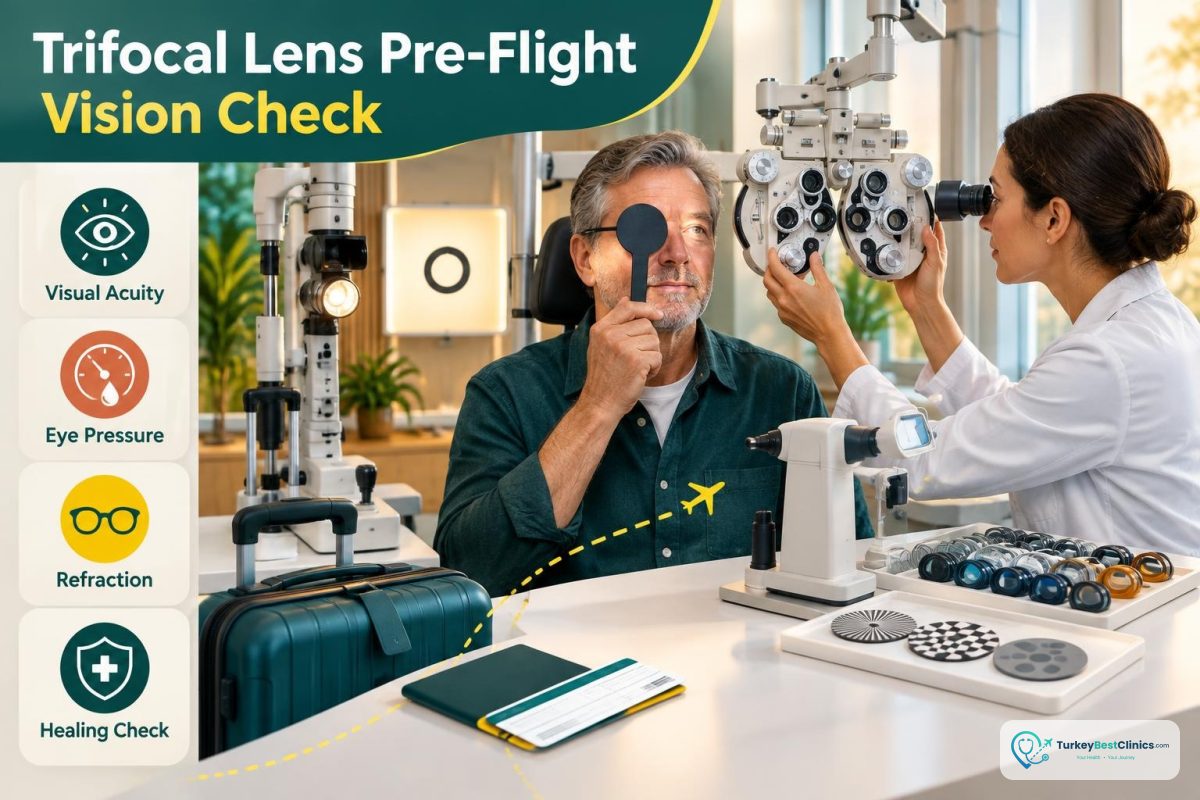
After your surgical process in Turkey is complete, the pre-flight check evaluates both the eye’s healing status and your visual performance with the new lens. This examination does not constitute automatic clearance for travel; flight timing is determined according to intraocular pressure, corneal edema, inflammation, retinal findings and the surgeon’s clinical assessment.
A Jaeger or equivalent near-vision card may be used for reading at close range, while an ETDRS or Snellen chart may be used for distance vision. If necessary, intermediate vision, such as the distance to a computer screen, is measured with a separate test.
Ministry of Health authorization and safety criteria in trifocal surgery
Within the scope of international health tourism, confirming that the provider you choose holds a Health Tourism Authorization Certificate issued by the Ministry of Health of the Republic of Türkiye is an important initial criterion for coordination and service delivery. Surgery should be planned in a fully equipped hospital environment and at a center with sterilization procedures, operating-room quality protocols and emergency observation facilities.
In trifocal lens surgery, the surgeon’s experience should be considered not only in terms of the number of cataract procedures performed, but also in relation to biometric planning, astigmatism management, assessment of pupil characteristics and selection among different intraocular lens designs. Femtosecond laser use, optical biometry and equipment for monitoring intraocular pressure during surgery may improve planning precision in appropriate cases; however, not every technique is necessary for every eye.
Pre-flight clinical check protocol
- Visual acuity: Distance, intermediate and near measurements are recorded separately.
- Refraction: Any residual myopia, hyperopia or astigmatism is assessed.
- Biomicroscopic examination: The cornea, incision site, anterior chamber and lens position are examined.
- Intraocular pressure: Postoperative pressure changes are checked.
- Retinal assessment: The fundus is examined, particularly in cases of diabetes, high myopia or a history of retinal disease.
- Healing and inflammation: Redness, light sensitivity, pain and cellular reactions are reviewed.
Postoperative follow-up and companion arrangements in your smart lens package
The organizational plan may include airport-hospital transfers, accommodation, interpreter support and logistical coordination required during the initial care period. Before trifocal lens surgery, optical biometry, corneal topography or tomography, eye pressure measurement, retinal examination and any necessary blood tests are planned; the length of stay in the country is determined according to whether one or both eyes are treated and the results of early check-ups.
Whether your companion can stay with you at the hospital can be arranged according to the center’s visitor and companion policy; choosing accommodation close to the hospital can reduce transportation-related stress. While you rest, your companion may spend time in a quiet wellness area around the hotel or take short, shaded walks, while following the eye-protection restrictions recommended by the surgeon.
Step-by-step return and online follow-up process
- Initial assessment: Corneal measurements, biometry and retinal status are examined before surgery.
- Early postoperative check: Vision, intraocular pressure, the incision site and inflammation are assessed.
- Near-and-distance performance measurement: A near-reading card, distance vision chart and, when necessary, a contrast test are used.
- Pre-flight decision: If the findings are stable, the surgeon individually assesses the travel plan.
- Online follow-up: After you return to your country, follow-up continues through scheduled video consultations and reports to be shared with your local eye doctor.
Although cabin pressure changes during flight, the change is generally limited on modern passenger aircraft; nevertheless, during the early postoperative period, surface dryness, light sensitivity and prolonged immobility may affect comfort. If worsening pain, sudden vision loss, marked redness, flashes of light or new floaters occur, travel plans should be postponed and urgent ophthalmic assessment should be sought.
Practical comparison of trifocal and monofocal approaches
| Options compared for you | Most important potential advantage | Recovery and hospital stay |
|---|---|---|
| Trifocal intraocular lens | Potential to reduce dependence on glasses at far, intermediate and near distances | Usually day surgery; visual adaptation may take several weeks or longer |
| Monofocal intraocular lens | Generally a simpler optical structure and more predictable visual experience at the selected single distance | Usually day surgery; glasses may be needed for near or intermediate vision |
Halos, glare or reduced night-time contrast may occur after trifocal lens surgery. The prominence of these effects varies with pupil size, the ocular surface, retinal health and the brain’s adaptation to the new optical system; the pre-flight check should therefore assess not only the amount of vision but also visual quality.
Cost of trifocal lens surgery in Turkey and international comparison
The total cost of cataract surgery and trifocal intraocular lens implantation in Turkey varies according to the features of the selected lens, whether one or both eyes are treated, the hospital infrastructure and the scope of follow-up care. The ranges below are general market indicators; the exact fee should be confirmed in writing after eye measurements and a surgical plan have been prepared.
| Country | Approximate range for trifocal lens surgery | Currency |
|---|---|---|
| Turkey | 1,800–3,800 | € / eye |
| United Kingdom | 3,000–5,500 | £ / eye |
| Germany | 3,000–5,000 | € / eye |
| United States | 4,000–7,000 | $ / eye |
In Turkey, the stated package may include surgery, the lens, early check-ups, interpreting and transfers; accommodation, additional retinal procedures, complication management or advanced diagnostic tests may be charged separately. When comparing options, review in writing not only the initial price but also the scope of the pre-flight check, surgical report and online follow-up plan.
Trifocal lens criteria that affect cost and visual outcomes
- Physician’s expertise and experience: Interpretation of biometry, determination of the need for a toric component, assessment of capsular support and postoperative refractive management all affect the overall plan.
- Lens and technology selection: Trifocal or toric-trifocal design, optical biometry, corneal topography, femtosecond laser use and, when necessary, capsulorhexis planning methods may change both the cost and the visual target.
- Clinic location: Hospital operating expenses, operating-room capacity, accommodation and local transportation costs may differ in Istanbul, Ankara, Izmir and other cities.
Near and distance visual quality depends not only on the lens model used. Dry eye, an irregular cornea, macular disease, glaucoma, diabetic retinal changes or residual refractive error after surgery may affect the expected optical outcome; therefore, the quotation and expectations should be related to the findings of an individual examination.
Next steps and important questions for pre-flight confirmation
Before planning your return abroad, request a file from the clinic in English or another appropriate language containing your measurement results, operative note, exact lens model, intraocular pressure records and flight recommendation. Airline rules and the surgeon’s medical assessment may differ; the final decision should be based on your examination findings.
- At what level was my near-reading quality measured after trifocal lens surgery using the Jaeger or an equivalent test, and was computer-distance vision assessed separately?
- At the pre-flight check, are my intraocular pressure, corneal edema, retinal findings and contrast sensitivity suitable for the return journey?
- After I return to my country, which symptoms should prompt me to see a local eye doctor, and which measurements and reports should I prepare for online follow-up consultations?
These assessments do not replace a medical examination. Trifocal lens surgery and flight timing should be personalized by an ophthalmologist after considering your eye health, the characteristics of the lens used and your postoperative findings together.