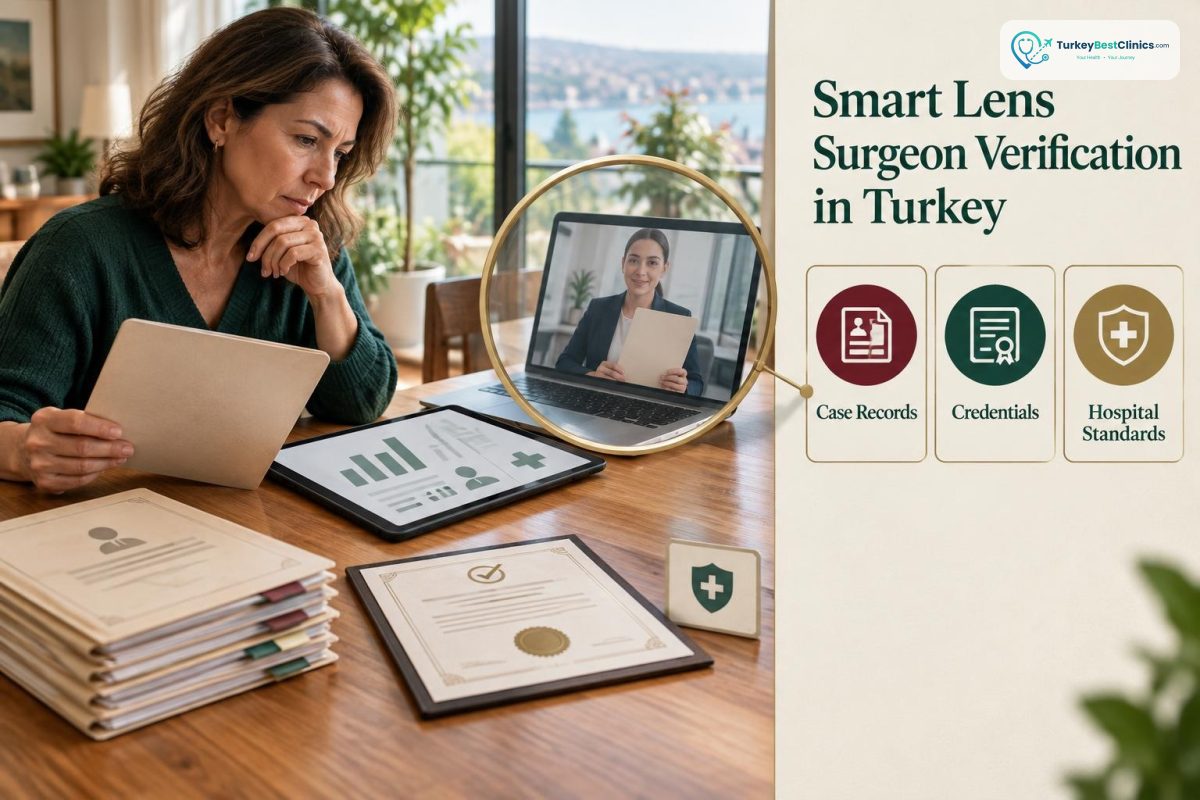
What information should you request when assessing smart lens experience?
A smart lens is a premium intraocular lens option implanted inside the eye during cataract surgery. The aim is not only to replace the cloudy lens, but also to assess expectations for distance, intermediate and near vision together with corneal characteristics, retinal status and daily lifestyle needs.
While seeking the advantage of shorter waiting times in Turkey, ask separately about the surgeon’s total number of cataract operations and the procedures performed using trifocal, EDOF or other lenses with different focusing properties. The statement “highly experienced” is not sufficient on its own; the annual case volume, premium lens procedures performed during the last 12 months and lens types used should be explained in writing.
Verifying case volume does not mean that the surgeon guarantees a particular outcome. Visual quality can be affected by many variables, including dry eye, corneal astigmatism, retinal and optic nerve health, lens selection and the healing process.
Criteria used when defining case volume
- Total cataract surgeries: The number of cataract operations the surgeon has performed throughout their career.
- Active annual case volume: The number of surgeries personally performed during the last 12 months.
- Premium lens experience: The separate totals for procedures performed with trifocal, EDOF, multifocal or toric lenses.
- Per eye or per operation: How surgeries on both eyes performed on separate dates are included in the total.
- Role as primary surgeon: Whether the surgeon personally performed the procedure or was only involved as a consultant within the team.
Safety and authorization checks for smart lens surgery in Turkey
Check whether the healthcare facility where the operation will be performed provides services under the Health Tourism Authorization Certificate issued by the Ministry of Health of the Republic of Türkiye. This certificate shows that international healthcare services are provided within a defined administrative and operational framework; however, it does not by itself prove a particular surgeon’s case volume or establish which lens is suitable for you.
Ask for the clinic and hospital information to be verified through official channels, and request that the surgery be planned in a fully equipped hospital operating room under appropriate sterilization protocols. Details such as the surgeon’s ophthalmology specialist qualifications, microsurgery training, professional memberships related to cataract surgery and the models of the biometry devices used should be included in the written file.
A reliable document trail for verifying case volume
- A current, signed surgeon’s CV.
- The total range of cataract surgeries performed during the last 12 months and the last 3–5 years.
- A clear description of the lens categories referred to as smart lenses.
- The technical class of the lenses used, listed before the brand: trifocal, EDOF, monofocal or toric.
- A sample operative report or discharge summary with your name and personal data redacted.
- Verification of the license and Health Tourism Authorization Certificate details of the hospital where the operation will be performed.
- The postoperative check-up schedule, emergency contact method and online follow-up plan after you return to your country.
Protect personal data when sharing documents. Request that operative reports belonging to other patients have their names, identification numbers, dates of birth, photographs and file numbers redacted; your own medical records should be transferred only through secure, authorized communication channels.
What should be included in a smart lens surgery package?
The international treatment plan should clearly explain VIP or standard airport-to-hospital transfers, accommodation, interpreter support and coordination of basic medication or consumable supplies for the initial care period within a single logistical plan; medication selection and instructions for use are determined by the physician only after examination. For cataract assessment, biometry, intraocular pressure measurement, corneal measurements, retinal examination and, when necessary, macular imaging may be planned.
Find out in advance whether your companion is allowed to stay with you at the hospital, how long it takes to travel from your hotel to the hospital, and whether you will need to avoid intensive screen use, swimming pools or dusty environments during the first days after surgery. While you attend your check-ups, your companion may consider low-impact options such as peaceful walks in nearby parks or wellness areas within the hotel; these activities should comply with the restrictions recommended by the hospital.
Preoperative and postoperative process protocol
- Remote preliminary assessment and review of your existing eye records.
- A comprehensive eye examination and biometric measurements after arrival in Turkey.
- Lens selection based on visual expectations, corneal astigmatism and retinal findings.
- Discharge usually after outpatient care or a short period of hospital observation; the exact duration is determined by your health status and the hospital’s protocol.
- Creation of a plan for the first check-up, subsequent eye examinations and online follow-up after you return to your country.
Whether both eyes are operated on the same day or on different days depends on eye measurements, the surgeon’s approach, safety assessment and individual circumstances. Your flight date should not be finalized before the first check-up has been completed.
Smart lens surgery costs in Turkey and country comparison
Because the figures below may be presented differently for one eye or a package covering both eyes, you should compare the scope of each quote in writing. Prices are approximate market ranges that vary according to lens class, hospital conditions, the measurement package, surgeon’s fees, currency fluctuations and the follow-up plan; a final quotation is provided after examination.
| Country | Approximate price range | Points to check carefully in the quote |
|---|---|---|
| Turkey | Approximately €1,800–4,000 per eye | Premium lens type, biometry, surgeon’s fee, hospital, check-ups and transfer coverage |
| United Kingdom | Approximately £3,500–7,000 per eye | Private clinic fee, lens model, follow-up and possible additional procedures |
| Germany | Approximately €2,500–5,000 per eye | Scope of private payment, measurement package, surgical and follow-up fees |
| United States | Approximately $4,000–8,000 per eye | Separate costs for the surgeon, facility, anesthesia, lens and postoperative visits |
When comparing options, do not look only at the total price. The quote should clearly state the exact technical name of the lens to be used, whether it covers one or both eyes, preoperative measurements, early check-ups, the route for seeking help in the event of complications and communication arrangements after you return to your country.
Factors that change smart lens pricing and the surgical plan
- Surgeon’s expertise and active experience: Assess the total number of cataract operations separately from recent premium lens cases. Ask specifically about experience with toric lens implantation, astigmatism management and interpretation of biometry results.
- Technology and lens technique: Find out whether a femtosecond laser-assisted approach is used, which technique is planned compared with standard phacoemulsification, and whether the lens is trifocal, EDOF, monofocal or toric. Not every advanced technology is necessary for every eye; the decision is based on examination findings.
- Clinic or hospital location: Hospital, transportation, accommodation and follow-up costs may vary in Istanbul, Ankara, Izmir and other cities. The distance from the airport to the hospital and the transportation plan for an unexpected check-up are also part of the overall process.
Assess these criteria separately from the case-volume documentation. A high surgical volume does not guarantee that the lens selected will be suitable for your eye structure or that the desired visual result will be achieved; individual suitability is determined through examination and measurements.
Three critical questions to ask after verifying case volume
- How many trifocal, EDOF and toric lens procedures did this surgeon personally perform during the last 12 months? Request a breakdown separate from the total cataract number and, if possible, a sample operative record with personal data redacted.
- Which lens selection is supported by my corneal, retinal and dry-eye findings? Ask how biometry, corneal topography and macular assessment affect the decision; learn the technical class of the lens, not only its brand or advertising name.
- If I experience an unexpected visual problem after returning to my country, how will online follow-up and coordination with a local ophthalmologist be managed? Obtain the dates of the initial check-ups, communication hours, emergency procedures and the conditions under which additional fees may arise in writing.
Clear, consistent answers supported by documentation provide a more meaningful assessment than a claim of high case volume alone. Before making a decision, obtaining an independent ophthalmologist’s opinion and signing the consent form only after understanding it are important parts of safe planning.