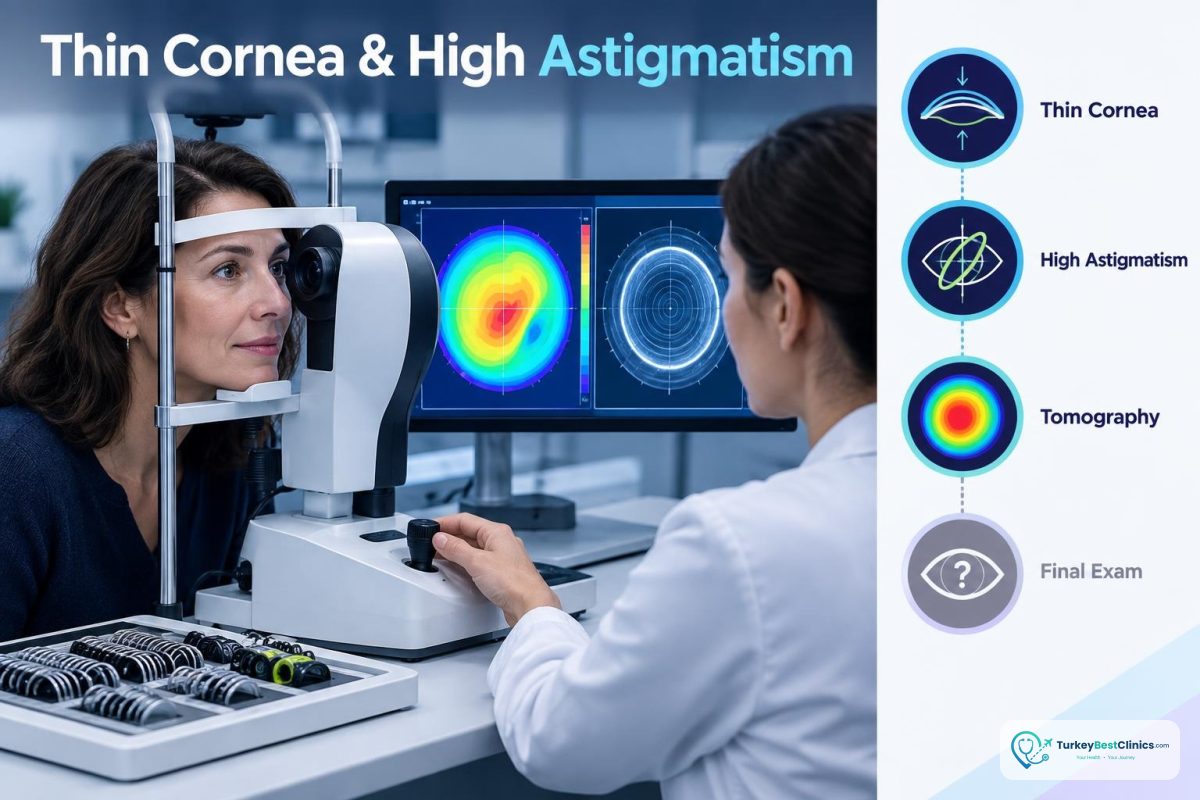
Laser Options for Thin Corneas and High Astigmatism
The desire to see more clearly without glasses or contact lenses may improve everyday comfort and satisfaction with your appearance. However, if your corneas are thin or your astigmatism is high, choosing laser eye surgery cannot be based on prescription values alone.
LASIK involves creating a flap in the cornea and applying a laser to the stromal tissue. No-Touch PRK, on the other hand, is based on removing the surface layer in a controlled manner without creating a corneal flap, followed by reshaping with an excimer laser. The appropriate method is determined by assessing corneal thickness, topographic regularity, the tear film, prescription stability, and individual healing factors together.
A remote preliminary assessment may reduce the risk of unnecessary travel before your trip to Turkey and indicate which tests should be prioritized. Nevertheless, an online review of your records cannot replace the detailed biomicroscopy and corneal analysis performed on the day of surgery.
Key Differences Between LASIK and No-Touch PRK
- LASIK: May provide faster visual recovery; however, because a flap is created, corneal thickness and biomechanical strength must be assessed more carefully.
- No-Touch PRK: Does not involve a flap and may be considered when corneal thickness is borderline; discomfort, light sensitivity, and slower visual clarification may occur during the first few days.
- High astigmatism: The axis of the cylinder, the amount of dioptric correction required, and corneal irregularities are analyzed together. A decision is not made solely on the cylinder value shown on a glasses prescription.
Corneal Tomography and Healthcare Standards in Turkey
When seeking care in this field in Turkey, it is important to work with a clinic or hospital holding a Health Tourism Authorization Certificate approved by the Ministry of Health. This certificate indicates that the institution is authorized to provide services within the framework of health tourism and that patient admission procedures and institutional responsibilities are managed within a defined framework; by itself, it does not guarantee surgical suitability or results.
Turkish refractive surgery teams assess procedures such as LASIK, femtosecond laser surgery, excimer laser treatment, and surface ablation together with the degree of myopia, hyperopia, and astigmatism. In thin corneas, residual stromal bed calculations, corneal volume, the curvature of the anterior and posterior surfaces, and signs of irregular astigmatism are particularly important.
When your records are reviewed remotely, ask the clinic for information about the model of the topography or tomography device used, the measurement dates, and the report format. Scheimpflug tomography, such as Pentacam, corneal biomechanical analysis, and tear film assessment may make a meaningful contribution to the suitability evaluation; however, no device should determine eligibility on its own.
Data Required for Remote Assessment
- Glasses prescriptions from the last 12 to 24 months and information about prescription changes
- Type and frequency of contact lens use and the time elapsed since stopping lens wear
- Spherical, cylindrical, and axis values for both eyes
- Corneal topography or tomography, preferably including a pachymetry map and anterior and posterior surface analyses
- Best-corrected visual acuity and intraocular pressure information
- History of dry eye, allergies, previous eye procedures, corneal disease, or trauma
- Medical conditions such as immune system disorders, uncontrolled diabetes, pregnancy, or breastfeeding
Laser Treatment Package and Travel Planning in Turkey
A health tourism package may generally include airport-to-hotel VIP transfers, hotel accommodation, interpreter support, and coordination of basic products required during the initial care period. Confirm the scope in writing, including the laser technology to be used, the number of follow-up visits, additional tests, and any assessment for possible enhancement procedures.
For thin corneas or high astigmatism, the topography and tomography records are reviewed before travel; in Turkey, the measurements are repeated, the ocular surface is assessed, and an in-person consultation with the surgeon takes place. If No-Touch PRK is selected, a few days are usually needed for the first follow-up, while a longer monitoring plan may be required to assess visual stabilization; the clinic should determine the exact timeline.
On the day of the procedure and during the early recovery period, your companion may plan a visit to an enclosed, quiet shopping center in Istanbul, a short museum visit, or a light meal in the evening. In Antalya, short, shaded rest activities near the hotel may be more suitable, while in Izmir, brief indoor activities away from wind and dust may be preferable; rubbing the eyes, intense sun exposure, and contact with seawater or swimming pools should be limited.
Laser Eye Surgery Costs in Turkey and Country Comparison
The figures below are approximate international ranges for both eyes, including standard preliminary assessment and basic follow-up checks. Thin corneas, high astigmatism, additional tomography, surface treatment, or a different laser platform may change the total cost; travel and accommodation expenses should be calculated separately.
- Turkey: Approximately €1,500–€3,000; this may vary depending on the center, method, scope of testing, and follow-up period.
- United Kingdom: Approximately £4,500–£7,000.
- Germany: Approximately €3,000–€5,000.
- United States: Approximately $4,000–$7,000.
Method Comparison for LASIK and No-Touch PRK
- LASIK | Main distinguishing advantage: Because the laser is applied after creating a flap, functional vision generally recovers more quickly. Effect on recovery time: Visual activities may become more comfortable within a few days; however, dry eye and flap-related risks must also be assessed.
- No-Touch PRK | Main distinguishing advantage: Because no flap is created, it may be considered as an alternative in cases such as thin corneas or participation in contact sports. Effect on recovery time: Renewal of the surface epithelium may make the first few days more uncomfortable, and it may take several weeks for clear vision to stabilize.
Details That Determine Eligibility and Cost
- Surgeon's expertise and experience: Experience in refractive surgery is important, particularly for axis alignment in high astigmatism, interpreting irregular corneal findings, and calculating the residual stromal bed in thin corneas. Ask about the surgeon's assessment protocol and approach to cases with similar corneal characteristics.
- Technology and method: Femtosecond laser flap creation for LASIK, wavefront-guided or topography-guided ablation, the excimer laser platform, and the No-Touch PRK protocol may lead to different clinical decisions. Topography-guided treatment may be considered only when the measurements are appropriate and reliable.
- Clinic location: Centers in Istanbul may offer broad access to equipment and specialists; accommodation plans in Antalya and Izmir may be arranged around a quieter recovery routine. The city alone does not determine the price; the number of postoperative checkups, emergency contact system, and the possibility of re-examination when necessary also affect the overall plan.
During a remote preliminary consultation, key questions include whether your prescription has remained stable over the past year, when you stopped wearing contact lenses, and the quality of your current tomography measurements. The clinic may request repeat imaging or an in-person examination if a measurement appears unsuitable; this is a normal safety step to reduce uncertainty before travel.
Next Steps Before Travel and Questions to Ask
When submitting your records, provide the report dates, contact lens use information, and details of any previous eye treatments in full. Obtain the preliminary assessment in writing and clearly ask under which conditions LASIK or No-Touch PRK would be considered and what process would be followed if surgery were postponed.
- Is the residual stromal bed calculation in my thin cornea sufficient for LASIK, or why is No-Touch PRK being considered the safer option?
- Can topography-guided or wavefront-guided ablation be performed for my high astigmatism, and how is axis accuracy checked?
- If the tomography, tear film, and biomechanical measurements performed in Turkey change the eligibility decision, how will the travel, fees, and follow-up plan be adjusted?
Final eligibility is determined after updated measurements and an eye examination in Turkey. Consider the online preliminary assessment not as a promise of surgery, but as a preparatory step that can help you reach the right center and arrange the appropriate testing plan.