Key Differences Between Smart Lens and Laser Eye Surgery
If you want to reduce your dependence on glasses and see more comfortably in daily life, price should not be the only factor when choosing between smart lens surgery and laser eye surgery. These two methods do not address the same anatomical issue in the same way: laser treatment reshapes the cornea, while smart lens surgery removes the eye’s natural lens and replaces it with an artificial intraocular lens.
The term smart lens most commonly refers to trifocal or EDOF intraocular lenses. These options may aim to reduce the need for glasses when switching between distance and near vision; however, suitability is assessed based on the condition of the retina and cornea, age-related lens changes, and detailed measurement results. Laser treatment may involve techniques such as LASIK, PRK, or SMILE, with the choice depending on corneal thickness, topography, prescription level, and tendency toward dry eye.
Choosing Based on Visual Comfort and Lifestyle
The smart lens option may be considered particularly for people who expect to use glasses less often when shifting between near and distance vision. Laser treatment preserves the natural lens and corrects vision through the cornea, offering a different advantage for people with a suitable corneal structure and appropriate refractive error.
Night driving, screen use, reading habits, dry eye symptoms, and existing eye conditions are important considerations. Appearance in the mirror, social life, and the desire to reduce dependence on glasses while travelling may also influence the decision; however, the final method should only be determined after a clinical examination and detailed measurements.
Safety and Authorization Criteria for Smart Lens Surgery in Turkey
When choosing a provider for medical tourism in Turkey, an important initial criterion is working with an organization that holds a Ministry of Health-approved Health Tourism Authorization Certificate. This certificate indicates that the clinic is authorized under the relevant regulations to provide international healthcare services; however, it does not by itself guarantee a specific surgical outcome.
Ask how the clinic conducts key stages of smart lens surgery, including biometry, corneal topography, retinal evaluation, and intraocular pressure measurement. For trifocal or EDOF lens calculations, axial length, corneal curvature, astigmatism level, and findings related to the central retina should be assessed together.
Assessing the Experience of Turkish Surgeons
Ask not only about the surgeon’s general ophthalmic surgery experience, but also about their practical experience in cataract surgery, toric lens calculations, multifocal lens implantation, and postoperative complication monitoring. If you are considering laser treatment, request clear information about corneal topography, pachymetry, aberrometry, and the features of the excimer or femtosecond laser platform used.
- The Health Tourism Authorization Certificate and details of the hospital where the surgery will be performed should be provided.
- For smart lens surgery, the lens brand, model, optical features, and warranty terms should be provided in writing.
- For laser treatment, it should be clearly stated whether the procedure will be LASIK, PRK, or SMILE and whether both eyes are included in the plan.
- The schedule for postoperative checks, emergency communication, and the examination before leaving the country should be explained in advance.
Because smart lens surgery involves a permanent intraocular lens replacement, patients should receive realistic information about possibilities such as halos or glare around lights at night, unmet expectations, or the need for additional evaluation. For laser treatment, they should be informed that temporary dryness, fluctuating vision, and recovery time may vary depending on the technique.
What Is Included in Smart Lens and Laser Packages in Turkey?
Medical tourism packages may typically include VIP transfers between the airport, clinic, and hotel, accommodation at the selected hotel, an interpreter providing language support, and coordination of basic products needed during the initial care period; check the scope and duration in the written quotation. For smart lens surgery, detailed biometry, retinal examination, corneal evaluation, and intraocular pressure measurement are usually planned. For laser treatment, corneal topography, pachymetry, tear-film assessment, and refractive error analysis are generally emphasized.
The length of stay in Turkey for smart lens surgery may usually be planned as several days to approximately one week, depending on the protocol and follow-up schedule. The need for follow-up after laser treatment varies between PRK, LASIK, and SMILE; particularly with PRK, more monitoring and greater visual fluctuations may be expected during the first few days.
After the procedure in Istanbul, your companion may spend a short and relaxing period in enclosed shopping malls; avoiding intense sunlight, crowds, and dusty outdoor areas is more suitable for eye comfort. In Antalya, quiet hotel areas may be considered, while in Izmir, short breaks by sheltered, low-wind coastal areas may be possible. However, restrictions on swimming, seawater, and rubbing the eyes should be followed according to the surgeon’s instructions.
Smart Lens or Laser: Comparing the Methods
| Methods Compared | Key Advantage | Effect on Recovery Time |
|---|---|---|
| Smart lens surgery | Aims to reduce the need for glasses for distance, intermediate, and near vision with a trifocal or EDOF lens; the natural lens is replaced. | Blurred vision and halos around lights may occur during the first days; visual adaptation may take several weeks or longer. |
| Laser eye surgery | The cornea is reshaped using LASIK, PRK, or SMILE while the natural intraocular lens is preserved. | Initial recovery is generally faster after LASIK and SMILE; surface healing may take longer with PRK. |
Cost Comparison in Turkey, the United Kingdom, Germany, and the USA
In Turkey, smart lens surgery may commonly be quoted at approximately €2,500–€5,000 for both eyes. Laser eye surgery may cost approximately €1,000–€2,500, depending on the technique used, whether both eyes are included in the package, and the clinic’s standards.
The ranges below are provided for market comparison only; the total cost may change depending on the lens model, additional tests, accommodation, transfers, and whether postoperative checks are included. Since prices in different countries may not cover the same services, you should compare the individual items in each quotation.
| Country | Smart Lens Surgery | Laser Eye Surgery | Approximate Comparison |
|---|---|---|---|
| Turkey | €2,500–€5,000 | €1,000–€2,500 | Smart lens surgery is generally €1,500–€3,000 more expensive than laser treatment. |
| United Kingdom | £6,000–£10,000 | £3,000–£6,000 | Lens and hospital fees may increase the total cost. |
| Germany | €5,000–€9,000 | €3,000–€5,500 | Costs vary according to the lens model and private clinic fees. |
| USA | $8,000–$14,000 | $4,000–$7,000 | The number of eyes treated, surgeon, and follow-up coverage can significantly affect the price. |
The main reason smart lens surgery costs more than laser treatment is that, unlike a procedure that reshapes the cornea, it includes the cost of a medical device implanted inside the eye and more comprehensive lens calculations. There may also be price differences between trifocal, EDOF, and toric lenses due to variations in material properties and astigmatism-correction capacity.
Factors Determining Smart Lens Costs and the Surgical Process
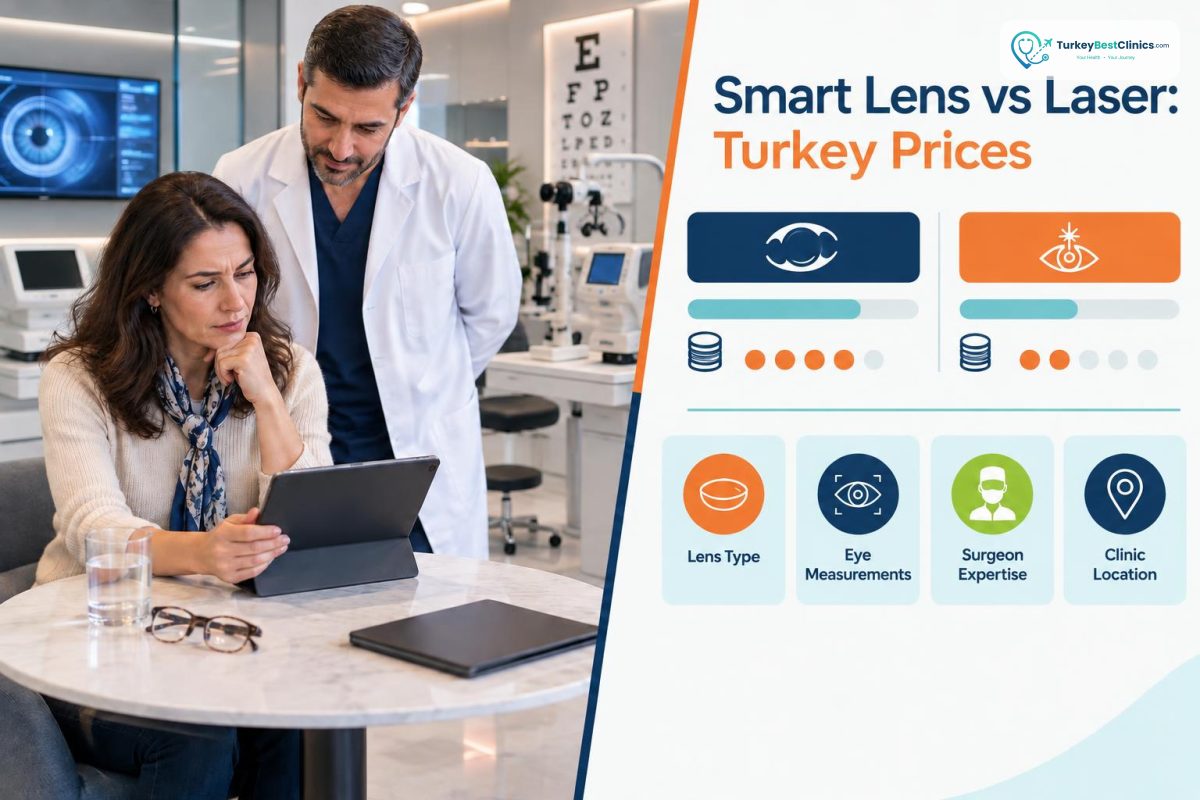
- Surgeon’s expertise and experience: Experience in cataract surgery, multifocal lens implantation, toric lens alignment, and managing postoperative visual complaints may affect pricing. Ask in writing about the surgeon’s annual procedure volume, measurement protocol, and policy on revisions or additional evaluations.
- Lens technology and material: Trifocal, EDOF, and toric intraocular lens options may not be priced at the same level. Toric lenses are designed to correct astigmatism, EDOF lenses focus on intermediate vision, and trifocal lenses cover distance, intermediate, and near vision; the appropriate choice is based on your eye measurements.
- Clinic location: In medical tourism hubs such as Istanbul, Antalya, and Izmir, hospital infrastructure, the surgical team, international patient coordination, and accommodation options may affect the total quotation. The city name alone is not an indicator of quality; confirm where the surgery will be performed and where follow-up care will be provided.
When requesting a quotation, ask for both eyes, the lens fee, biometry and retinal scanning, postoperative checks, possible additional treatment fees, and the transfer and accommodation coverage to be listed separately. Since LASIK, PRK, and SMILE may also differ in price, choosing based only on the term laser does not provide an accurate comparison.
Three Important Questions to Ask After Choosing Smart Lens Surgery
- How will the differences between trifocal, EDOF, and toric lenses affect my daily visual expectations?
Ask which lens design is being considered in relation to reading distance, computer use, night driving, and existing astigmatism. This choice affects expectations for visual adaptation as well as the price. - What measurements should be performed before smart lens surgery, and how many days should I stay in Turkey?
Ask whether biometry, corneal topography, retinal examination, and intraocular pressure measurement are included in the plan. Confirm the follow-up dates and flight suitability with the surgical team. - If I am not suitable for laser treatment, what vision-correction options other than smart lenses could be considered?
Different options may be considered depending on corneal structure, age, dry eye, lens condition, and retinal findings. The final decision should be made after a comprehensive eye examination, not through a remote price assessment.
When comparing quotations in Turkey, focus not on the lowest price but on whether the proposed method is suitable for your eye measurements, whether the lens or laser technology is clearly specified, and how comprehensive the postoperative follow-up plan is. This will help you assess both your travel budget and your expectations for visual comfort more realistically.