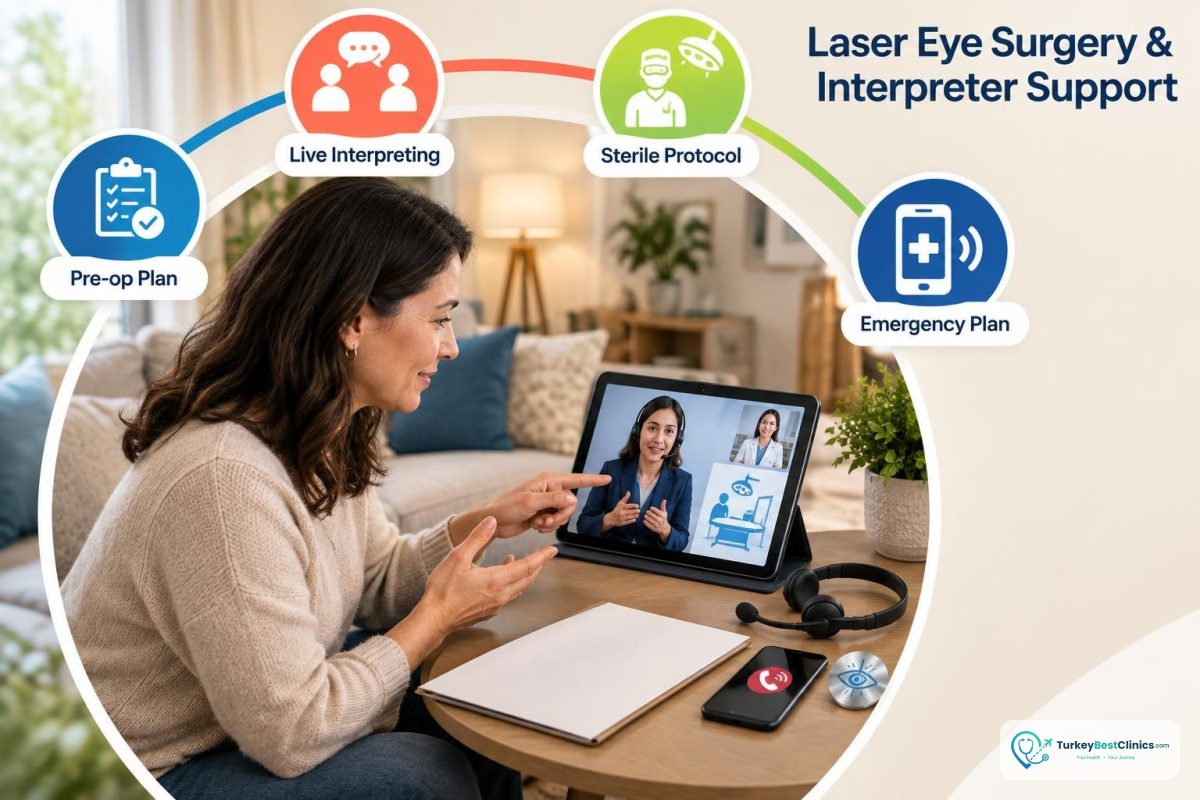
How Is Communication in Your Language Provided During Laser Eye Procedures?
During laser eye procedures such as LASIK, PRK, or SMILE, instructions to look at a fixed point for a few seconds, avoid blinking, or keep your head in a specific position may be important. Therefore, before contacting clinics in Turkey, confirm how the brief instructions given during the procedure will be communicated in your language to support safe planning.
At most clinics, a medical interpreter assists with examinations, consent forms, preoperative preparation, and discharge consultations. However, it may not always be possible for the interpreter to stand physically beside you in the operating room where the laser device is located. The sterile field, equipment safety, number of staff in the room, and the clinic’s internal procedures determine this.
The safest approach is not to rely solely on the interpreter translating during the procedure, but to rehearse the instructions that will be used in your language beforehand. This gives you a prearranged communication plan for the short, clear instructions delivered in English, Turkish, or another language at the laser device.
Interpreters for Laser Eye Surgery and Turkey’s Health Tourism Standards
As part of your health tourism arrangements, check whether the provider you choose holds a Health Tourism Authorization Certificate issued by the Ministry of Health of the Republic of Türkiye. This certificate indicates that international applications are handled within certain administrative and organizational rules; however, it does not by itself guarantee that every clinic will provide an operating-room interpreter in the same language or to the same extent.
What to Check Alongside the Authorization Certificate
- Which languages the clinic supports through in-person or online medical interpreters.
- The interpreter’s experience with laser eye terminology, the consent process, and operating-room communication.
- Whether the interpreter will be present in the room during the procedure or provide support through an audio communication system.
- Whether the instructions to be used during the procedure will be explained in writing and verbally beforehand.
- A shared language or alternative translation plan that enables the doctor to communicate with you directly in an unexpected situation.
The main factors Turkish ophthalmologists assess in refractive surgery include corneal thickness, corneal topography, the tear film, refractive error, and pupil characteristics. In procedures such as LASIK, which uses a femtosecond laser to create a flap; PRK, which involves surface ablation; and SMILE, which removes a corneal lenticule without creating a flap, accurately interpreting preoperative measurements is as important as communication.
Realistic Expectations for an Interpreter in the Operating Room
You should not assume that the interpreter will be positioned beneath the laser device or immediately beside the laser head. Some providers may use audio support from a non-sterile area, prerecorded instructions, or translation through operating-room staff. This should be clearly confirmed before the procedure.
Laser Eye Surgery Package and Companion Arrangements
Depending on the agreement, the planned package may include airport or hotel-to-clinic VIP transfers, accommodation, interpreter support in your language, and initial aftercare instructions. Laser eye procedures generally involve a detailed eye examination, corneal topography, pachymetry, tear-film assessment, and refractive error measurement; travel plans are often arranged around a stay of 2–4 days.
You should plan in advance whether your companion can wait with you at the clinic, how close the hotel is to the eye center, and any restrictions on going outdoors in bright light after the procedure. While you rest, your companion may use the hotel’s wellness facilities, take a quiet walk in a park, or enjoy low-intensity activities near the clinic; however, during the first few hours you may be expected not to rub your eyes and to follow instructions regarding protective eyewear.
Step-by-Step Communication and Follow-Up Protocol
- During the remote pre-assessment, provide information about your refractive error, the languages you speak, and your communication needs.
- After arriving in Turkey, undergo a detailed eye examination and suitability assessment.
- Read the consent documents with the interpreter; ask for any risks, alternatives, or limitations you do not understand to be explained before signing.
- Before the procedure, rehearse the instructions for maintaining a fixed gaze, avoiding blinking, positioning your head, and stopping when necessary.
- Schedule the follow-up examination after the procedure and online follow-up consultations after returning to your country.
You should receive written information about when the first check-up will take place, how the use of protective eye drops will be monitored, and which symptoms require you to contact the clinic. After you return to your country, online follow-up may continue through the exchange of photographs or reports from a local ophthalmologist; this process does not always replace an in-person examination.
Recovery Differences Between LASIK and PRK
| Methods Compared for You | Most Important Potential Advantage for You | Your Recovery and Hospital Stay |
|---|---|---|
| LASIK | Generally faster visual recovery due to the corneal flap created with a femtosecond laser | Usually discharged the same day; initial visual recovery may be rapid, but follow-up is needed for the final result |
| PRK | May be an alternative for certain corneal characteristics because no flap is created on the corneal surface | Usually discharged the same day; surface healing may be slower, and comfort support may be needed during the first few days |
The appropriate method is not determined solely by interpreter support or price. Corneal measurements, the ocular surface, the degree of refractive error, and the doctor’s clinical assessment are considered together.
Laser Eye Surgery Cost Comparison in Turkey
The figures below are approximate 2026 ranges for both eyes, based on standard assessment and procedure coverage. A definitive quotation should be provided in writing after the examination, method selection, and confirmation of the package contents.
| Country | Approximate Price | Currency | General Coverage |
|---|---|---|---|
| Turkey | €1,000–€2,500 | Euro | Examination, laser procedure, and basic check-ups; interpreter services and accommodation may be charged separately or included in the package |
| United Kingdom | £2,000–£4,500 | GBP | Procedure and clinic check-ups |
| Germany | €2,000–€4,500 | Euro | Procedure and follow-up examinations |
| United States | $2,500–$5,500 | USD | Procedure, pre-assessment, and follow-up coverage vary by clinic |
When comparing prices, look beyond the procedure fee and also consider the scope of interpreter support, the number of postoperative check-ups, additional measurements, and the terms of transfers and accommodation. The quotation should clearly state which items are included and which are excluded.
Factors Affecting the Cost and Communication Process of Laser Eye Treatment in Turkey
- The doctor’s expertise and experience: The doctor’s length of practice in refractive surgery, experience performing LASIK, PRK, or SMILE, and approach to complication management may affect the price.
- Technology and method used: Femtosecond laser, excimer laser, wavefront-guided or wavefront-optimized planning, topography-guided ablation, and SMILE technology may each constitute separate cost items.
- Clinic location: Clinic operating costs, hospital infrastructure, and international coordination services may be reflected differently in prices in cities such as Istanbul, Ankara, Izmir, or Antalya.
From a communication perspective, there is also a difference between having an interpreter physically present in the room throughout the procedure, receiving support only before and after surgery, or using a remote audio connection. Requesting this service as a separate item in the written quotation helps ensure that your expectations match the service provided.
Three Critical Questions to Ask Before Coming to Turkey
- How will the instructions to maintain a fixed gaze and avoid blinking while the laser is operating be communicated in my language? Will the interpreter be in the room or provide support through an audio connection?
- Based on my corneal topography, pachymetry, and tear-film measurements, which method among LASIK, PRK, and SMILE is being considered, and why?
- How will online follow-up be conducted after I return to my country, and which emergency communication channel should I use if I develop blurred vision, severe pain, or light sensitivity?
Do not arrange flights, accommodation, or a procedure date until you have received clear, written answers to these three questions. In particular, the scope of interpreter support during the procedure should be clearly stated in the service agreement between you and the clinic.