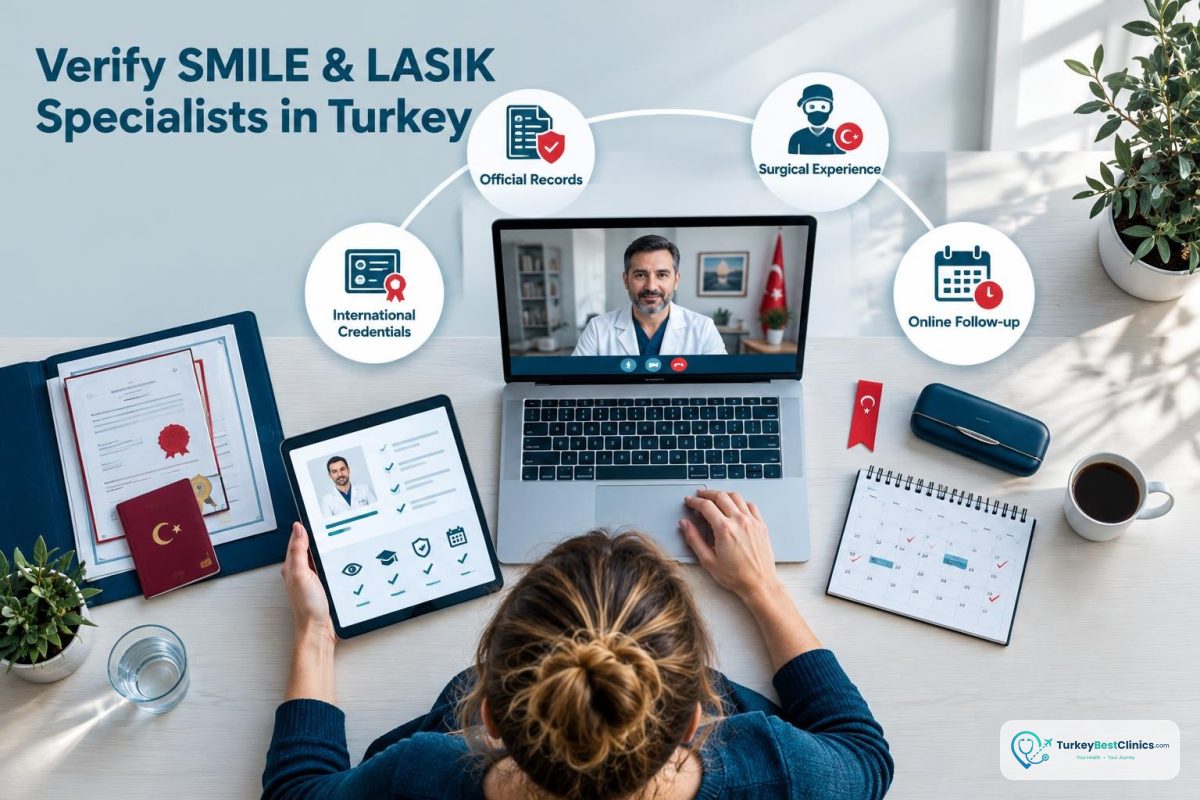
Fundamentals of Remotely Evaluating a SMILE or LASIK Specialist
SMILE and LASIK are corneal laser procedures designed to reduce dependence on glasses or contact lenses. Selecting the appropriate method depends not only on the laser device, but also on corneal thickness, topographic mapping, signs of dry eye, the degree of refractive error, and your lifestyle.
When researching from abroad, your first objective should not be limited to obtaining a price. You should document which method the ophthalmologist regularly performs, how outcomes are monitored, and what plan is offered for managing complications. Remote evaluation does not replace an in-person examination; it provides a reliable preliminary screening before travel.
Official Safety Checks for SMILE and LASIK in Turkey
The first verification step is to ask whether the facility where the procedure will be performed operates under a Health Tourism Authorization Certificate issued by the Republic of Türkiye Ministry of Health. The certificate’s facility name, address, and validity status should be provided in writing; do not rely solely on terms such as “international” or “accredited” on a website.
You should also ask about the clinic’s or hospital’s licensing information, operating-room conditions, sterilization protocols, emergency access, and post-procedure observation arrangements. Even if the laser procedure is planned in an outpatient setting, rapid access to ophthalmology support is important if an unexpected corneal, infectious, or intraocular pressure problem occurs.
The Ophthalmologist’s Credentials and Specialist Profile
- The specialty listed on the specialist certificate should be ophthalmology, and graduation details should be presented in a verifiable format.
- The doctor should explain which of the following they perform regularly: SMILE, femtosecond LASIK, and excimer laser procedures.
- The university or training institution from which the academic title was obtained, along with links to publications, clinical research, conference presentations, or teaching activities.
- For international credentials, the issuing organization, certificate number, issue date, validity period, and the competency demonstrated by the certificate.
Examination-based European qualifications such as FEBO or EBO should be checked through the verification pages of the relevant professional organizations. ICO examinations, ESCRS membership, AAO membership, and a training certificate from a device manufacturer do not mean the same thing; evaluate membership, course attendance, and independent specialist examinations as separate categories.
Remote Experience Verification Protocol
Rather than simply asking the doctor, “How many years have you been performing laser procedures?”, request anonymized statistics broken down by method for the most recent 12- or 24-month period. The clinic may be able to explain the number of SMILE and LASIK procedures, enhancement rates, cases requiring retreatment, the scope of follow-up, and how common side effects are managed.
- Approximate annual numbers of SMILE and femtosecond LASIK procedures.
- The rate of patients excluded or deemed unsuitable before the procedure.
- The follow-up protocol for dry eye, light scatter, or night-vision complaints during the first few weeks.
- The approach taken in cases of residual refractive error, undercorrection, or a need for enhancement.
- The situations in which you should contact your local eye doctor after returning home.
These data should not contain names, facial images, or identifying information. When assessing clinical outcomes, focus not only on social media photographs but also on aggregated data that explain the measurement methods and specify an adequate follow-up period.
What a Remote SMILE and LASIK Assessment Package May Include
A remote preliminary assessment may include medical-record uploads, video consultations, interpreter support, travel planning, and coordination of online follow-up after the procedure. The written quotation should clearly state whether logistical items such as transfers, hotel accommodation, interpreter services, and initial care supplies are included. Plan in advance whether your companion can stay with you at the hospital, how close the hotel is to the hospital, and whether your companion can enjoy low-intensity activities such as peaceful walks in nearby parks or wellness services while your use of visual screens is restricted after the procedure.
The length of stay in Turkey varies according to repeat measurements and the doctor’s follow-up plan. Usually, the initial examination and corneal measurements are reviewed before travel; final eligibility is determined only after the combined interpretation of tests such as corneal tomography, topography, pachymetry, tear-film assessment, fundus examination, and, when necessary, pupillometry.
If you wear contact lenses, the required discontinuation period may vary depending on the lens type. Obtain this information in writing from your own eye doctor or the clinic planning the procedure. During online follow-up after you return home, you may be asked to provide structured feedback about visual acuity, dry-eye symptoms, pain, redness, and light sensitivity; in the event of emergency symptoms, you should not rely solely on an online consultation.
Understanding SMILE and LASIK Costs in Turkey
There is no single standard price for laser eye surgery in Turkey. The city, clinic infrastructure, laser platform used, scope of preoperative testing, specialist’s level of expertise, and follow-up plan all affect the total cost. The ranges below are approximate indicators for international market research only; obtain a written, itemized quotation before travelling.
| Country | Approximate range for SMILE or LASIK | What to ask when verifying the price |
|---|---|---|
| Turkey | Approximately €1,500–€3,500 | Whether both eyes, tests, follow-up visits, the enhancement policy, and logistics are included |
| United Kingdom | Approximately GBP 3,000–6,000 | The method, surgeon’s fee, follow-up period, and any possible additional checks |
| Germany | Approximately €3,000–€5,500 | Whether topography, corneal analysis, the procedure, and follow-up fees are itemized separately |
| United States | Approximately USD 4,000–7,000 | Whether the price is per eye or for both eyes, and the terms for retreatment |
Be cautious if a quotation includes phrases such as “guaranteed vision” or promises of a specific refractive result. Complete elimination of refractive error cannot be guaranteed for every eye, and age-related changes in near vision may progress independently of laser surgery.
How Specialist Experience, Laser Platform, and Clinic Location Matter
- Specialization and experience: In addition to the ophthalmologist’s overall eye-surgery experience, assess their current procedure volume in SMILE, femtosecond LASIK, and excimer laser surgery. Teaching, scientific publications, and experience managing complications provide additional context; procedure volume alone is not sufficient evidence.
- Method and technology: Ask about the model of the femtosecond laser platform used for SMILE, the femtosecond flap-creation system used for LASIK, and whether the excimer laser offers wavefront-guided or wavefront-optimized planning. These terms should not be considered evidence of superiority unless they are related to your own corneal measurements.
- Clinic location: When choosing a center in Istanbul, Ankara, Izmir, or another city, do not consider only ease of transportation. Assess airport access, hospital support, the ability to return to the same center for postoperative checks, and the availability of emergency ophthalmology services together.
These three areas should appear as separate items in the quotation, with the contents of the package clearly specified. If the term “free follow-up” is used, the document should state how many days or months the follow-up covers, whether it will take place in person or online, and how coordination will be provided after you return home.
Next Steps Before Choosing SMILE or LASIK
Practical Comparison of the Two Surgical Approaches
| Methods Compared for You | Potentially Important Advantage for You | Recovery and Length of Hospital Stay |
|---|---|---|
| SMILE | Removal of a lenticule through a small incision without creating a large flap on the corneal surface; in some suitable eyes, more limited effects on the superficial corneal nerves | Usually planned as an outpatient procedure; visual clarity develops according to individual measurements and the cornea’s response |
| Femtosecond LASIK | Ability to plan flap thickness and precisely reshape the corneal surface with an excimer laser | Usually performed as an outpatient procedure; initial visual recovery may be rapid, but dry eye and night vision require monitoring |
This table is not a diagnosis or a treatment recommendation. SMILE or LASIK should not be selected without considering corneal topography, the tear film, refractive stability, corneal thickness, occupational requirements, and contact sports together.
Three Specific Questions to Ask During a Remote Consultation
- “Approximately how many SMILE and femtosecond LASIK procedures have you performed in the past 12 months, and what anonymized rates can you share for enhancements and cases requiring follow-up?”
- “Which findings on corneal tomography or topography would lead you to advise against laser surgery for me or recommend a different approach?”
- “After I leave Turkey, what is your written online follow-up protocol for the first check-up, managing emergency symptoms, and communicating with a local ophthalmologist?”
Compare documents, quotations, and consultation responses in a single file. Before deciding to travel, clarify in writing who the doctor responsible for the procedure is, their official authorization status, their method-specific experience, the total cost, and the care plan after you return home.