How Is Infection Risk Managed in Cataract and Laser Procedures?
Cataract surgery involves removing the eye’s natural lens and replacing it with an artificial intraocular lens, while refractive laser procedures reshape the cornea to reduce vision errors. Although these procedures use different surgical techniques, a sterile operating environment, preparation of the ocular surface, device safety and postoperative follow-up are important for both.
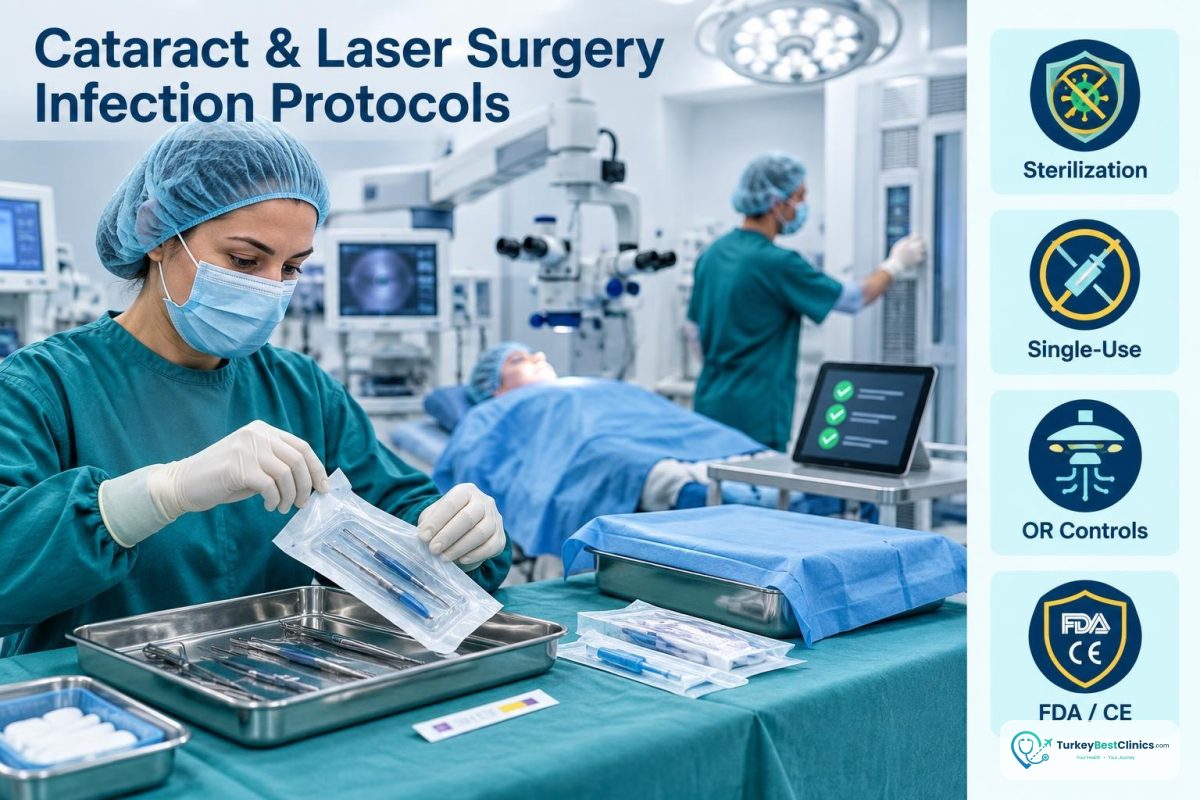
At authorized healthcare institutions in Turkey, infection risk is managed through single-use consumables, sterile package checks, validation of reusable surgical instruments and operating room hygiene protocols. However, no material or surgical protocol can “eliminate risk completely”; the more accurate description is a controlled process designed to reduce risk to the lowest reasonably achievable level.
FDA approval may indicate that a product has undergone relevant regulatory assessments in the United States, while the CE marking indicates that a conformity declaration or assessment exists under European Economic Area legislation. These markings alone do not prove that the clinic has stored the materials correctly, checked the integrity of sterile packaging or conducted the entire procedure safely.
Standards for Phacoemulsification and Laser Safety in Turkey
Authorization, operating room standards and the sterilization chain
The facility you choose for medical tourism should hold a Medical Tourism Authorization Certificate issued by the Ministry of Health of the Republic of Türkiye. This certificate is an important administrative indication that the facility meets the requirements for providing international healthcare services; however, the hospital’s license, operating room infrastructure and organization of the relevant specialty should also be verified separately.
In cataract surgery, Turkish ophthalmologists commonly use phacoemulsification, intraocular lens implantation and, when appropriate, femtosecond laser-assisted stages. In refractive laser surgery, the suitability of methods such as LASIK, PRK or SMILE is assessed based on corneal thickness, corneal topography and the ocular surface. These method names alone are not indicators of quality; it is important that the surgeon can explain why a particular method was selected, which risks were assessed and how complications would be managed.
How should you assess FDA and CE markings?
- The packaging of implants, surgical blades, laser consumables and other medical products should include the product name, manufacturer, lot number and expiration date.
- Packaging for single-use products should be opened before surgery; torn, damp or illegibly labeled packages should not be used.
- For reusable instruments, a process with records covering cleaning, packaging, sterilization and storage should be preferred.
- For laser devices, maintenance, calibration and pre-procedure equipment check records should be included in the safety assessment.
- You may ask the center’s infection-control officer to provide sterilization records and explain the procedure to be followed in the event of possible complications.
Any claim of compliance with international standards should be explained together with the relevant document or certification name. Instead of using the phrase “FDA/CE sterile materials,” the clinic should clearly specify which product is FDA-approved or CE-marked, whether the product is supplied sterile and which sterilization method is used at the clinic.
What Is Included in a Cataract and Laser Surgery Package?
A medical tourism package may include VIP airport-to-hospital transfers, hotel accommodation near the hospital, medical interpreter support and basic coordination for the initial care period. Since package contents vary between providers, transfer dates, companion arrangements and follow-up visits should be confirmed in writing.
For cataract assessment, examinations may include biometry, corneal measurements, intraocular pressure and retinal examination. Before refractive laser surgery, corneal topography, pachymetry, the ocular surface and prescription stability are assessed. Depending on the procedure, the stay in Turkey may generally be planned for several days to approximately one week; the exact schedule is determined after the examination and the surgeon’s assessment of fitness to fly.
Find out in advance whether your companion can stay with you at the hospital and how long it will take to travel from your hotel to the operating facility and follow-up center. Since light sensitivity or blurred vision may occur, it may be more appropriate for your companion to plan a quiet walk in a nearby park or a low-intensity wellness activity while you rest, rather than a busy city itinerary.
The process from preoperative assessment to online follow-up
- Existing eye reports, previous operations, visual aids used and general health information are submitted for an online pre-assessment.
- A detailed eye examination, measurements and method selection are carried out in Turkey; a surgical plan is not finalized until suitability has been confirmed.
- On the day of the procedure, the sterile operating room, product packaging and device checks are verified.
- Follow-up examinations, visual acuity and ocular surface findings are monitored.
- After you return to your country, reports and follow-up results are reviewed during scheduled Online Follow-up appointments. If you develop sudden pain, a significant reduction in vision, increasing redness or flashes of light, you should seek local emergency eye care without waiting for an online consultation.
Estimated Cataract and Laser Surgery Costs in Turkey, the UK, Germany and the USA
The ranges below are approximate figures that may be seen in the international medical tourism market in 2026. The quotation should separately specify whether examinations, lens selection, treatment of one or both eyes, hospital stay, transfers and follow-up are included.
| Country | Cataract surgery, one eye | Refractive laser surgery, both eyes | Approximate details |
|---|---|---|---|
| Turkey | €1,800–€3,800 | €1,500–€3,500 | Varies according to the lens and package contents |
| United Kingdom | £3,500–£6,500 | £3,000–£6,000 | Private-sector prices |
| Germany | €3,000–€5,500 | €2,500–€5,000 | Private-center ranges |
| United States | $4,000–$8,000 | $4,000–$7,000 | May vary outside insurance coverage |
In Turkey, approximately €1,800–€3,800 for cataract surgery in one eye and approximately €1,500–€3,500 for refractive laser surgery in both eyes may be used as reference ranges. These figures are not medical quotations or guarantees; individual measurements and the selected type of intraocular lens may change the cost.
Key Factors That Affect the Price and Surgical Process
- Surgeon’s expertise and experience: The cataract surgeon’s experience with phacoemulsification and complex intraocular lens cases, as well as the laser surgeon’s experience with corneal topography and different laser platforms, should be assessed. More important than the surgeon’s procedure count alone is whether the method is selected according to your measurements and whether there is a plan for managing complications.
- Technology, method and materials: In cataract surgery, the choice of a monofocal, toric or multifocal intraocular lens, as well as a phacoemulsification or femtosecond laser-assisted approach, affects the price. For laser procedures, the excimer laser, femtosecond laser, LASIK, PRK or SMILE method is assessed together with corneal thickness and topographic findings.
- Clinic location: In centers with high international demand, such as Istanbul, hospital, hotel and transportation costs may differ. Quotes from Ankara, Izmir or Antalya may also vary according to hospital standards, length of stay and follow-up arrangements; quality should not be inferred from the city name alone.
When comparing quotations, review in the same table which eye will be treated, the lens or laser method, postoperative follow-up, conditions for repeat intervention and support for follow-up after returning home, in addition to the total price. This will help you assess more clearly whether an apparently low price may increase later because certain services are excluded.
Next Steps for Cataract and Laser Surgery Before Making a Decision
Three questions to include on your checklist
- Based on my eye measurements, would phacoemulsification or a femtosecond laser-assisted cataract approach be more suitable, and how could the selected intraocular lens affect my visual expectations?
- Which of LASIK, PRK or SMILE can be considered based on my corneal thickness, topography and ocular surface, and what is the alternative plan if I am not considered suitable?
- How are single-use sterile products, device calibration, sterilization records for reusable instruments and coordination of online follow-up with an ophthalmologist in my country documented on the day of surgery?
Receiving clear, written answers based on your individual measurements helps you assess the offer not only by price, but also by the surgical plan and continuity of follow-up. The decision to undergo surgery should be based not on general online information, but on a detailed eye examination in Turkey and the surgeon’s assessment of suitability.